

Despite rising prices and global supply chain challenges, South African coffee drinkers are embracing quality and convenience, showcasing a resilient coffee culture that adapts to economic pressures.
Image: File.
SA coffee drinkers choose quality and convenience despite rising prices
The global coffee industry has faced sustained volatility in recent years, with climate change in key production regions reducing yields and pushing up prices, while geopolitical tensions continue to drive fluctuations across global supply chains.
In South Africa, however, coffee consumption has proven resilient.
Despite ongoing cost-of-living pressures, consumers in the country continue to prioritise quality, adjusting how they consume coffee rather than abandoning it altogether.
South African coffee drinkers are increasingly opting for premium coffee products, which are proving more resilient and continuing to grow even amid a challenging economic environment.
“Despite market pressures, Douwe Egberts had a strong 2025, with increased market share largely driven by our product diversification strategy and focus on authentic coffee formats,” said Mbulelo Mashilo, brand manager at Douwe Egberts.
According to insights from Eighty20, a consumer strategy firm in South Africa, ground coffee drinkers relish about 1.8 cups daily, compared to 1.7 cups consumed on average by instant coffee drinkers, with the upper echelons of the income spectrum (SEM 10 and LSM 10 consumers) exceeding two cups per day.
Instant coffee reigns supreme in South Africa, with leading brand Ricoffy captivating a loyal base, outpacing the next five competitors combined, as pointed out by Andrew Fulton, Director at Eighty20.
Fulton said, “Coffee is not just a beverage; it signifies a cultural lifestyle choice that continues to thrive even in tough economic climates.”
Despite rising prices and global supply chain challenges, South African coffee drinkers are embracing quality and convenience, showcasing a resilient coffee culture that adapts to economic pressures.
Image: Supplied.
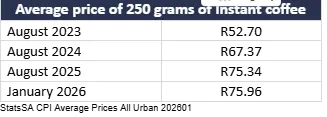
The graph above shows increases in the average price of 250 grams of instand coffee in South Africa.
Fulton said that in the second half of 2024, while national inflation remained below 4.5%, coffee prices surged, with instant coffee experiencing the steepest year-on-year consumer price increase of any food or beverage item in August 2024, jumping 22.3%, joining eggs as the only other category exceeding 20% inflation.
While inflation abates, prices do still rise. The average price for 250 grams of Instant coffee over the past 3 years has shown a compound annual growth rate of nearly 13%.
"Despite sustained inflationary pressure however, coffee sales show no signs of slowing. According to MAPS data, a quarterly survey of over 20,000 people released by the MRF, 22.7 million South Africans (nearly half the adult population) drink some form of coffee daily. After adjusting for the survey's reweighting, comparable consumption growth year-on-year reached nearly 8%," Fulton said.
He added that in the most recent analysis, Stats SA replaced ground coffee and coffee beans with rosé wine and snuff in its inflation basket to better reflect the nation's evolving shopping habits.
Fulton said, "While we can no longer track year-on-year inflation for ground beans, we still can for instant coffee and Cappuccino sachets (just under 10% and below inflation respectively), which are both a significant moderation from last year. While inflation abates, prices do still rise. The average price for 250 grams of Instant coffee over the past 3 years has shown a compound annual growth rate of 12.65%."
With over 10 million tonnes produced annually globally and 2.25 billion cups consumed daily, South Africa’s enduring coffee love story is a testament to its cherished status as a global commodity.
“We’ve remained agile in responding to market shifts, meeting consumers across different price points and consumption occasions.”
South Africa’s coffee culture is catching up to its European and other first-world counterparts, with local taste profiles evolving toward café-style quality.
Instant coffee remains the largest segment in the South African market, as its convenience and functional benefits continue to meet the needs of the majority of consumers, even as interest in premium and convenient formats grows.
This is where the intersection between quality and convenience becomes most apparent.
As lifestyles become faster-paced, consumers are selecting formats that deliver an authentic coffee experience while fitting seamlessly into daily routines.
“Ready-to-drink and capsule formats are performing particularly well.As of December 2025, volumes in the ready-to-drink category were up more than 15%. Consumers want coffee that tastes authentic, but they also want accessibility, whether that’s on the go, during a commute, or at home with minimal preparation,” Mashilo said.
Douwe Egberts launched its ready-to-drink range in 2024 and has seen double-digit growth since launch, alongside sustained demand for instant coffee, capsules, and refill formats.
South African consumers are increasingly ‘trading across formats’, selecting products based on occasion, value, and convenience rather than simply downgrading to cheaper substitutes.
“This has been a key driver of our growth through 2025,” Mashilo added.
“Our focus has been on balancing quality with practicality, delivering coffee that meets consumers’ expectations, whether they’re brewing at home or grabbing coffee on the move.”
Market forecasts supported this outlook.
According to Statista, South Africa’s coffee market is expected to grow by approximately 7.2% annually between 2024 and 2028, driven by increased at-home consumption and rising demand for premium yet convenient options.
Looking ahead to 2026, Mashilo expected the convenience trend to continue locally.
“South Africa is slightly different. Consumers here are embracing formats that deliver quality without complexity. We expect steady growth in ready-to-drink, capsules, and refill formats over the next few years.”
While the market outlook remained positive, price sensitivity is expected to persist.
“Consumers are still under pressure, which is why value-driven options like refill pouches are gaining traction. Even in a challenging economic environment, coffee remains non-negotiable. As manufacturers, we need to deliver formats and options that meet consumers’ needs to stay relevant,” Mashilo said.
Follow Business Report on Facebook, X and on LinkedIn for the latest Business and tech news.