

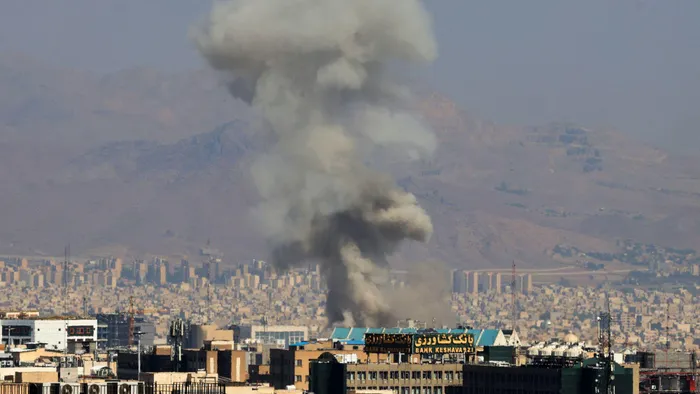
As the Iran conflict escalates and oil prices surge, South African consumers face increased financial strain, with rising fuel costs and economic uncertainty affecting their daily lives.
Image: Atta Kenare / AFP
As the conflict between Iran, the Unites States of America and Israel continues to send shockwaves across global markets and driving oil prices higher, closer to home the geo political tensions spells disaster for South African consumers.
With March seeing an end to fuel prices dropping as motorists will be forking out more at the pumps after the Department of Mineral and Petroleum Resources announced fuel increases for the month, economists have warned of further hefty increases with the effective closure of the Strait of Hormuz threatening to disrupt a significant share of global energy supply.
Oil markets have been rattled by the escalating war in the Middle East, but economists say prices are unlikely to rise above $100 a barrel for a sustained period, even as supply disruptions push crude sharply higher in the short term.
The conflict placed further uncertainty for consumers with the geo political tensions possibly having an effect on the South African Reserve Bank's (Sarb) stance on interest rates for the country.
Neil Roets, CEO of Debt Rescue said that while a 20 cent increase in petrol and the sharper rise in diesel may appear modest on paper, the knock-on effect across the economy will be significant.
He noted that households are already contending with high interest rates, elevated food costs and persistent debt obligations.
With the repo rate remaining at 6.75%, many bondholders and vehicle finance customers are paying substantially more each month than they did just a few years ago.
“Disposable income has been steadily eroded. For many families, there is simply no buffer left to absorb additional increases,” Roets added.
The timing is particularly difficult with the Easter period approaching, when many families traditionally travel to visit relatives.
“For millions of South Africans, even short-distance travel is becoming financially unviable. What should be a time of connection and rest is instead overshadowed by budget anxiety,” he said.
Roets warned that sustained fuel increases, combined with global geopolitical pressures and domestic economic constraints, risk deepening the financial vulnerability of already over-indebted consumers.
He urged households who are struggling to seek assistance sooner rather than later, emphasising that early intervention can prevent long-term financial damage.
The crisis has already forced major producers to halt output and severely limited traffic through the Strait of Hormuz, a critical chokepoint for global oil flows.
Despite the flare-up, economists on Wednesday argued that the market reaction reflects disruption rather than outright shortage.
Bridget Payne, head of energy forecasting at Oxford Economics Africa, said current pricing suggests investors expect the shock to be temporary. She said the broader global economic impact is limited as the Gulf Cooperation Council region accounts for less than 2% of world GDP.
“Our base case is now for a notable but manageable supply disruption. We are downgrading global oil supply by 4 million barrels per day over the next quarter to account for disrupted flows through the Strait of Hormuz,” Payne said.
She also argued that geopolitical incentives favour de-escalation. A prolonged closure of Hormuz would inflict severe economic costs not only on Iran but also on Gulf neighbours, China and the United States. As the economic fallout intensifies, Payne said pressure is expected to mount on all sides to restore flows.
“Iran can create a sharp shock by disrupting the Strait, but sustaining a severe disruption for a prolonged period would be much harder,” Payne said.
Follow Business Report on Facebook, X and on LinkedIn for the latest Business and tech news.