

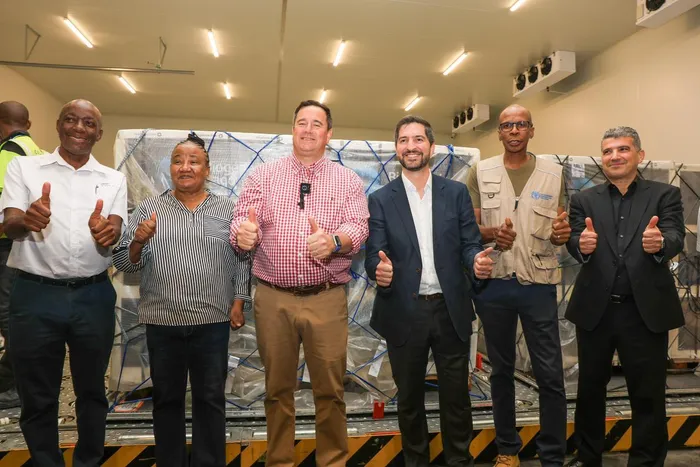
Minister of Agriculture John Steenhuisen announced on Thursday that the Government will be covering the full cost of vaccinating the national herd against Foot and Mouth Disease (FMD).
Image: GCIS
Minister of Agriculture John Steenhuisen announced that the Government will be covering the full cost of vaccinating the national herd against Foot and Mouth Disease (FMD). The Minister has dismissed claims that the government is “making a profit” from vaccines and said it is entirely incorrect.
Steenhuisen said that this means there will be no cost to farmers for vaccines administered as part of the national response to the FMD outbreaks.
“Vaccines have been distributed to all provinces and the vaccination programme is now well underway. Hundreds of thousands of animals are being vaccinated each week as the country works towards the target of vaccinating 80% of the national herd by December,” he said.
Steenhuisen added that South Africa has already received one million vaccine doses from Biogénesis Bagó in Argentina and 1.5 million doses from Dollvet in Türkiye, with further consignments scheduled to arrive during the coming weeks to sustain the vaccination campaign.
Steenhuisen said that he is grateful to the veterinary professionals and industry partners assisting with the rollout.
“We would like to thank the state and private veterinarians who are on the frontline of the vaccination campaign, as well as industry organisations, particularly the Milk Producers’ Organisation (MPO), for their cooperation and support in helping to protect South Africa’s livestock sector,” he said.
Steenhuisen added that as FMD remains a serious threat to the agricultural economy he also also calls on stakeholders to exercise caution regarding misinformation circulating on social media and other platforms.
“FMD is everyone’s responsibility. It is critical that farmers and stakeholders verify information before sharing it. Misinformation during a biosecurity crisis can cause real damage to the sector,” he said.
Steenhuisen said that there have been recent rumours spread by a certain agriculture lobby group that have attempted to misrepresent the cost of the Dollvet vaccines being procured by the government.
“These claims focus on R45, which is the single quoted bulk supply price per dose, without recognising the broader logistical and operational requirements involved in a national vaccination programme of this scale. Most agricultural organisations understand and appreciate this reality,” he said.
Steenhuisen added that the price that has been circulated publicly relates to the supplier’s bulk delivery price to an approved cold-storage facility in South Africa.
“In other words, it reflects the cost of producing the vaccine and transporting it internationally under cold-chain conditions to a designated facility within the country. However, the R45 price does not represent the full cost of getting a vaccine from that point into the national veterinary system and ultimately to farms across South Africa - a reality that would be no different if, as claimed, ‘private companies’ were responsible for importing and distributing it,” he said.
Steenhuisen said that once vaccines arrive in the country they must still be received, quality-checked, stored under strict temperature control, managed through national inventory systems and distributed through a network of provincial depots and veterinary teams. This includes maintaining the cold chain, managing secure storage facilities, handling inventory management and coordinating distribution to vaccination teams operating across multiple provinces.”
Steenhuisen added that these are essential components of any large-scale animal health intervention. Without them, vaccines cannot be delivered safely or remain effective when they reach livestock in the field. The government's procurement cost therefore reflects the full operational process required to move vaccines through the national veterinary distribution system, ensuring that doses are delivered safely and reliably to veterinarians administering the vaccination campaign.
Steenhuisen said that the suggestion that the government is “making a profit” from vaccines is therefore entirely incorrect.
“The vaccines are being procured and paid for by the state and administered free of charge to farmers. No farmer is paying for these vaccines, and the government is certainly not selling them,” he said.
Steenhuisen added that another claim circulating is that the government does not have the resources to fund the vaccination programme.
He responded, “The Department of Agriculture has allocated funding specifically for the procurement of vaccines and will continue to ensure that sufficient doses are available to sustain the vaccination campaign.”
Steenhuisen said that in February, during the State of the Nation Address, President Cyril Ramaphosa formally classified FMD as a national disaster. This classification underscores the seriousness of the situation and explains why the state has taken responsibility for funding the vaccination campaign.
Steenhuisen added that that controlling FMD requires collective responsibility across the entire livestock sector. “It is deeply unfortunate that, during a time of crisis, some individuals choose to spread disinformation and sow division. The only way we will defeat this disease is through cooperation, science-based decision-making and a united effort across the sector.”
BUSINESS REPORT