
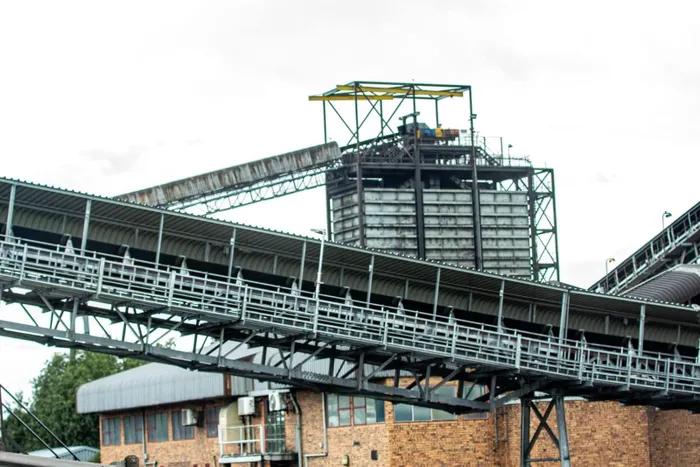
Sasol officially opened its new Destoning Plant in Mpumulanga on Friday marking a significant milestone in efforts to enhance coal quality and drive improved operational performance.
Image: Mineral and Petroleum Resources (DMPR) Facebook page
Sasol officially opened its new Destoning Plant in Mpumulanga on Friday marking a significant milestone in efforts to enhance coal quality and drive improved operational performance. Minister of Mineral and Petroleum Resources (DMPR) Gwede Mantashe said in a keynote address that investments of this nature and magnitude give us confidence that, with commitment and dedication, we can indeed transform the South African mining sector into an industry that we can all be proud of.
Sasol said that the plant, which achieved beneficial operation in December 2025, forms part of Sasol’s broader plan to strengthen, grow, and transform the business. “ Developed through the conversion of the Twistdraai Export Plant, the facility removes high-density stone from the run-of-mine coal sourced from the Thubelisha and Bosjesspruit mines.”
Sasol added that by reducing ash and sinks before coal enters the gasification process, the plant helps improve syngas quality for Sasol’s synthetic fuels and chemicals value chain. “Since commissioning, the plant has contributed to a reduction in average sinks for Q1 FY26 to below 14%, supporting improved coal quality availability to Secunda Operations and helping to lift overall production for the quarter.”
Simon Baloyi, Sasol President and CEO said that this facility is a key commitment we made at Capital Markets Day in 2025, and it plays an important role in enhancing operational performance at Secunda Operations by enabling the processing of higher-quality, destoned coal.
Mantashe said that this occasion represents confidence in South Africa’s mining and energy future, and it demonstrates the kind of investment that strengthens industrial capacity while supporting economic growth and job creation. “This is significant because it speaks directly to our long-standing mission of adding value to the minerals mined on our shores, closer to the point of production. Sasol’s decision to upgrade an export plant into a modern destoning facility demonstrates that you are serious about transforming your business in a way that delivers sustainable value for both Sasol and South Africa as a whole.”
Mantashe added that this is crucial because, for decades, the mining industry has often been described through the “five Ds”: dirty, difficult, dangerous, diseased, and deadly. “It has also been characterised by holes left in the ground while much of the mineral wealth was exported for beneficiation elsewhere, thus exporting jobs and profits that should have benefited the people of South Africa.”
Mantashe said that this is the legacy that we have been working to reverse over the past 30 years. “Whereas we have made notable progress in addressing this historical injustice since the enactment of the Mineral and Petroleum Resources Development Act (MPRDA), much more still needs to be done to transform the industry. Investments of this nature and magnitude give us confidence that, with commitment and dedication, we can indeed transform the South African mining sector into an industry that we can all be proud of.”
Mantashe added that what is particularly fulfilling for me about this project is that it gives renewed life to a mineral that is often criticised by many, yet it continues to play a critical role in our economy and that mineral is coal. “Our country has been actively engaged in coal mining since the late 1860s. Over the decades, coal has played a central role in meeting the country’s energy needs, including supporting steel production, petrochemicals, cement manufacturing, and brick production.”
Mantashe said that as production expanded over the years, coal became the backbone of Eskom’s fleet of coal-fired power stations, thereby providing energy baseload required to support the country’s industrial development. “Today, South Africa produces the largest amount of coal in Africa and ranks among the top 10 coal-producing countries in the world. Despite this rich history and natural endowment, we are often told to abandon coal for alternatives that we have not yet proved their resilience and effectiveness for our developmental context. We are told to choose ecology over the economy. Yet these two are mutually reinforcing.”
Mantashe added that our Critical Minerals Strategy recognises that coal remains critical because it continues to create employment for thousands of people and sustains the livelihoods of millions of South Africans. “It also makes a significant contribution to the national economy through both domestic use and exports. It is for this reason that we continue to invest in the future of cleaner coal utilisation in South Africa, including initiatives such as Carbon Capture, Utilisation and Storage (CCUS). We, therefore, welcome Sasol’s continued support and investment in this regard.”
“The ongoing tensions in the Middle East serve as a powerful reminder of the importance of energy independence and diversified feedstocks in the production of petrochemicals. Projects such as this destoning plant demonstrate that industrialisation, beneficiation, and responsible resource utilisation remain central to South Africa’s economic future,” concluded Mantashe.
BUSINESS REPORT
https://businessreport.co.za/