

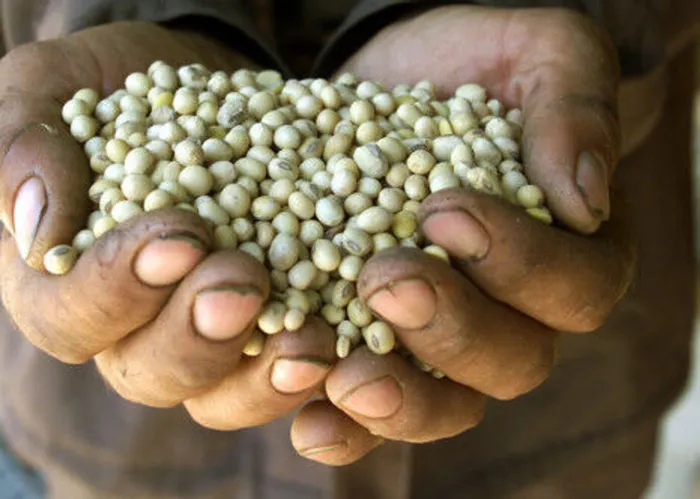
The Agricultural Business Chamber of South Africa (Agbiz) said that despite heavy rains posing some challenges for harvesters, South Africa’s 2025-26 soybean crop is the third-largest on record, at 2.66 million tonnes.
Image: File
The Agricultural Business Chamber (Agbiz) on Monday said South Africa’s 2025-26 soybean crop is the third-largest on record at 2.66 million tons despite heavy rains posing some challenges for harvesters.
Wandile Sihlobo, chief economist at Agbiz, said the crop is down 5% from the previous season, although the area increased somewhat.
“The decline in harvest expectations is due to poor yields in some regions on the back of excessive moisture,"Sihlobo said. "We are still in the early days of the season, with a few more production estimates to give us a clearer picture of the harvest, but the crop promises to remain at these decent levels.”
Sihlobo added that at the start of this month, the industry entered the new 2026-27 soybean marketing year, which corresponds with the 2025-26 production year.
“Farmers in the early planted areas delivered 3,350 tonnes of soybean to commercial silos. But we still have a long way ahead, with the final crop estimate at 2.66 million tons.”
Sihlobo said South Africa’s soybean crop has grown notably over the years.
“The growing demand for soybean oilcake or meal by the animal feed industry stimulated this growth,"he said.
"This, in turn, has been driven by increased demand for high-protein foods, particularly poultry products. South Africa’s per capita consumption of poultry meat has almost doubled over the past 17 years, currently estimated at around 41 kilograms.”
Sihlobo added that to meet the growing demand, South African agribusinesses, supported by the government, invested to increase domestic soybean processing capacity from roughly 860,000 tons in 2012 to over 2 million tons today.
“This was also intended to stimulate domestic soybean production as part of an import-substitution strategy. The farmers responded positively to these changes in demand, as evidenced by an ample harvest.”
Sihlobo said that underpinning this positive production response were increased area planted and technological improvements, such as seeds, fertilisers, and better farming practices.
“Most importantly, the investment in expanding South Africa’s soybean processing capacity and improving production techniques has led to a success story in soybean meal import substitution.”
TLU SA General Manager Bennie van Zyl said there was no problem regarding the world markets and no impact on the future of the production of especially grains and soybeans.
“We don't know how long it will last and that makes things complicated for any farmer to plan and make these adjustments to make sure that they stay at the production price of diesel and fuel," he said.
"Our markets can also be disturbed because of the capacity to export through different channels of sea routes that are not necessarily safe anymore.”
Van Zyl added that due to the current situation, the industry should look into biodiesel and ethanol production plants for maize, for sugar, as well as for soybeans and groundnuts.
“So that we can produce as much as possible to help our farmers for a market for that. So that we can make the calculations about what is profitable at the end of the day because there is a strategic value in that.”
“We have to look now strategically for the future. What is the best proposition for our country? For your farmers, first of all, if they have this need for much more soybeans that can be used in biodiesel plants.”
BUSINESS REPORT