

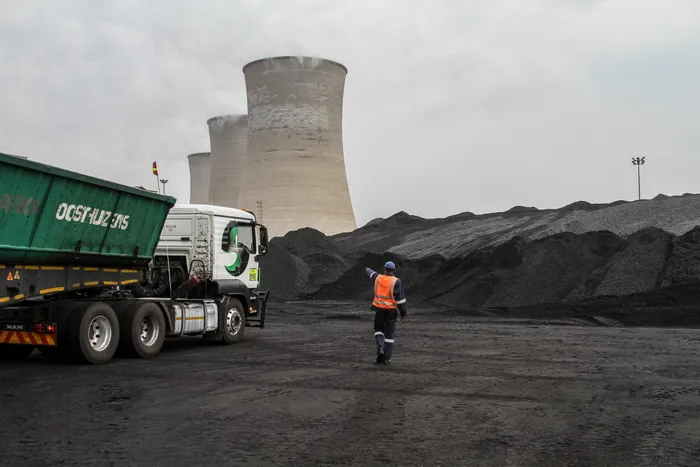
Energy experts believe that South Africa will remain coal reliant for future years to come despite some worry about the impact on the environment.
Image: File
Energy experts say South Africa is likely to remain heavily reliant on coal for years to come, despite growing environmental concerns and global pressure to transition cleaner energy sources.
This follows the recent launch of a new destoning plant by Sasol in Mpumalanga, where Minister of Mineral Resources and Petroleum Gwede Mantashe reaffirmed coal’s critical role in the country’s economy and energy security.
According to Vally Padayachee, the facility represents a significant step toward improving coal quality and operational efficiency.
Padayachee on Tuesday said the investment signals confidence in the long-term viability of South Africa’s mining sector, particularly as debates intensify around energy security and environmental sustainability.
He said that South Africa's energy landscape heavily relies on coal-fired power plants, making it an essential component for ensuring a stable energy supply.
“Given the increasing instability in global oil and gas markets, particularly due to events like the crisis in the Middle East, coal serves as a critical backup," he said.
"While transitioning to renewable energy is vital for long-term sustainability, coal evolving to clean coal provides a necessary buffer against energy shortages, ensuring that industries and households have reliable access to power.”
Padayachee added that the coal sector, including clean coal, is a significant source of employment and economic activity within South Africa. He said that clean coal is pivotal not only for energy production but also for various industries such as steel, cement, and petrochemicals.
“Its versatility as a raw material makes it indispensable for South Africa’s industrial ecosystem. The criticism surrounding coal often revolves around its environmental impacts, particularly in terms of CO2 emissions," Padayachee said.
"However, advancements in technologies aimed at reducing the environmental footprint of coal usage, such as Carbon Capture and Storage (CCS), are critical to mitigating its impact. These technologies can help transition the coal sector towards clean coal and more sustainable practices.”
However, Padayachee stressed that balancing emissions reduction with immediate energy needs remains a complex challenge.
“The challenge lies in balancing immediate energy needs with the long-term goal of reducing carbon emissions. This necessitates a thoughtful approach that incorporates cleaner coal technologies while pursuing renewable alternatives," he said.
“Therefore, it is crucial to balance our long-term sustainability goals with immediate energy needs. In this context, coal remains an important asset, helping to bridge the gap while we develop and scale renewable energy technologies.”
Ruse Moleshe, the managing director of RUBK, an energy and infrastructure consulting and advisory firm, said coal’s dominance in South Africa is driven by structural realities rather than policy preference.
“It provides about 77% of primary energy and more than three-quarters of electricity generation - underpinning Eskom's baseload capacity and system reliability,” he said.
Moleshe added that coal is also embedded in key industrial value chains such as petrochemicals, steel, and cement, where production processes remain directly dependent on coal rather than substitutable inputs.
“Sasol alone processes about 30-35 million tons of coal annually, while coal mining sustains direct jobs, estimated to be 76,000 to 108,000, particularly in Mpumalanga. It is therefore not simply a fuel, but a pillar of industrial activity and economic stability.”
Moleshe said that South Africa's constitution is clear that the country must pursue ecological sustainability while also promoting justifiable economic and social development.
“The issue is therefore not whether South Africa should transition, but how to do so without undermining the economy. While alternatives exist, many are not yet deployed at scale, cost, or reliability to replace coal in energy-intensive industries or Eskom's baseload role.”
BUSINESS REPORT