

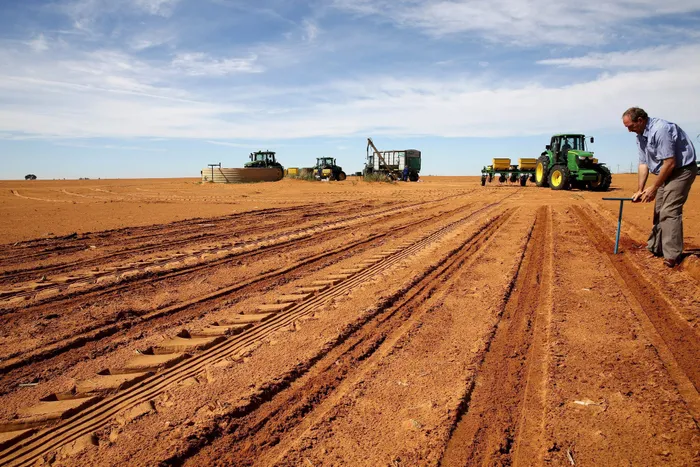
Farming associations warn that they expect an increase in fertiliser prices and an impact on farming due to the ongoing conflict in the Middle East.
Image: Siphiwe Sibeko Reuters
South African farming organisations are warning of mounting pressure on the agricultural sector as global fertiliser prices surge escalating tensions in the Middle East, raising concerns about production costs, crop yields and food prices.
According to Francois Rossouw, chief executive of the Southern African Agri Initiative (Saai), the intensifying conflict involving Iran and disruptions along the Strait of Hormuz have sharply driven up fertiliser prices in early March 2026.
The waterway is a critical artery for global trade, particularly for energy and chemical inputs used in fertiliser production.
“South Africa imports roughly 80% of its fertiliser needs, with a notable portion of nitrogen-based products like urea historically sourced from or routed through the Persian Gulf region, which plays a major role in global supplies of urea, ammonia, and related inputs,” Rossouw said.
“This has led to significant price surges amid blocked shipping routes and higher freight/insurance costs, compounding pressures from elevated Brent crude oil prices.”
He estimates that global fertiliser prices could rise by around 17% in the first half of 2026 compared to the previous year, with South African farmers likely to experience similar increases due to their dependence on imports.
Fertiliser is one of the most significant input costs in agriculture, typically accounting for between 35% and 50% of production expenses for grains and other staple crops.
Rossouw warned that sustained price increases or supply constraints could force farmers to cut back on fertiliser use, potentially lowering yields—particularly for fertiliser-intensive crops such as maize.
“Fertiliser typically accounts for 35-50% of production costs for grain and other key crops, potentially leading to reduced application rates, lower yields on fertiliser-intensive crops like maize, squeezed profit margins, shifts in planting decisions toward less demanding options, and knock-on effects such as elevated food prices for consumers,” he said.
The situation is further aggravated by rising diesel and fuel costs, also linked to geopolitical instability in the Middle East. Together, these factors are creating a broad cost squeeze across the agricultural value chain, prompting calls for government intervention to stabilise supply and affordability.
Dranca Neo Phalatse, postgraduate coordinator at the Faculty of Natural and Agricultural Sciences at the University of Pretoria, noted that the Middle East plays a crucial role in supplying both energy and raw materials used in fertiliser production.
“Any geopolitical tensions or conflicts can disrupt supply chains. Such disruptions may lead to increased production and transportation costs, which could translate into higher fertiliser prices for farmers,” Phalatse said.
“Higher fertiliser prices can increase input costs for farming operations, potentially affecting crop yields, profitability, and food security. Farmers may need to consider strategies such as adjusting fertiliser use, exploring alternative suppliers, or implementing cost-efficient practices to mitigate the impact.”
Meanwhile, Wandile Sihlobo, chief economist at the Agricultural Business Chamber, said the current price spikes are largely driven by uncertainty rather than confirmed shortages.
“Indeed, we will be nearing the start of the season then, as plantings begin in October 2026. Currently, we see price surges driven by fears of supply constraints,” he said.
“But we can’t be certain that supplies will remain constrained for some time, as we don’t know when the war will end or when logistics will be cleared to move the fertilisers.”
Sihlobo added that farmers globally, and here in South Africa, are paying higher fertiliser prices ahead of the start of the 2026-27 winter crop season, driven by the “fear” of supply constraints.
“Of course, domestically, we also don’t have much room for the government to cushion farmers in such times. The challenges we are facing now are lower commodity prices and surging input costs, which are putting farmers in a tough financial position.”
TLU SA general manager Bennie van Zyl highlighted the scale of the disruption. He noted that Iran previously accounted for roughly 10% to 12% of global fertiliser trade, producing around 4.5 million tonnes.
He said that fertiliser prices have surged significantly, rising from about $590 (R9,800) to $700 (R11,070) since the conflict began.
“At this stage, before this conflict in Iran, they actually produced almost 4.5 million tons. That is about 10 to 12% of the world trade in fertiliser,” he said.
“The reality for us and the short, medium, and long term regarding this conflict unless the conflict is stopped very soon it will have a huge impact on fertiliser prices.”
BUSINESS REPORT