

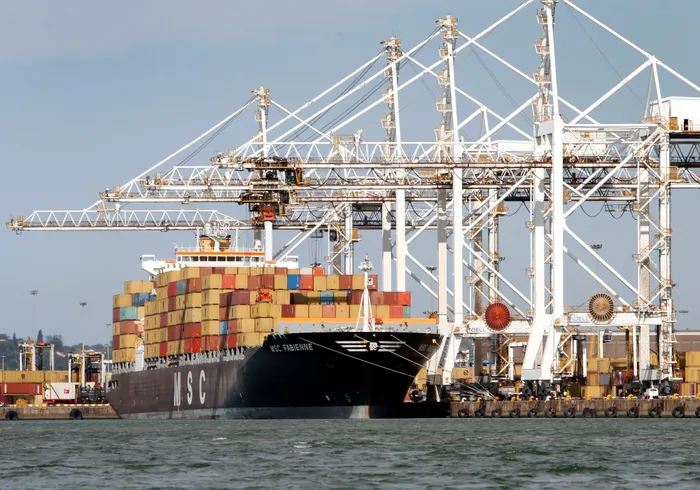
A report by Bureau for Economic Research (BER) Chief Economist Lisette IJssel de Schepper indicated that the recent escalation in the Middle East has pushed the global economy into a space where there is no single most likely outcome, only a range of possibilities
Image: Shelley Kjonstad / Independent Media
Escalating tensions in the Middle East have pushed the global economy into a period of heightened uncertainty, with South Africa particularly vulnerable to rising fuel costs, a weaker currency and inflationary pressure, according to Lisette IJssel de Schepper of the Bureau for Economic Research (BER).
De Schepper on Tuesday said that for South Africa, the immediate transmission is straightforward: a weaker rand, higher oil prices, and rising fuel costs and inflationary pressures.
“The current under-recovery in fuel prices is scary, and the impact will be significant. But beyond that, the story becomes far more uncertain - and far more dependent on how long the disruption lasts.”
She added that they have been framing this in three broad scenarios.
“In a mild case, where the disruption is contained and shipping routes normalise relatively quickly, the impact is largely confined to a short-term inflation spike. Growth slows a little, rate cuts are delayed, but the broader trajectory remains intact.”
De Schepper said that in a more prolonged scenario - say a few months of disruption - the story becomes more uncomfortable.
“The fuel price remains elevated, second-round effects push inflation to 4%, and the SA Reserve Bank (Sarb) is forced to stay on hold for longer. Growth takes a more noticeable knock as both global demand and local purchasing power come under pressure.”
De Schepper added that then there is the severe case.
“If the disruption persists for an extended period, say, six months or more, the global shock becomes much harder to absorb. Inflation rises more sharply, the rate-cutting cycle is abandoned altogether, and growth slows meaningfully - not just globally, but in SA too. In other words, the length of the duration matters more than the height of the spike.”
De Schepper said that the latest GDP numbers show that the SA economy ended 2023 on a slightly stronger footing than expected, with growth of 0.4% quarter-on-quarter in the fourth quarter.
“That makes it five consecutive quarters of expansion - a gradual recovery that, at least on paper, remains intact. But zoom out, and the picture is less encouraging. Growth for 2023 came in at just 1.1%.”
She added that business confidence has been improving.
“The RMB/BER Business Confidence Index rose to 47 in the first quarter of 2026, above its long-term average and the highest level outside the post-Covid rebound in about a decade.”
De Schepper said that on the surface, that sounds like good news.
“Look a little deeper, and the story becomes more complicated. One respondent in our Absa Manufacturing Survey captured it perfectly. The local macroeconomic factors are the most positive they have been in 10 or more years, so it is frustrating that we haven’t seen more of an upturn in demand for our products.”
De Schepper added that a conflict in the Middle East that disrupts global oil supply is hardly something SA can influence.
“Although, sticking to a consistent and credible non-aligned global position would certainly help ensure we are not weighing down our investment case with unnecessary risk premia. But resilience is not built in a crisis. It is revealed in one," she said.
"Countries with stronger fundamentals, better infrastructure, and more predictable policy environments are simply better able to absorb external shocks. They have buffers (and decent fuel reserves). We are still building ours, slowly. And that is the real risk.”
Tristan Klement, product specialist and technical strategist at Specno, said that with early projections from the Central Energy Fund pointing to un precedented increases, the economic argument for electric vehicles (EVs) has never been stronger.
“South Africa’s EV ecosystem has grown quickly, and much of the early technology was designed to establish access and reliability. Now, the opportunity exists to refine that experience for the local user, to wildly improve their experience and amenability to make the switch over to EV,” he said.
Klement added that many of the foundational platforms originally used in South Africa to locate charging ports had been adapted from international markets, particularly Europe, where EV adoption is more mature, and the infrastructure landscape is fundamentally different.
“In Europe, the challenge is abundance. There are more chargers than a user needs, so platforms are designed to filter and optimise choice. In South Africa, the context is different. Availability of charging stations is more limited, journeys are more deliberate, and user behaviour is not yet habitual. That requires a different kind of design thinking.”
BUSINESS REPORT