

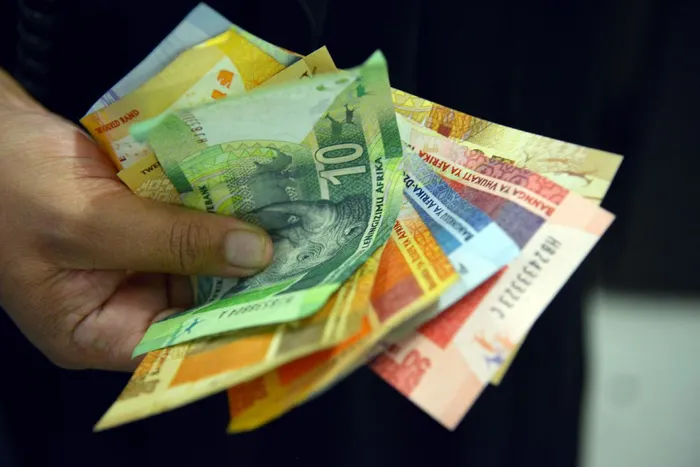
The PayInc Net Salary Index for February released on Wednesday indicated that the average nominal salary for February was R21 550, up from 0.1% in January and 2.2% higher than a year ago. Despite the improvement, some economists still have reservations.
Image: Karen Sandison/ Independent Newspapers.
South African workers are seeing modest gains in their salaries, but rising inflation and global uncertainty are eroding purchasing power, leaving many households financially worse off than a year ago.
According to the latest PayInc Net Salary Index released on Wednesday, the average nominal net salary reached R21,550 in February 2026, reflecting a marginal increase of 0.1% from January and a 2.2% rise compared to the same period last year.
The data, which tracks around 2.1 million salary earners, points to a relatively stable start to the year—but economists warn the outlook is becoming increasingly fragile.
Shergeran Naidoo, head of stakeholder engagements at PayInc, said salaries have stabilised over the past two months. However, he cautioned that escalating geopolitical tensions, particularly the conflict involving the United States, Israel and Iran, have introduced significant uncertainty.
“This positive outlook, however, has been disrupted by the outbreak of the US-Israel-Iran conflict on 28 February.”
Economists said the real concern lies not in nominal salary growth, but in how it compares to inflation.
Elize Kruger, an independent economist, highlighted that when adjusted for inflation, net salaries actually declined by 1.2% in the first two months of the year.
While inflation briefly aligned with the South African Reserve Bank’s 3% target in February, this reprieve is expected to be short-lived.
Kruger warned that looming fuel price increases could quickly reverse this trend. On current projections, petrol and diesel prices could rise sharply in April, pushing headline consumer inflation to around 4.5%, up from 3.1% in March.
Over the full year, inflation is now expected to average about 4.4% in 2026—well above earlier forecasts of 3.4%.
“This is an undesirable outcome for a central bank that has recently adopted a 3% inflation target with a tolerance band of 1%. Interest rate hikes could therefore be on the cards in a few months’ time,” Kruger said.
“However, the Monetary Policy Committee will likely keep interest rates unchanged at its meeting this Thursday.”
Higher inflation, combined with weak salary growth, is expected to further erode the purchasing power of consumers. This could have broader implications for the economy, given the central role of household spending in driving growth.
Research firm Carpe Diem has already revised its 2026 economic growth forecast downward to 1.1%, from an earlier estimate of 1.6%, reflecting the increasingly challenging environment.
Kruger noted that ongoing global uncertainty is also affecting business confidence, with companies becoming more cautious in their investment decisions.
“These days geopolitical events, trade uncertainties, and political reshuffling are the norm, and companies need to be resilient to withstand multiple challenges,” Kruger said.
“The U-turn in economic expectations for 2026 does not bode well for company prosperity and labour market prospects. Already, company prosperity as measured by nominal growth in gross operating surplus has been moderating in recent years.”
Professor Waldo Krugell, an economist at North-West University, described the current trend as concerning.
“When nominal incomes grow by 2.2% year on year but inflation is above 3%, it means that even at a low inflation rate our money is buying less and on average, South Africans are worse off than a year ago,” Krugell said.
“With the expected fuel price shock in March, this position is going to deteriorate further. We need faster economic growth that gets more people into jobs and those with jobs to get pay increases.”
Ulrich Joubert, another independent economist, cautioned that average figures can mask significant disparities across households.
“What happened to people who have children at school? By how much did school fees increase? By how much did university fees increase? It depends so much on what you are spending,” Joubert said.
“If we look at the 2.2% increase, nominal increase, then one would say, or even a real increase, that was less than the inflation rate. So one would say that overall, on average, people are worse off than they were a year ago.”
BUSINESS REPORT