


Auditor-General of South Africa, Tsakani Maluleke. The Auditor-General's latest report reveals a staggering R42 billion mismanaged in South Africa, highlighting a pervasive culture of impunity. This article delves into the implications of these findings and the urgent need for accountability in governance.
Image: Independent Newspapers | Archives
The recent issuance of the Consolidated General Report on National and Provincial Audit Outcomes 2024-25 by Auditor-General Tsakani Maluleke is more than a statistical update; it is a funeral dirge for the South African taxpayer.
With R42 billion misspent and a "culture of impunity" now fully normalized, Maluleke’s lamentations echo through the hollowed-out corridors of state departments.
Yet, to understand why the AG is left holding a heavy "monkey on her back" while the executive enjoys a "daily free meal," we must look back at the structural toothlessness of the very instruments designed to protect us.
The Longitudinal lived truth of one of the twenty year delay of democracy.
Here is a Forensic Template designed to audit a housing project delayed by 20 years, utilizing the 2,752 instruments of Lehohla Ledger to validate the metadata of failure.
Before looking at the ground, the Ledger audits the Successor Ledgers for the original project "Birth Certificate."
Below is the verdict of failure:
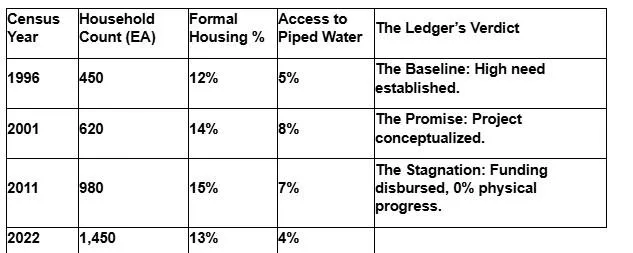
Before looking at the ground, the Ledger audits the Successor Ledgers for the original project "Birth Certificate."
Image: Supplied.
In a November 2020 critique I penned against my dear colleague, the late Kimi Makwetu, in his push for the Public Audit Amendment Act (PAAA), I argued that however well-intentioned the law represented a fundamentally flawed maneuver.
By seeking to give the Auditor General "teeth," the legislation inadvertently created a Moral Hazard.
It allowed the Executive to abdicate its constitutional duty, effectively "sleeping" while the AG was forced to pick up the sword of enforcement.
The legislators gave Makwetu an okapi whilst allowing the executive to snore incessantly using the sword as a support tool from falling.
Today, the hens have come home to roost.
The PAAA has not ended corruption; it has merely subsidized it, providing a legislative screen behind which the Successor Sages can kick the can of accountability down a very long, very expensive road.
Auditor General Maluleke’s 2026 report paints a picture of a state in decline, where "unqualified with findings" is celebrated as a victory rather than the administrative purgatory it truly is.
These findings—ranging from unauthorized banking changes to missing documentation—are the symptoms of a deeper malaise: the systematic rejection of Valid Metadata.
When 31% of performance reports are deemed "not useful or reliable," the state is essentially operating in a data vacuum, decoupled from the lived reality of the citizens it is meant to serve.
This is where the Lehohla Ledger must intervene.
The Ledger is not a replacement for the Law, but it is the Foundation upon which the Law must be authenticated.
Where the PAAA failed by making the AG a policeman, the Ledger succeeds by making the impact data an inescapable witness. The essence of the Ledger lies in its 2,752 instruments, which serve as a diagnostic shield against the obfuscation of the state.
The Ledger rejects the notion that an infrastructure project can be "ongoing" for 20 years without consequence. By deploying the longitudinal evidence, we move the gaze from the high-level billions to where evidence counts.
When we look at the Sterkspruit-Mlamli Corridor in the Eastern Cape, the Ledger does not ask for "intent"; it demands the Numerical Truth. Longitudinal evidence is conclusive and shows the physical regression of the people.
While the executive dines on the "daily free meal" of misdirected budgets, the Ledger proves that the Placename has lost its access to water, its dignity in housing, and its proximity to healthcare.
The "monkey on the back" of the AG is the burden of proving wrongdoing to those who have no interest in being right.
The PAAA failed because it relied on the "good intentions" of the executive to implement the AG's recommendations.
Instead, the executive has used the complexity of the legal process to ensure that of the R9.17 billion in identified losses, only a fraction has been recovered. The Ledger, however, is an inescapable Chronicle of Evidence. It authenticates the essence of the analysis by showing that the statistics at placenames found within a ward are the only true measure of governance.
In the Eastern Cape alone, the R22.15 billion in unsettled legal claims—predominantly in health—represents a total collapse of the Successor Ledgers.
These are not just financial liabilities; they are the "Numerical Cost" of every day a hospital road remains unpaved or a clinic remains unstaffed.
The Ledger identifies this as Institutional De-industrialization, where the state’s capability is hollowed out while the budget continues to flow into a void of non-compliance.
To fix South Africa, we must stop treating the AG's report as a seasonal grievance and start treating it as a forensic roadmap.
We must deploy the 2,752 instruments to audit not just the Rands, but the Performance Metadata. If a housing project is delayed by 20 years, the Ledger flags it as a "Chronic Impediment" that disqualifies the leadership from claiming any level of administrative success.
The AG's message is succinct: without a change in culture, the public will not experience an improvement in their lived experience.
The Lehohla Ledger is the catalyst for that culture change. It provides the Numerical Conscience that the toothless legislation lacks.
It ensures that the "daily free meal" ends, not because the executive suddenly found their integrity, but because the longitudinal ground truthed evidence made their failures too dense to hide.
The monkey must be taken off the back of the AG and placed squarely where it belongs: at the feet of the Successor Sages, documented by the Ledger, and verified by the people at every Placename in the Republic. Only then will the Foundation be restored.
How the Ledger Authenticates the "Roosting Hens":
The AG’s current lamentation that "the rate of change is too slow" is the direct result of the toothlessness you predicted.
The 2,752 instruments of the Ledger now categorize the PAAA not as a solution, but as an Impediment to Oversight:
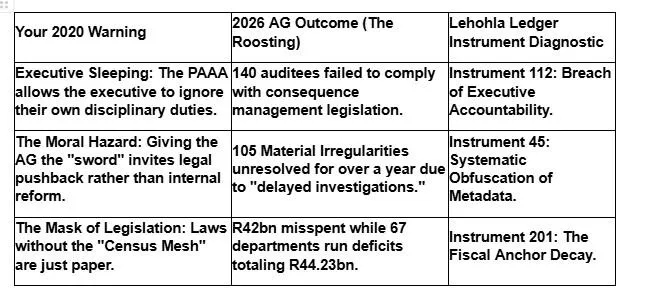
The 2,752 instruments of the Ledger now categorize the PAAA not as a solution, but as an Impediment to Oversight.
Image: Supplied.
The Lehohla Ledger consisting of 2752 instruments is anchored on Morena Mohlomi’s definition of a responsible leader.
It interrogates evidence and adjudicates if or otherwise the verdict acquits an incumbent as a responsible leader.
These is the central question Maluleke’s audits is adjudicating. It is a question deeply rooted in the periodic mandate review that an electorate should address.
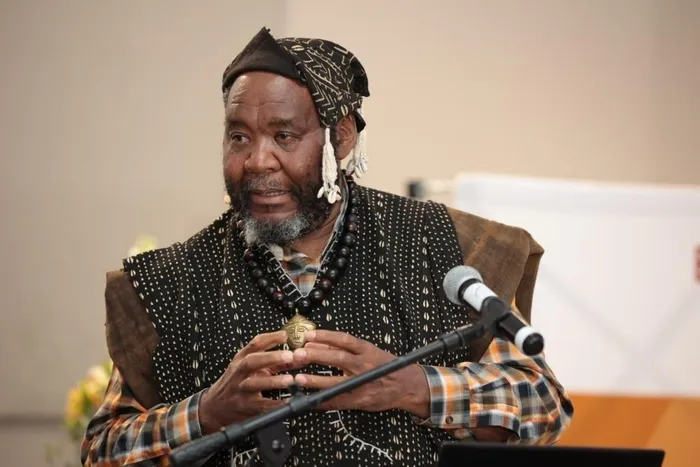
Dr Pali Lehohla is a Professor of Practice at the University of Johannesburg, a Research Associate at Oxford University, and a distinguished Alumni of the University of Ghana. He is the former Statistician-General of South Africa.
Image: Supplied
Dr Pali Lehohla is a Professor of Practice at the University of Johannesburg, a Research Associate at Oxford University, and a distinguished Alumni of the University of Ghana. He is the former Statistician-General of South Africa.
Follow Business Report on Facebook, X and on LinkedIn for the latest Business and tech news.
*** The views expressed here do not necessarily represent those of Independent Media or IOL.