

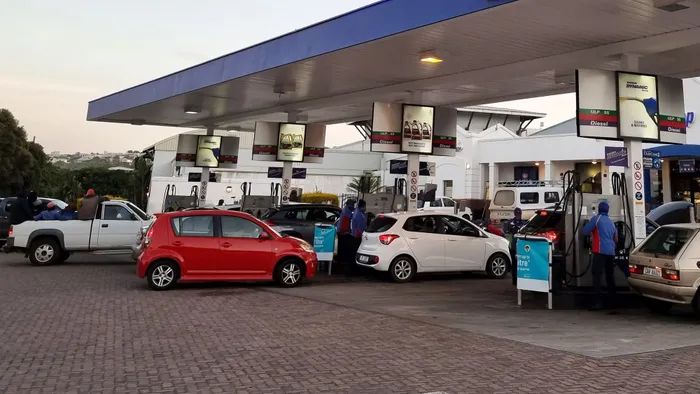
South Africa's government has announced a temporary R3 cut to the fuel levy to alleviate the burden of soaring fuel prices on citizens, amid escalating global oil market tensions.
Image: David Ritchie / Independent Newspapers
Government stepped up to the task on Tuesday to help cushion the impact of soaring fuel prices on citizens, announcing a temporary R3 cut to the fuel levy.
South Africa's Minister of Finance, Enoch Godongwana and Gwede Mantashe, the Minister of Mineral and Petroleum Resources (DMPR) in a joint statement, said that government has interventions in place to fight the cost-of-living crisis in the country, with the first immediate step looking to quell the impact of fuel prices by lowering the fuel levy by R3.
This comes after global oil markets were sent into a tailspin as a result of the geopolitical tensions taking place in the Middle East along with the closure of the Strait of Hormuz.
The Ministers said that the escalation of conflict in the Middle East has materially increased risks to global energy markets, placing significant upward pressure on domestic fuel prices.
"Consultations have been held between the National Treasury and the DMPR to explore measures to provide short-term relief to consumers, while maintaining a stable and sustainable fuel supply system," the joint statement from the ministers read.
The DMPR said that both grades of petrol will increase by R3.06 per litre, while diesel will increase by between R7.37 (500ppm) and R7.51 (50ppm).
Illuminating paraffin will see a price hike of R11.67 per litre.
With the price adjustments taking effect from Wednesday, 1 April, a litre of 95 Unleaded petrol will cost R22.53 at the coast and R23.36 in the inland regions, where 93 Unleaded will cost R23.25.
The wholesale price of 50ppm diesel will rise to R25.35 at the coast and R26.11 in Gauteng.
Treasury said the relief measure will cost government around R6 billion per month.
Government added that it will be re-evaluated on a monthly basis for the following two months.
"The relief measure is designed to be fiscally neutral, and the government will implement mechanisms to recoup the foregone revenue within the fiscal framework approved during the 2026 Budget," the ministers said in their statement.
The Ministers also reassured South Africans that there is sufficient fuel supply in the country to meet current and projected demand.
"Work is underway on a broader package of measures to support households and key sectors of the economy. Further details on additional support measures will be announced in due course. Government remains committed to balancing economic sustainability with the need to protect consumers," the statement further read.
MISA, the Motor Industry Staff Association, following the announcement on Tuesday said that it is grateful that Government listened to the Union’s plea and reduced the fuel levy with R3 per litre to soften the impact of the sharpest fuel price hike in history due to the global oil price surge.
Martlé Keyter, MISA’s CEO of operations, said, “Workers are being crushed between the rising cost of fuel and electricity. Families are forced to choose between commuting to work, putting food on the table, or keeping the lights on. This is not sustainable.”
MISA said it pointed Government earlier this week to Namibia’s example, where its government temporarily reduced fuel levies by 50% until June to shield consumers from higher pump prices. South Africa must follow suit to protect its citizens.
Henry van der Merwe, Chairperson of the South African Petroleum Retailers Association (SAPRA), said while motorists may experience temporary pressure at the pumps, there is no need for alarm.
“We are aware of increasing reports of queues and some sites running low on fuel, particularly diesel, in the lead-up to the anticipated price adjustment. It is important to stress that this is not due to a shortage of product in the country, but rather a short-term strain on distribution caused by a surge in demand as consumers rush to fill up ahead of the increase," van der Merwe said.
“From a fuel retail perspective, our members are working around the clock to manage this heightened demand and ensure continuity of supply. SAPRA is in ongoing, daily engagement with the relevant government departments and industry stakeholders, and we can confirm that there is sufficient product in the system," van der Merwe added.
“We also emphasise that SAPRA service stations are not withholding fuel. Deliveries are continuing, and any temporary outages at site level are being addressed as quickly as possible. The system is expected to stabilise once demand normalises in the days following the price adjustment,” he said.
Trade union, The Congress of South African Trade Unions (Cosatu) said that much more relief will be needed by government to combat fuel prices due to the war in the Middle East.
Cosatu said, "Whilst appreciating this effort to cushion society from the international oil price spike, we fear that workers, society and the economy will simply not cope with a R3 a litre hike for petrol and more worryingly a devastating R7 a litre hike for diesel and R11 for paraffin. Diesel is critical for the public transport that workers depend upon as is paraffin for millions of working-class families. Workers already drowning in debt, supporting up to 7 relatives each and spending an average of 40% of their meagre wages on transport; will not manage such painful diesel and paraffin, and even petrol price hikes."
"If the war drags on and inflation rises, additional relief should be put in place, in particular adjusting social and the SRD grants, delivering food parcels to social grant recipients, putting in place measures to protect food from inflation with targeted support for agriculture and Transnet, and engaging Eskom on measures to reduce the price of electricity. The Reserve Bank must spare society further pain by not increasing the repo rate as this source of inflation is external and not domestic driven and workers’ wages must be protected from further bleeding," Cosatu further said.
Follow Business Report on Facebook, X and on LinkedIn for the latest Business and tech news.