

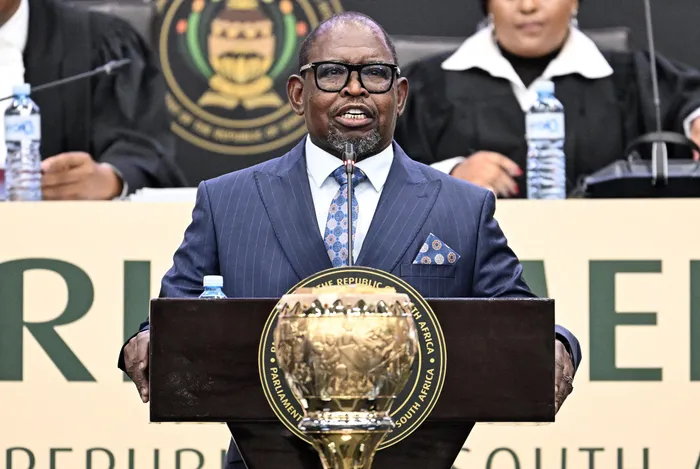
On the eve of significant fuel price hikes, South Africa's Finance Minister Enoch Godongwana announces a temporary R3 reduction in the fuel levy, aiming to provide relief to consumers amidst escalating global oil prices and geopolitical tensions.
Image: GCIS
On the eve of fuel price shocks, South Africa's Minister of Finance, Enoch Godongwana has offered some relief to consumers with government set to cut the fuel levy by R3.
Godongwana, speaking at the Investment Conference said, "I will temporarily be lowering the fuel levy for this month of April by R3 and then I am still discussing what we can do for the next two months."
This comes after global oil markets were sent into a tailspin as a result of the geo political tensions taking place in the Middle East along with the closure of the Strait of Hormuz.
Godongwana said that the levy will be reduced by R3 per litre.
In a joint announcement Gwede Mantashe, the Minister of Mineral and Petroleum Resources of South Africa and Godongwana, said that the escalation of conflict in the Middle East has materially increased risks to global energymarkets, placing significant upward pressure on domestic fuel prices.
"Consultations have been held between the National Treasury and the Department of Mineral and Petroleum Resources to explore measures to provide short-termrelief to consumers, while maintaining a stable and sustainable fuel supply system," the joint statement from the ministers read.
Below are the interventions that government has set out:
The agreed approach consists of an immediate intervention for the next month, and abroader package of measures to support households and key sectors of the economy.
a. The Minister of Finance proposes that the general fuel levy is temporarily reduced by R3 per litre from Wednesday 1 April 2026 to Tuesday 5 May 2026.
This will reduce the general fuel levy for petrol from R4.10 per litre to R1.10 per litre andreduce the general fuel levy for diesel from R3.93 per litre to R0.93 per litre for one month. These amounts exclude other levies such as the Road Accident Fundlevy and the Carbon Fuel Levy.
b. It is estimated that the partial reduction in the fuel levy will cost around R6 billion in foregone tax revenue for the one-month period. The relief measure will be re-evaluated on a monthly basis for the following two months.
c. The relief measure is designed to be fiscally neutral, and the government will implement mechanisms to recoup the foregone revenue within the fiscal framework approved during the 2026 Budget.
d. In reaching this decision, the Minister of Finance sought to balance the socio-economic impact on the country and welfare impact on South African consumers, specifically regarding food and transport inflation, with the fiscal objectives announced in the February Budget.
e. Government further wishes to assure the public that there is sufficient fuel supply in the country to meet current and projected demand.
Reports of shortages in certain areas are largely due to localised distribution and logistical challenges driven by panic buying rather than a lack of national fuel stocks and these are expected to self-correct in the next coming days.
Motorists and businesses are encouraged to purchase fuel responsibly and avoid unnecessary stockpiling.
Broader package of measures:
a. The Minister of Mineral and Petroleum Resources will continue work to review fuel pricing over the medium term.
b. Work is underway on a broader package of measures to support households and key sectors of the economy. Further details on additional support measures willbe announced in due course. Government remains committed to balancing economic sustainability with the need toprotect consumers.
The last time the fuel levy was decreased was in 2022 when Russia invaded Ukraine.
ANC Secretary General, Fikile Mbalula, took to social media platform, X, formerly known as Twitter praising the government for cutting the fuel levy.
He said, "We welcome the ANC led governments intervention with regards to the rising fuel costs because of the war in the Middle East. By cutting the fuel levy by R3 it will buffer the citizens from rising fuel and food prices. This is what a government that cares and is responsive to the needs of the people does. We welcome this swift response."
The price of Brent crude oil remained volatile near $112 a barrel on Monday, poised for a record monthly surge of more than 50% in March, as the ongoing Middle East conflict continues to disrupt energy markets.
According to recent insights from consulting firm EY, the ramifications of this unrest are profound, as disruptions have inhibited access to approximately 20% of the global oil supply, posing a direct threat to the nation’s fuel security.
“These disruptions have hampered access to around 20% of global oil supply, directly threatening South Africa’s fuel security,” said Angelika Goliger, EY Africa Chief Economist.
The implications for the local economy are significant, with fuel prices anticipated to see unprecedented increases in the near term.
South Africa's reliance on external oil supplies makes it particularly vulnerable to international disturbances.
Approximately one-quarter of the country's crude oil imports and nearly a third of its total fuel supply are sensitive to disruptions in the Strait of Hormuz.
With a significant supply shock now appearing likely, the combination of these dire circumstances and soaring prices presents a growing crisis for the nation.
The anticipated changes create a challenging landscape for South African consumers and businesses alike.
"Resilience during fuel shortages in the developing world is built not through idealised demand reduction, but through targeted efficiency measures and a realistic assessment of existing constraints," Goliger added.
Follow Business Report on Facebook, X and on LinkedIn for the latest Business and tech news.