

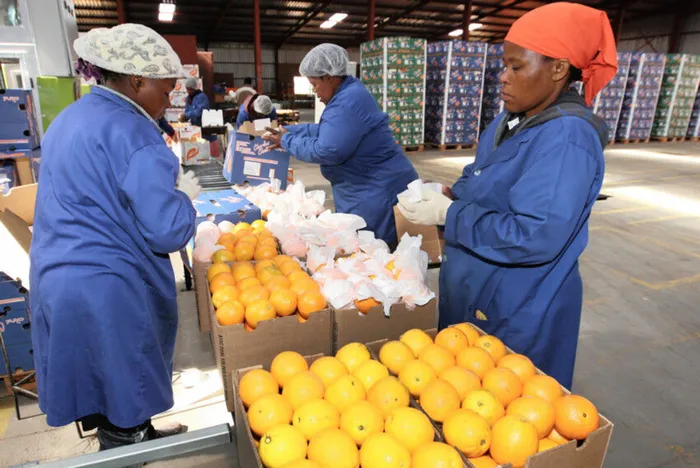
Because of its size, agroeconomic advantages, and technical advancement, amongst other things, South Africa dominates the region’s agriculture and food production.
Image: Simphiwe Mbokazi Independent Newspapers
The Agricultural Business Chamber (Agbiz) has warned that restrictions on exports to the Southern African Customs Union (SACU) partners will negatively impact the South African agriculture sector.
Wandile Sihlobo, chief economist at Agbiz, said on Tuesday that Namibia, Botswana, and Mozambique were among the few countries that have recently introduced restrictions on South African agricultural exports.
“In the case of Namibia and Botswana, these are our customs union partners (SACU). An important benefit of a customs union is the free movement of goods in the common customs area,” he said.
“All these countries, including Mozambique, have committed to removing all trade barriers by 2030 as part of the African Continental Free Trade Area (AfCFTA).”
Sihlobo said Namibia, Botswana, and Mozambique have unjustifiably restricted imports of South African vegetables.
“There is no basis for import restrictions in the common customs area to advantage domestic sectors. These actions risk unravelling SACU, which has already fettered South Africa’s ambition to negotiate bilateral trade deals globally to boost its export sectors and create jobs,” he said.
“We need to take a serious look at SACU’s utility for shared economic interests in the region, as well as, crucially, for our economic interests in a changing global environment. With food security a priority for many governments globally, the ambition to boost domestic agricultural production is understandable.”
According to Sihlobo, the approach to domestic policy, particularly in the regional perspective, should not create barriers that disadvantage producers in other countries, especially in a customs union.
He said this will not be done through restrictive measures, but rather supply-side instruments that could be coordinated.
“Trade restrictions in SACU risk straining relations and devaluing the customs union. Within the SACU region, there is supposed to be free movement of agricultural goods, with a few exceptions, including national security and when there are crop and animal diseases.”
Sihlobo said that in the recent restrictions on vegetables, fruit, and some poultry products in December, there was no such fear of animal diseases.
“The restrictions were based mainly on national aspirations and on what countries intended to do to support their producers, with limited consideration of regional implications.”
Sihlobo added that while it may be tempting for the affected countries to seek a strong policy response to these inconsistencies, dialogue at a higher level to ease these frictions remains an ideal path.
“The region’s agriculture and food sector is interlinked; thus, the path ahead is to understand each country’s priorities and pursue them while minimising interruptions to trade flows.”
Because of its size, agroeconomic advantages, and technical advancement, amongst other things, South Africa dominates the region’s agriculture and food production.
Sihlobo said when other countries in the region seek to increase production, a coordinated strategy with South Africa and reliance on South African agribusinesses to provide inputs are paths worth considering.
“We should pick up dialogue with our partners but make it clear that we are exploring options to de-risk the future. This is important given our significant trade exposure to the region. For example, about 17% of South Africa’s $15.1 billion (R255 billion) in agricultural exports in 2025 went to the SACU region. This is almost comparable to South Africa’s 21% share of agricultural exports to the EU region.”
Dawee Maree, head of agriculture information and marketing at FNB, said this was a matter of concern for SA agriculture.
“We are in a customs union, which is supposed to allow for free movement of goods,” he said.
“However, neighbouring countries from time to time unilaterally close their borders for our exports, especially vegetables, citing protection of their own industries as the reason. This creates an oversupply in the local market and drives prices down, adding volatility to the market.”
Maree said while it might be understandable, it creates uncertainty for SA exporters and is counter-productive for a customs union.
“It is really time for SACU and its members to consider an overhaul of the customs union, especially in light of the AfCFTA.”
BUSINESS REPORT