

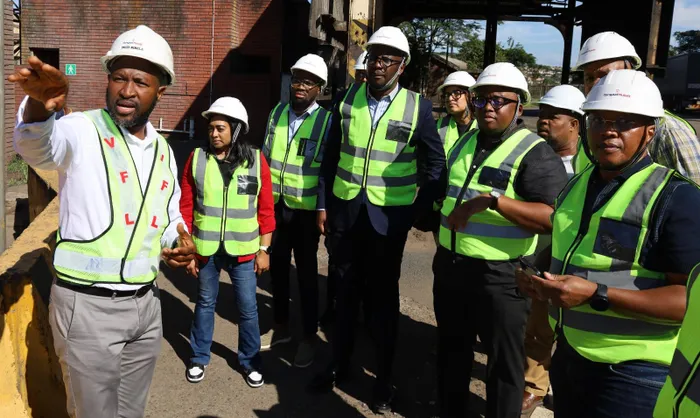
Deputy Minister of Trade, Industry and Competition, Zuko Godlimpi, attended the relaunch of Gledhow Sugar Mill in KwaDukuza, north of Durban, on Wednesday ahead of the sugarcane crushing season.
Image: Supplied
Deputy Minister of Trade, Industry and Competition, Zuko Godlimpi, yesterday vowed that the government would resuscitate the sugar industry and create jobs, during the relaunch of Gledhow Sugar Mill in KwaDukuza, north of Durban.
The mill, which entered business rescue during the 2023/2024 period, is now back on track following a R1.8 billion expansion investment by its new owners.
The commitment was initially announced at last week’s Presidential Investment Conference and is expected to revitalise operations while strengthening the broader sugar value chain. The relaunch was also attended by the South African Farmers Development Association (SAFDA).
Godlimpi said that a new investor is contributing advanced technology to a plant, enhancing efficiency and reducing reliance on fossil fuels, with plans to sell spare parts to other factories. He reassured workers that government remains committed to safeguarding jobs while ensuring long-term sustainability.
“Workers are reassured that the government will prioritise their employment while ensuring the company operates in a sustainable manner,” he said.
Godlimpi added that the government is dedicated to supporting the company’s transition to renewable energy resources.
“Gledhow Mill has a back-end refinery and is currently in the middle of a major off-crop programme as part of the new mill owner's three-year major capital investment programme.”
Godlimpi is currently on a week-long sugar industry stakeholders engagement and mills site visits in KwaZulu-Natal and is expected to preside over the signing of the Phase 2 Sugarcane Value Chain Master Plan on Friday.
The Sugar Industry Master Plan (SIMP) - Phase 1 was established as a partnership between government, private sector and labour to stabilise and transform the sugar sector.
The local sugar industry remains a strategic agro-processing value chain, supporting rural livelihoods, small-scale growers, and regional economies, particularly in KZN and Mpumalanga.
The industry is currently facing several structural challenges, including the risks of potential mill closures that could significantly affect cane growers, rural employment, and associated value chains.
Notwithstanding the challenges faced by the industry, the dtic and government Development Finance Institutions like Industrial Development Corporation (IDC) remain committed to supporting the reopening of the sugar cane mills to preserve jobs and sustain the rural livelihoods in KZN.
Nkosinathi Msweli, a sugarcane farmer, said that he was very excited that Gledhow Mill is reopening.
“Although we are still waiting for the mill to be opened and now we can make use of our cane this season.”
Dr Siyabonga Madlala, executive chairman of SAFDA, said that the association will support the reopening of Gledhow.
“The expansion and relaunch of Gledhow Sugar Mill means that they would require more sugarcane. We are on the ground planting more sugarcane, and Gledhow is our partner.”
Madlala added that the good news with Gledhow is followed up with some positive news on Tongaat Hulett.
“In February, Tongaat Hulett filed for provisional liquidation. We did receive some positive news this morning that the IDC will be investing. There is some certainty that the mills will open a bit late but ít is still good news. We, however, need a long-term solution in this regard.”
Madlala said that SAFDA's main job is advocating and lobbying for the industry. “We have been active in the saving of Tongaat Hulett.
“If it had to close, that would mean a shortage of sugar and would have pushed the price of local sugar drastically up. We are lobbying for a tariff to reduce sugar imports. We are appealing to the government to fast-track the process so that we can protect the local industry.”
Madlala added that the country remains vulnerable to rising oil prices and increases in fuel prices following Middle East tensions.
“There is an opportunity to unlock biofuels for the sugar industry. That would mean tripling the sugar industry’s reach; we see this as a job creator and a way to save jobs.”
BUSINESS REPORT