

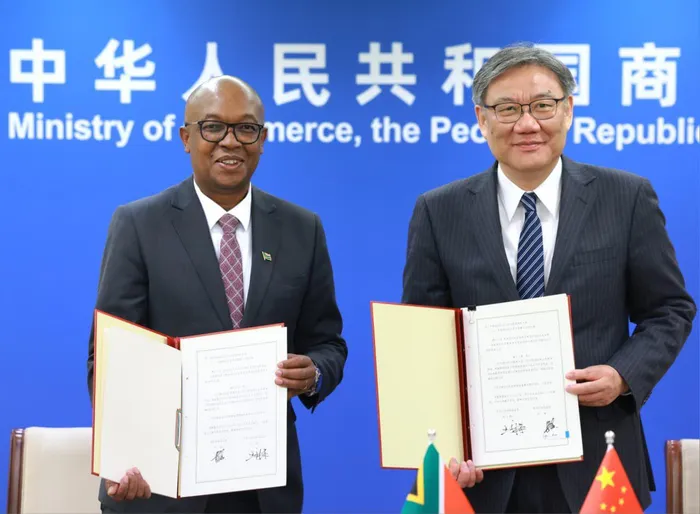
Minister Parks Tau and China’s Minister of Commerce, Wang Wentao, signed the China–Africa Economic Partnership Agreement (CAEPA), a landmark deal set to grant South African exports duty-free access to the Chinese market while boosting investment into South Africa’s economy.
Image: Supplied
South Africa is on the brink of a major trade breakthrough as zero-tariff access to China’s vast consumer market comes into effect on 1 May 2026.
Yet while the policy milestone marks a significant diplomatic and economic achievement, analysts warn that the real challenge now lies in execution — turning opportunity into tangible growth, jobs, and investment.
The new trade framework, established under the China–Africa Economic Partnership Agreement (CAEPA), grants South African exporters duty-free access to a market valued at roughly R3.5 trillion.
Government leaders have hailed the development as a turning point, signalling renewed momentum in trade and investment after years of sluggish growth.
But according to global advisory network HLB International, the removal of tariffs is only the beginning.
“Zero tariffs remove a commercial barrier — but they do not automatically create factories, supply chains, or employment,” said Coco Ke Liu, chief growth officer at HLB International.
“The investors and exporters who will capture this opportunity are those who close the execution gap; and that requires a very different set of capabilities from simply signing a framework agreement.”
Recent weeks have seen a flurry of high-level engagements reinforcing South Africa’s growing economic ties with China.
In February, Trade, Industry and Competition Minister Parks Tau signed CAEPA in Beijing alongside China’s Commerce Minister Wang Wentao. Days later, Chinese President Xi Jinping announced zero-tariff treatment for 53 African countries, including South Africa.
By late March, Deputy President Paul Mashatile was positioning South Africa as China’s “most indispensable trade and investment partner” at a bilateral forum in Cape Town.
At the same time, the South African Investment Conference showcased an ambitious R2 trillion investment drive, with Chinese automaker Chery committing to a multi-billion-rand manufacturing plant at the former Nissan site in Rosslyn.
Liu says this sequence represents genuine and significant progress. But she warned that the gap between a signed agreement and on-the-ground delivery is where most investment stories falter.
“South Africa has done the diplomatic and policy work. The question now is whether businesses, both Chinese investors coming in and South African exporters going out, have the operational, regulatory and structural capability to capture what has been created. That is where the real work is,” she said.
For Chinese investors, South Africa offers a relatively sophisticated but complex operating environment.
Successfully entering the market requires navigating intricate regulatory frameworks, aligning with localisation and Broad-Based Black Economic Empowerment (B-BBEE) requirements, and establishing robust tax and investment structures that can function across multiple jurisdictions.
Equally, South African exporters face a demanding road as they prepare to enter the Chinese market. While tariffs may be eliminated, technical and regulatory barriers remain firmly in place.
These include phytosanitary approvals, registration with China’s General Administration of Customs (GACC), and strict cold-chain logistics requirements for perishable goods.
Beyond compliance, exporters must also contend with strong global competition. Established players from countries such as New Zealand, Chile, and Australia already have deep-rooted distribution networks and strong brand recognition in China’s premium retail sector.
“The CAEPA is a platform. It is not a guarantee,” Liu noted. “Turning it into genuine economic impact requires exactly the kind of implementation discipline that both governments have now rightly made central to their investment narrative.”
Despite these challenges, broader indicators suggest a favourable environment for growth.
HLB’s 2026 Survey of Business Leaders shows that 74% of executives across the Middle East and Africa expect global economic growth to accelerate, supporting increased cross-border investment.
At the same time, Africa’s economic landscape continues to evolve. Start-ups across the continent raised approximately $3.1 billion in 2025, with South Africa emerging as a leader in fintech and digital services. China-Africa trade has also surged, reaching $348bn in 2025 — a 17.7% increase year-on-year.
However, structural constraints remain a concern. Internet penetration in Sub-Saharan Africa stands at just 38%, significantly below the global average of 68%.
Infrastructure bottlenecks in ports, rail networks, and digital connectivity continue to hinder efficient trade flows. Additionally, more than a third of business leaders cite gaps in digital and artificial intelligence capabilities as a key barrier to growth.
Against this backdrop, HLB International emphasised that successful cross-border investment depends on long-term planning and disciplined execution.
“The companies that will build lasting, profitable operations in South Africa are those who take the long view, who see localisation not as a cost of compliance but as the foundation of a sustainable business,” Liu said.
“And the South African exporters who will win in China are those who invest in relationships, brand and distribution, not just logistics.”
BUSINESS REPORT