

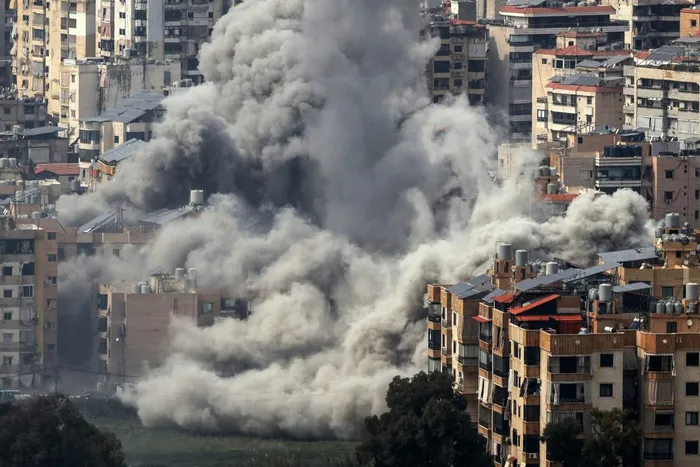
At least 182 people were killed and nearly 900 wounded on Wednesday, the Lebanese Health Ministry said. As the US-Iran ceasefire hangs by a thread, South Africa's economic stability is intricately tied to the outcomes of these pivotal negotiations.
Image: AFP
On the first day of the much-anticipated ceasefire between Iran and the United States, a fragile sense of calm was disrupted by escalating tensions in the Middle East.
Allies of both nations engaged in skirmishes, with Lebanon grappling with escalating conflicts against its neighbour, Israel.
Adding to the unrest, Iran has taken the decisive step of closing the strategic Strait of Hormuz, highlighting the precariousness of peace even as negotiations have begun in Pakistan.
The ceasefire, instigated by US President Donald Trump, was viewed as a potential turning point for global stability, yet events on the ground suggest a turbulent road ahead.
With the fragile peace now in place for two weeks, the ramifications extend far beyond the immediate geography of the conflict and resonate deeply within the South African economy.
Fuel prices and the expectations surrounding the South African Reserve Bank’s Monetary Policy Committee (MPC) decision on interest rates are intricately linked to the outcomes of these geopolitical tensions.
April has already experienced its share of economic strain as South Africa witnessed significant increases in fuel costs.
In response, the government implemented a reduction of R3 in fuel levies to alleviate the burden on consumers.
Furthermore, the Sarb chose to keep interest rates unchanged at the end of March, a decision that reflects cautious optimism amid uncertainty.
The local markets exhibited a positive reaction to the ceasefire announcement, evidenced by an uptick in stocks on the Johannesburg Stock Exchange (JSE), which reached its highest levels in over a month. The South African rand also showed signs of strengthening, signalling investor confidence, albeit in a context rife with volatility in the region.
As peace talks unfold in Pakistan, and the two-week ceasefire period progresses, the world watches closely.
Maarten Ackerman, Chief Economist at Citadel told Business Report that the market reaction following the announcement of the ceasefire provided a clear illustration of how successful peace talks and a sustained ceasefire could positively influence global markets, global growth prospects and the inflation outlook.
Ackerman said, "That optimism, however, proved short-lived. Renewed attacks between Israel and Lebanon overnight on Tuesday, 9 April, followed by Iran once again closing the Strait of Hormuz, quickly reversed sentiment. Discussions will continue, with the US sending a delegation led by Vice President J.D. Vance. Should the peace talks succeed over the next two weeks and should the parties find meaningful common ground, history suggests that markets would respond positively, with supportive implications for the global economy."
"Unfortunately, barely two days into the ceasefire, it is already clear that the parties remain far apart. Given the breadth of the ten outstanding points of disagreement, at least half of which appear extremely difficult to resolve, it is hard to see a durable agreement emerging," Ackerman said.
"As a result, at Citadel, we are increasingly focused on our protracted-risk scenario. Under this outcome, almost irrespective of what happens over the next two weeks, the global economy is likely to lose approximately 0.8% of growth over the next 12 months, while inflation could rise by a further 1% from its current base and remain stubbornly sticky," he added.
Ackerman said that for South Africa, this backdrop is particularly challenging.
"The economy’s heavy reliance on agriculture and elevated input costs mean higher diesel prices and fertiliser costs, much of which is sourced from the Gulf, will place additional pressure on growth. In this environment, South Africa is likely to struggle to achieve 1% growth," the Citadel economist said.
"While we remain hopeful that the peace talks deliver some form of resolution, investors should be mindful that even in a best‑case outcome, significant economic damage has already been done. Reversing these effects will take time and it is unlikely that the global economy will return to full capacity in the near term," Ackerman further said.
Follow Business Report on Facebook, X and on LinkedIn for the latest Business and tech news.
At least 182 people were killed and nearly 900 wounded on Wednesday, the Lebanese Health Ministry said. As the US-Iran ceasefire hangs by a thread, South Africa's economic stability is intricately tied to the outcomes of these pivotal negotiations.
Image: AFP