

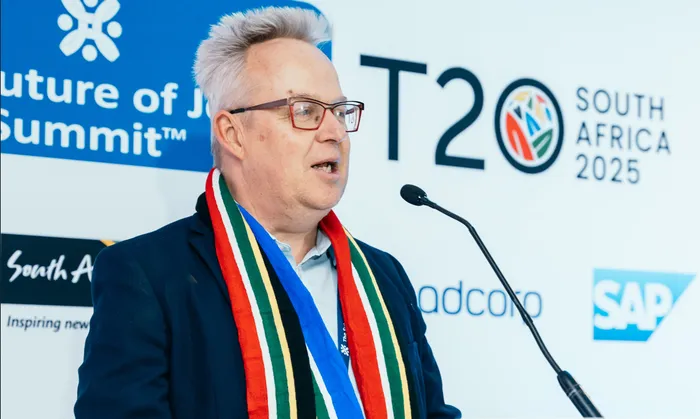
Dr Nik Eberl is the founder and executive chair: The Future of Jobs Summit™ (Official T20 Side Event). He is also the author of Nation of Champions: How South Africa won the World Cup of Destination Branding).
Image: Supplied
I still remember the sound of the vuvuzelas in 2010. At the time, much of the world wasn’t listening for celebration—it was listening for failure.
In the months leading up to the 2010 FIFA World Cup, the dominant global narrative questioned whether South Africa was ready. Concerns about safety, infrastructure and delivery filled headlines.
And then, almost overnight, the story changed.
Visitors arrived with caution and left with conviction. Journalists who came to critique stayed to praise. What the world experienced was not the country they had been told to expect, it was something far more powerful: a nation that delivered, connected and inspired.
Tourism didn’t just spike during the tournament. It accelerated in the years that followed. More importantly, South Africa achieved something far more valuable than visitor numbers: it built trust.
That is the lesson we must return to today. Because once again, the global tourism landscape is shifting—and once again, South Africa has an opportunity to step forward.
Global tourism has rebounded strongly after the pandemic, but it is doing so in a more fragmented and uncertain world. The ongoing conflict in the Middle East is disrupting key aviation routes and reshaping traveller confidence. As perceptions of safety shift, so too do travel decisions.
Tourism is, at its core, a confidence industry. When confidence declines in one region, it rises in another. This creates what can best be described as a global reallocation of demand—a moment when travellers, airlines and operators actively seek alternative destinations that offer stability, accessibility and value.
South Africa is uniquely positioned to benefit. But—as 2010 taught us—opportunity alone is not enough. It must be matched by strategy, coordination and belief.
The traveller of 2026 is fundamentally different from the traveller of 2010. Today’s tourists are not looking for passive sightseeing. They are looking for experiences that are immersive, meaningful and, increasingly, transformative.
Cultural tourism is booming as travellers seek authentic human connection—something South Africa offers in abundance, from the legacy of Nelson Mandela to the vibrancy of township life and the richness of its diverse cultures.
Adventure and nature-based tourism are also on the rise, driven by a post-pandemic desire for outdoor experiences and physical engagement. Few destinations in the world can match South Africa’s combination of wildlife, landscapes and adventure activities.
Then there is the rapid growth of participatory travel. Tourists are no longer content to watch events; they want to be part of them. Marathon tourism, cycling tours and surf circuits are attracting a new generation of travellers who want to move, compete and challenge themselves.
Wellness tourism is another powerful trend, reflecting a broader shift toward intentional living. Travellers are seeking destinations that offer not just relaxation, but renewal—mentally, physically and emotionally.
Overlay all of this with the rise of slow travel, sustainability and purpose-driven journeys, and a clear pattern emerges: tourism is shifting from consumption to transformation. And this is where South Africa’s true competitive advantage lies.
In 2010, we succeeded because we delivered an experience that exceeded expectations. We did not simply host matches; we created moments.
The fan walks, the spontaneous celebrations, the warmth of local communities—these were not part of the official programme, but they became the defining memory of the tournament.
That is the blueprint for the future. South Africa must move beyond positioning itself as a destination and instead embrace its role as an experience economy powerhouse.
This means investing in:
In short, it means designing tourism not as a product, but as a journey.
One of the limitations of 2010 was that it was, by definition, temporary. A single event, no matter how successful, has a finite lifespan. The opportunity today is different. Instead of building toward a single moment, South Africa can build a sustained movement—one that positions the country as a year-round destination for cultural, adventure, sports and wellness tourism.
Imagine a coordinated national calendar of events that attracts runners, cyclists, surfers and explorers from around the world.
Imagine township tourism elevated into a globally recognised model of inclusive growth.
Imagine South Africa becoming synonymous not just with beauty, but with depth, meaning and participation. This is not an unrealistic vision. It is a strategic choice.
The success of 2010 was not accidental. It was the result of alignment—between government, business and society—around a shared goal.
That same level of coordination is required today.
South Africa must:
Tourism is one of the few sectors capable of delivering both economic growth and broad-based employment. In a country facing deep socio-economic challenges, that makes it not just an opportunity, but a necessity.
In 2010, we faced a choice: to be defined by global scepticism or to redefine ourselves on the world stage. We chose the latter.
Today, the world is once again in flux. Travellers are searching for destinations that offer confidence, connection and meaning.
South Africa has all three.
The question is whether we are ready to act with the same ambition and belief that defined 2010.
Because when the world becomes uncertain, people don’t stop travelling. They simply choose differently. And South Africa, once again, can be that choice.
Dr Nik Eberl is the founder and executive chair: The Future of Jobs Summit™ (Official T20 Side Event). He is also the author of Nation of Champions: How South Africa won the World Cup of Destination Branding)
Follow Business Report on Facebook, X and on LinkedIn for the latest Business and tech news.