

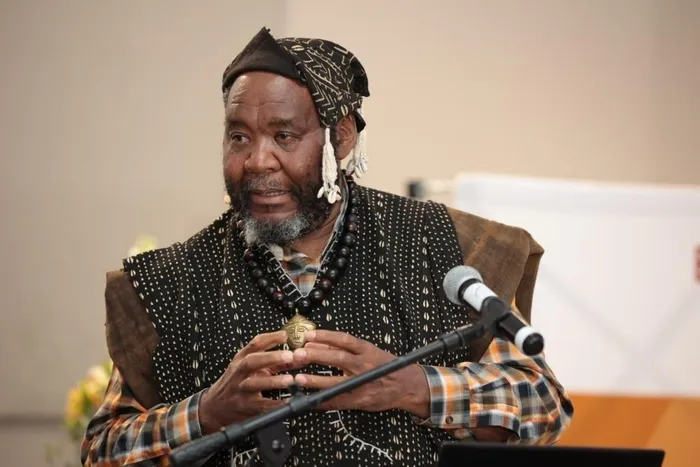
Dr Pali Lehohla is a Professor of Practice at the University of Johannesburg, a Research Associate at Oxford University, and a distinguished Alumni of the University of Ghana. He is the former Statistician-General of South Africa.
Image: Supplied
The applications of the Lehohla Ledger are vast and versatile.
The Ledger demonstrates its capacity as a diagnostic tool for the two decade evasive phenomena from implementing the District Development Model (DDM).
I selected three areas in South Africa and generated a schematic of Local Indicator of Spatial Association (LISA) Map comparing Mitchells Plain, Soweto, and Nobody.
This illustrates the diagnostic power of the 2752 instruments derived from my 3000 columns written over a career of twenty four years.
These instruments diagnose and provide pathways to solutions that are driven by the quest and pursuit for intergenerational value.
Through this South African 'Subterranean Mesh' we interrogate at three distinct metabolic states: the 'Dormitory Disconnect' of the Cape, the 'Relentless Pulse' of Gauteng, and the 'Traditional Stagnation' of Limpopo. Each represents a different struggle against the 2050 Abyss."
I have picked up three provinces and in each I selected a settlement. Mitchells Plain in the Western Cape, Soweto in Gauteng and Nobody in Limpopo.
Diverse as these areas are across provinces, they however exhibit common heritage that has intensified their status of disadvantage at worst or remained static at best.
While it boasts 99% access to piped water and electricity, Mitchells Plain Gross Value Added (GVA) is leaked daily as residents commute 20km to the Cape Town Central Business District and back.
Mitchells Plain therefore remains a dormitory that leaks its resources into the transport sector through daily commuting.
Without commuting Mitchells Plain remains a dormitory of despair and the future remains bleak.
If the conditions persist into 2036, in another ten years the "Zero-Investment" Void in the Plein Chambers there will be "Zero International Call Centres" and "Zero Business Incubators,".
The youth of Mitchells Plain will remain locked out of the Grand Inga–Gauteng City Region Energy Bridge that could drive digital economy. Because there are no "Head Offices of Listed Companies" or "Business Parks," the street-level economy will remain informal and vulnerable to the Vulture Vortex of extortion and gang form of capitalism.
Soweto a dormitory of both Joburg which has been deserted by business in favour of Sandton will remain a dormitory. It will feel the pressure of new entrants with densification per stand and decay of infrastructure.
Nobody will remain nobody with traditional stagnation and infrastructure void.
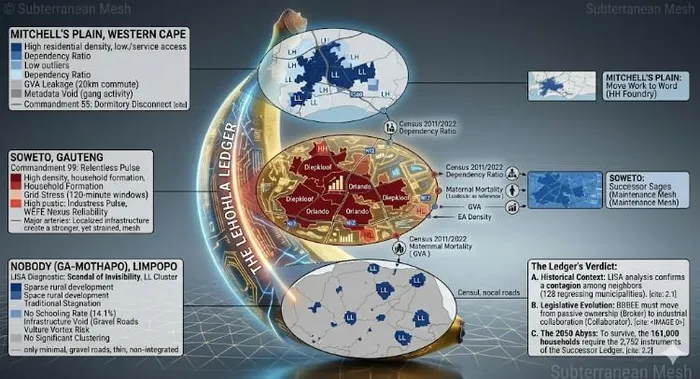
The Lehohla Ledger serves as a vital diagnostic tool, revealing the economic challenges faced by Mitchell's Plain, Soweto, and Nobody. This analysis explores the systemic issues affecting these areas and offers insights into potential pathways for intergenerational value creation.
Image: Supplied.
The LISA map gives a critical analysis of where the ironclad locks of antidevelopment are located. That Bad associates with Bad is an outcome of policy.
Mitchells Plain is in a self-reinforcing cluster of low-low and deliberately removed from the high-high of Cape Town. Similarly, Soweto is a Low Low trapped by the apartheid dormitory design with some with patches of High Low but overwhelmingly pressured by the density per stand which leads to weighing heavily on the infrastructure and terminal decay.
Nobody is sparsely populated and is an isolated Low Low.
Tools such as the Lehohla Ledger are the new instruments of power that Morena Mohlomi trained Morena Moshoeshoe in to place foundational intelligence directed at intergenerational value creation.
These new instruments of power provide the much needed solutions to integrate thinking by design.
In turn that introduces rationality of action through system design and integrated reporting. Integrated reporting should be an outcome of an integrated service delivery in which human settlements are not just a term but a lived and enjoyed experiences.
To this thought process of renewal there is need to Rebalance. We cannot treat the ''Commuter' of Mitchells Plain the way we have to date
The 'Backyarder' of Soweto, and the 'Villager' of Nobody continue to be treated with contempt.
A clear policy stance and action can and should reverse this stubborn legacy. The Local Indicator of Spatial Association identify the "Contagion of neighbouring failure" and breaking it with a Sovereign Hubs and not extractive ones is a necessary imperative.
Dr Pali Lehohla is a Professor of Practice at the University of Johannesburg, a Research Associate at Oxford University, and a distinguished Alumni of the University of Ghana. He is the former Statistician-General of South Africa.
Follow Business Report on Facebook, X and on LinkedIn for the latest Business and tech news.