

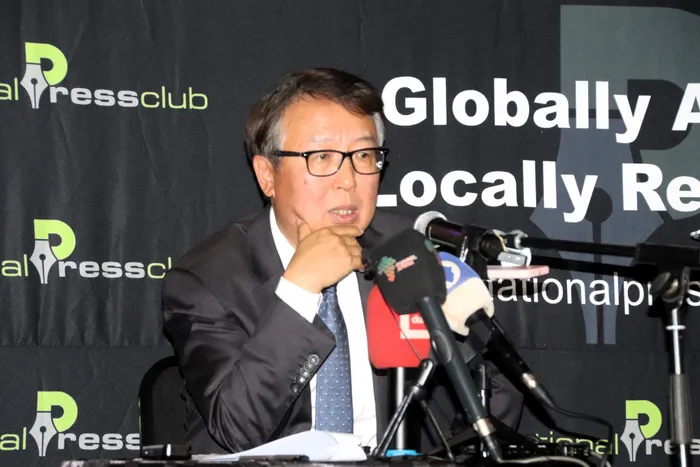
Chinese Ambassador Wu Peng said South African citrus has excellent quality and complements China’s domestic citrus production due to South Africa's counter-seasonal supply
Image: File
South Africa has taken a significant step to expand its agricultural exports after reaching a new phytosanitary agreement with People’s Republic of China to amend cold treatment requirements for citrus exports, a move expected to improve efficiency and unlock further growth in a key market.
The agreement, signed in Pretoria between Agriculture Minister John Steenhuisen and Chinese Ambassador Wu Peng, has been widely welcomed by industry stakeholders, including the Citrus Growers’ Association of Southern Africa.
Steenhuisen described the development as a major milestone in strengthening trade relations and expanding opportunities for South African producers.
“It will cement our position as the biggest exporter of citrus to the PRC,” he said.
The Department of Agriculture said the revised cold treatment protocols are designed to improve export efficiency, reduce costs for producers and exporters, and ensure that higher-quality fruit reaches consumers in China.
The changes are expected to enhance the competitiveness of South African citrus in a market that continues to grow in both size and importance.
China remains one of South Africa’s most valuable agricultural trading partners. In 2025, exports of citrus to China and Hong Kong totalled approximately 11.5 million cartons, accounting for around 6% of South Africa’s overall citrus exports.
The department said the latest agreement creates clear potential for further expansion as demand in the Chinese market continues to rise.
The deal builds on a series of recent trade gains between the two countries, including expanded market access for South African stone fruit such as apricots, peaches, nectarines, plums and prunes.
Together, these developments signal a strengthening bilateral relationship that is delivering tangible benefits for farmers and exporters.
Steenhuisen emphasised that South Africa places high value on its partnership with China, noting that sustained cooperation has been key to unlocking new export opportunities
“These agreements are the result of trust, respect, and sustained cooperation, and they are helping open doors for our producers at a time when diversification has never been more important.”
The department also underscored South Africa’s continued support for China’s One China Policy, describing it as a stable foundation for deeper economic cooperation. This alignment, officials say, helps facilitate smoother negotiations on export protocols, quicker resolution of phytosanitary issues, and broader access for South African agricultural products.
Beyond citrus, the strengthened relationship is expected to support investment, logistics and infrastructure partnerships, all of which are critical to driving economic growth, job creation and long-term food security in South Africa.
The citrus industry remains a cornerstone of the country’s agricultural economy. In 2025, Southern Africa exported around 204 million cartons of citrus, with South Africa contributing approximately 193 million cartons. Export earnings surpassed $2 billion (R32 billion) for the first time, reaching an estimated $2.47bn (R39bn).
Chinese Ambassador Wu Peng said South African citrus has excellent quality and complements China’s domestic citrus production due to South Africa's counter-seasonal supply.
“That is a very positive contribution to Chinese consumers’ fruit baskets. With China’s huge market of 1.4 billion people, our cooperation has enormous potential and bright prospects,” Wu said.
“This agreement for further access to the Chinese market cannot be more timely, because South Africa’s citrus season this year is just beginning and is going very strong. It reflects the high level of China-South Africa bilateral relations and the deep friendship between our peoples.”
According to the Citrus Growers’ Association (CGA), the sector supports roughly 140,000 direct jobs at farm and packhouse level, with significantly more employment generated across the broader value chain, including logistics, export services and international distribution.
Dr Boitshoko Ntshabele, CEO of the CGA, said the organisation remains committed to working closely with government and global partners to strengthen market access and maintain high phytosanitary standards.
“As such, the citrus sector forms the economic heart of many rural communities across the country and continues to play a critical role in driving inclusive growth and sustained rural development,” Ntshabele said.
BUSINESS REPORT