

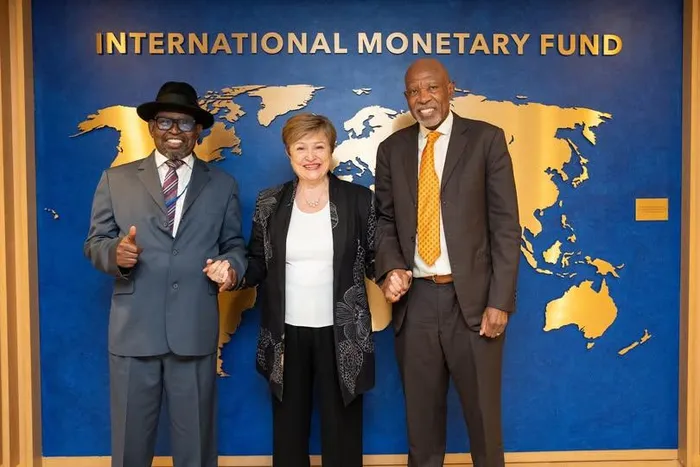
IMF managing director Kristalina Georgieva on Tuesday held high-level discussions with Finance Minister Enoch Godongwana and South African Reserve Bank (Sarb) Governor Lesetja Kganyago.
Image: Supplied
The International Monetary Fund (IMF) has commended South Africa’s economic management, highlighting the country’s resilience in the face of mounting global uncertainties and regional risks.
South Africa has faced a series of economic challenges in recent years, including energy constraints, fiscal pressures, and weak growth.
However, the government has implemented a range of reforms aimed at stabilising public finances, improving governance in State-owned enterprises, and addressing structural bottlenecks.
IMF managing director Kristalina Georgieva on Tuesday shared positive feedback following high-level discussions with Finance Minister Enoch Godongwana and South African Reserve Bank (Sarb) Governor Lesetja Kganyago, where discussions focused on economic risks facing both South Africa and the broader region.
According to Georgieva, South Africa’s economy is showing increased resilience in the face of mounting global uncertainty, even as the IMF sharply downgraded the country’s growth outlook for the next two years.
“Prudent macroeconomic policies and structural reforms have strengthened South Africa's resilience to current and future shocks,” Georgieva said, signalling confidence in the country’s policy direction despite a deteriorating global backdrop.
Her comments come as the IMF’s latest World Economic Outlook paints a more subdued picture for South Africa’s growth prospects. The Fund revised its 2026 growth forecast down to 1.0%, from 1.4% projected earlier this year, while the 2027 outlook was lowered to 1.3% from 1.5%.
The downward revisions reflect the growing impact of the Middle East conflict, which has disrupted global energy markets, driven up oil prices, and intensified inflationary pressures worldwide.
As an energy-importing economy, South Africa is particularly vulnerable to these developments, which are expected to weigh on growth and household spending.
The IMF’s more cautious outlook contrasts with projections from National Treasury and the Sarb, which anticipate growth gradually rising towards 2% over the medium term. However, the Fund’s assessment underscores how external shocks are increasingly shaping domestic economic outcomes.
Georgieva’s emphasis on resilience highlights the role of sound economic management in cushioning the country against these pressures. South Africa has implemented a range of reforms in recent years, including efforts to stabilise public finances, improve governance in State-owned enterprises, and maintain a credible monetary policy framework.
Kganyago has prioritised anchoring inflation expectations, while Treasury has worked to contain debt levels and improve spending efficiency—measures that have contributed to macroeconomic stability.
Beyond South Africa, the IMF also downgraded growth forecasts for sub-Saharan Africa, reflecting broader regional challenges. Growth is now expected to reach 4.3% in 2026 and 4.4% in 2027, slightly lower than earlier projections.
At the same time, inflation in the region is projected to rise significantly, with median inflation increasing from 3.4% in 2025 to 5% in 2026. Higher fuel and fertiliser costs, along with potential supply disruptions, are expected to drive price pressures, particularly in vulnerable economies.
Deniz Igan, division chief of the IMF Research Department, pointed out that the region had entered 2025 on relatively strong footing, supported by favourable global conditions. However, the war has reversed many of these gains.
She also highlighted additional pressures, including declining foreign aid and worsening terms of trade for oil-importing countries, which are compounding economic challenges.
Meanwhile, the IMF downgraded its global growth outlook for 2026 to 3.1%, down from 3.3% projected in January, as escalating conflict in the Middle East disrupts energy markets and threatens to derail economic momentum.
Ben May, director of global macro research at Oxford Economics, said the IMF’s latest world GDP growth forecast for 2026 of 3.1% on a purchasing-power-parity (PPP) weighted basis is still too optimistic.
May said on a like-for-like basis, their baseline forecast is for world GDP growth of 2.9% in 2026. A key factor explaining the differences in forecasters’ latest growth assessments, May said, is the assumed oil price path.
"Our slightly more pessimistic growth forecasts for this year are consistent with a higher oil price path than the IMF’s: we anticipate the Brent oil price averaging $90 per barrel (pb) in 2026 – about $10pb higher than the IMF assumes. While the IMF doesn’t provide a precise path, we assume that the oil price peaks at $113pb in Q2 before falling back to an average of about $80pb in Q4," he said.
"We are sceptical that the conflict in the Middle East is likely to result in the oil price peaking next year. Still, the key takeaway that a surge in the oil price of this magnitude and duration could push the global economy into recession is in line with our own Prolonged Iran war scenario published in March."
BUSINESS REPORT