

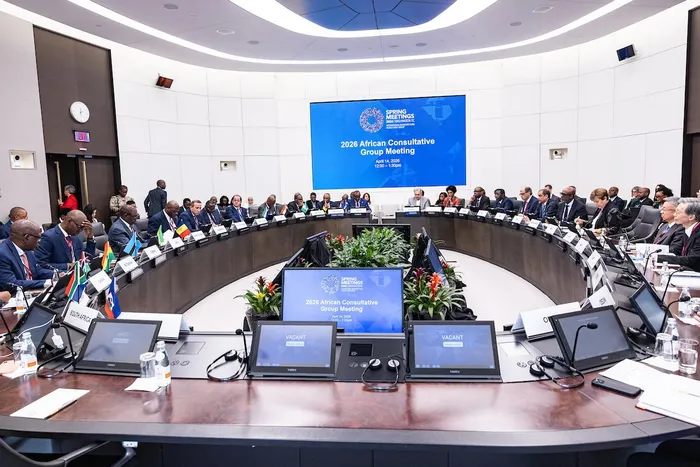
This assurance came at the conclusion of the African Consultative Group meeting in Washington, where Seedy Keita, chairman of the African Caucus, and Kristalina Georgieva, managing director of the IMF, led discussions on the continent’s economic outlook and policy priorities.
Image: Supplied
The International Monetary Fund (IMF) has reaffirmed its commitment to supporting African economies through an increasingly uncertain global environment, as policymakers warn of slowing growth, rising debt pressures, and heightened external risks.
This assurance came at the conclusion of the African Consultative Group meeting in Washington, where Seedy Keita, chairman of the African Caucus, and Kristalina Georgieva, managing director of the IMF, led discussions on the continent’s economic outlook and policy priorities.
The meeting took place against the backdrop of ongoing geopolitical tensions, particularly the conflict in the Middle East, which continues to cast a shadow over global economic prospects. While a ceasefire has been announced, officials cautioned that the outlook remains fragile, with risks tilted to the downside.
Global growth is projected to slow to 3.1% in 2026 before recovering slightly to 3.2% in 2027. However, policymakers warned that a prolonged conflict or delays in restoring global supply chains could further dampen economic activity.
For Africa, the outlook is similarly challenging. Growth is expected to ease from 4.5% in 2025 to 4.2% in 2026, reflecting both external shocks and domestic constraints. Sub-Saharan Africa and North Africa are both projected to see slower expansion, highlighting the broad-based nature of the slowdown.
Despite these headwinds, the IMF emphasised that it remains firmly committed to working with African countries to navigate the difficult environment. The institution pledged continued support through policy advice, financing, and capacity development.
“The IMF reaffirmed its strong commitment to its African members,” Georgieva said, adding that the Fund will “continue to work closely with African countries to support sound policies, mobilize financing, strengthen resilience, and advance the region’s development objectives in an increasingly complex global environment.”
African policymakers welcomed this commitment, noting that close cooperation with international financial institutions will be essential as countries confront rising debt burdens, limited access to affordable financing, and growing development needs.
Keita underscored the importance of coordinated action, particularly in addressing immediate economic shocks while building long-term resilience.
“Policymakers must focus on addressing the shock in the near-term while building resilience over the medium-term,” he said.
The meeting highlighted several key priorities for African governments. In the near term, maintaining stable inflation and protecting vulnerable populations through targeted support measures will be critical. With many economies still recovering from previous crises, social protection remains a central concern.
Fiscal policy will also play a crucial role. Officials stressed the need for credible yet flexible fiscal frameworks. Oil-exporting countries were encouraged to save temporary windfalls and rebuild buffers, while oil-importing nations should prioritise essential spending and strengthen domestic revenue mobilisation.
Beyond immediate measures, the discussions emphasised the importance of structural reforms to drive sustainable growth. These include diversifying economies, deepening regional integration, and strengthening domestic financial markets.
Investment in energy and digital infrastructure was also identified as essential to unlocking productivity and enabling countries to harness emerging technologies such as artificial intelligence.
Debt sustainability remains a pressing issue across the continent.
The IMF and World Bank are currently reviewing the Low-Income Country Debt Sustainability Framework, with the aim of improving how debt risks are assessed and managed. Policymakers said this work is particularly important in the current environment, where global shocks are exacerbating existing vulnerabilities.
In addition, participants called for improvements in the IMF’s surveillance processes, urging the institution to provide more tailored and effective policy advice, as well as stronger analysis of global economic spillovers.
As uncertainties persist, the reaffirmation of the IMF’s commitment provides a measure of reassurance to African countries navigating a complex and rapidly evolving landscape.
However, both the Fund and African leaders acknowledged that sustained reform efforts and strong partnerships will be essential to safeguarding economic stability and achieving long-term development goals.
BUSINESS REPORT