

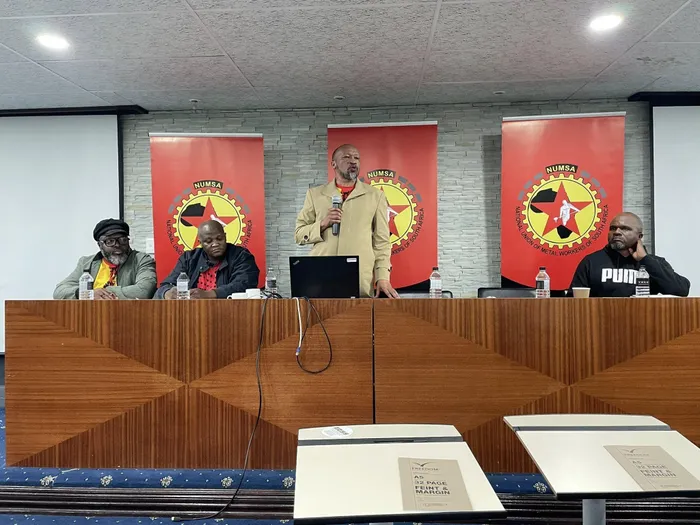
Numsa general secretary Irvin Jim together with the union's representatives at their headquarters in Johannesburg on Tuesday during a media briefing on the ongoing wage negotiations with Eskom.
Image: Supplied
The National Union of Metalworkers of South Africa (Numsa) has declared a deadlock in wage negotiations with Eskom, rejecting the utility’s offer of a 7% annual increase over three years and warning of escalating tensions if the impasse is not urgently resolved.
In a strongly worded media briefing yesterday, Numsa said it had “been left with no option” but to go public after talks failed to yield a meaningful agreement.
The union accused Eskom of undermining the collective bargaining process and short-changing workers despite a significantly improved financial position.
Numsa general secretary Irvin Jim said the offer on the table falls far short of what workers deserve, especially given the utility’s recent financial recovery.
“We are going public in rejecting the current offer on the table which Numsa regards as a sham and openly undermining the collective bargaining process. We hold a very strong view that Eskom is embarking on broad daylight robbery of hard-working Eskom workers,” Jim said.
Numsa cautioned that continued deadlock risks polarising relations and undermining the workforce that has been central to keeping the lights on.
The dispute is particularly contentious because negotiations began six months earlier than usual, at Eskom’s request. The power utility has not stated in public the way forward since wage talks have stalled.
Numsa said it had initially been reluctant to agree to early talks but eventually conceded, believing the move signalled the employer’s readiness to table an improved offer. Instead, the union argues that the 7% proposal contradicts Eskom’s own budget projections, which it says provide for a 9% salary increase for bargaining unit employees.
Numsa is demanding an 8% increase in the first year, followed by 7% in each of the next two years, along with a once-off payment of R10,000 after tax.
The union has also criticised what it calls a “double standard” in remuneration, pointing to significant increases awarded to senior executives.
According to Numsa, top management such as Monde Bala, Bheki Nxumalo and Segomoco Scheppers received salary hikes of more than 100%, with annual packages rising from about R2.8 million to R5.8m, alongside bonuses of at least R2m.
Jim said this disparity has fuelled anger among workers, particularly given management’s own acknowledgement of employees’ contribution to stabilising the utility.
Quoting Eskom’s chief negotiator, Numsa highlighted that leadership had recognised the role of workers in improving operations. Numsa argues that workers should now share in the benefits of Eskom’s turnaround.
The utility reported a R24 billion profit in its mid-year results in November 2025 and expects to post a full-year profit of around R18bn. Longer-term projections indicate further growth, with profits forecast at R22bn in 2027 and R35bn in 2028.
This marks a sharp reversal from previous years when Eskom posted significant losses.
Numsa said in 2022, for instance, the utility recorded a R24bn loss, yet workers still settled for a 7% wage increase. The union said it had consistently shown flexibility in difficult periods, including during the COVID-19 pandemic when a 1.5% increase was imposed.
Beyond wages, the union stressed the growing financial strain on workers due to rising living costs. It cited recent increases in fuel prices, transport costs and electricity tariffs as key pressures eroding disposable income.
According to Numsa, a worker could see only about R900 after tax from the proposed increase, which it argues is insufficient to keep pace with inflation.
The union has called on the Minister of Electricity and Energy, Dr Kgosientsho Ramokgopa, Eskom’s board and Group CEO Dan Marokane to intervene and prevent further deterioration in labour relations.
“With all these circumstances, there is no reasonable justification as to why Eskom cannot offer workers a much improved offer,” Jim said, warning that failure to resolve the dispute could affect morale and productivity at a time when the country relies on stable electricity supply.
BUSINESS REPORT