

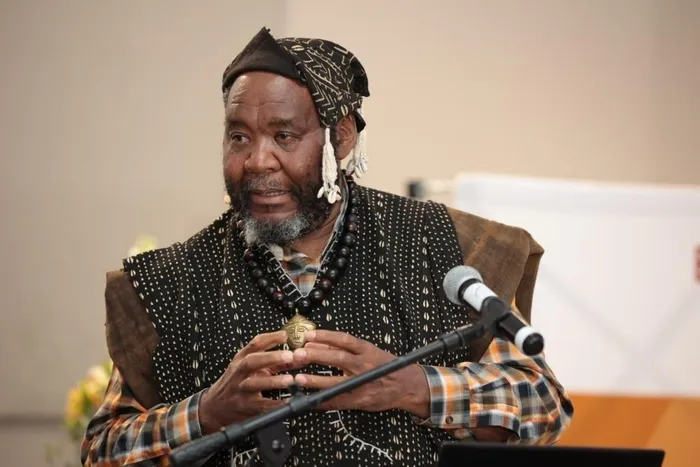
Dr Pali Lehohla is a Professor of Practice at the University of Johannesburg, a Research Associate at Oxford University, and a distinguished Alumni of the University of Ghana. He is the former Statistician-General of South Africa.
Image: Supplied
My responsibility for being the Statistician-General of South Africa from 2000 to 2017 presented me with a privilege to serve.
When confronted by the Census of 1996, I had a faint idea that my father was involved in the Census of Lesotho in 1966.
What I remembered quite vividly was the brown Afrikaner Ox that I named Census.
Little did I know that at some point posthumously I would get the memoirs of my father – the original census taker in Hermon Lesotho.
My late father Kenneth Job Lehohla wrote that on the 18-04-1966 that on the 14th of April Lesotho mounted its first Census of the Population and teachers were deployed to undertake this crucial national effort.
He was responsible for counting people in Hermon where he was teaching, Mankeng was counted by Mpitso, Tsupane Gate was counted by Monaheng Tjeka, and Nkoko counted Mofoka.
He concluded his task within four days by 17-04-1966. My father made the following observations as he undertook the count. He notes in his memoir that all the surrounds where he undertook enumeration of the population the surrounds were very neat and clean.
In fact, as he took his surrounds some households were still busy cleaning the surrounds. In counted some houses he visited he noted that the furniture was of a high price tag.
But he also notes in his memoir that other households were dirt poor and you wonder how they make ends meet on a daily basis.
When presenting what he describes in long hand, a privilege he generously passed onto me, I cannot but understand the passage of time.
Six decades on, the poverty he witnessed is poverty we witness today.
Whilst this is so, it is important to point at the depth of analysis I am privileged to present with much deeper analysis and when exposed to better technology. Yet the observations sixty years on are the same. How on earth are the wretched of the earth engulfed in poverty make ends meet.
Reflecting on my tenure as the Statistician-General of South Africa, I explore the enduring challenges of poverty and the evolution of census data from my father's experiences in Lesotho to today's South Africa.
Image: Supplied.
Sixty years on from the census he reported on for my village of birth Hermon, I am privileged to report on the 2022 Count of South Africa, but with better technology and possibility of making a multidimensional expose of challenges that the people of Soweto face.
In this column through an integrated analysis that is georeferenced we can understand the challenges of Soweto at lower levels of geography.
These include Protea, Diepkloof, Jabulani, Zola, Chawelo and Kliptown amongst others.
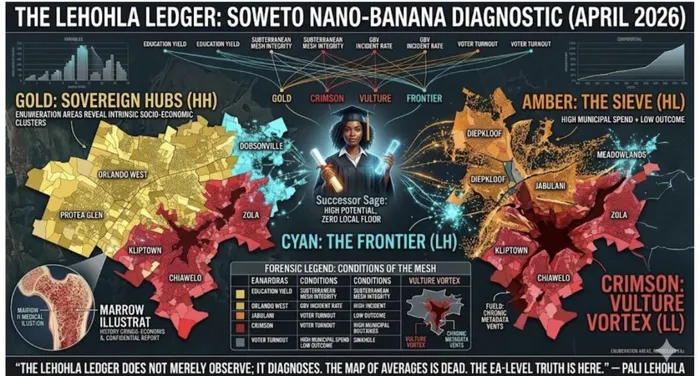
To understand what confronts Soweto just as what confronted Hermon in 1966, I use the Local Indicators of Spatial Association to illustrate the challenges faced by the suburbs of Soweto.
The map is split into four quadrants.
Each of the quadrants represent the LISA.
The LISA relates to birds of a feather that flock together (clusters). For instance, the LISA is coloured in Gold – the Sovereign Hub, Amber – The Seive, , labelled the Sovereign Hubs, Cyan-The Frontier Hub and Crimson which is the Vulture Vortex.
Driving these clusters are the variables at the heading of the map and the interactions of this drivers.
Reading this from the top we can identify the role of Education yield and the disruptive subterrain that is crimson.
This illustrates how the subterrain of crimson undemines the effort of eduction and the drivers of this subterrain are GBV. But more importantly as we face the local government elections we can assess ahead of time of elections what the voter turnout is likely to be.
The Lehohla Ledger is endowed with 2752 instruments that interrogate the evidence and draw a conclusion of the trajectories of different age and race cohorts by geography are going to traverse.
With Local Government Elections faced with a prospective low turnout, the drivers of such are in our face. Is there something that can be done to improve turnout.
The Ledger probably provides a unified basis that society can deploy to ensure that at the minimum society understands itself.
Understanding oneself is a mirror and constitutes one of the conditions Morena Mohlomi’s code of responsible leadership espouses.
The picture presented in Soweto fifty years since June 16 is not a pleasant one.
The question the 1976 leadership has to confront is what legacy are they handing over to the leadership of 2026 and what are the new instruments of power the 1976 cohort provide as guides.
Further question is what will the 2026 leadership hand over to the 2076 leadership in 2076.
These are the issues the Lehohla Ledger applying Morena Mohlomi principles answers.
Dr Pali Lehohla is a Professor of Practice at the University of Johannesburg, a Research Associate at Oxford University, and a distinguished Alumni of the University of Ghana. He is the former Statistician-General of South Africa.
Follow Business Report on Facebook, X and on LinkedIn for the latest Business and tech news.