

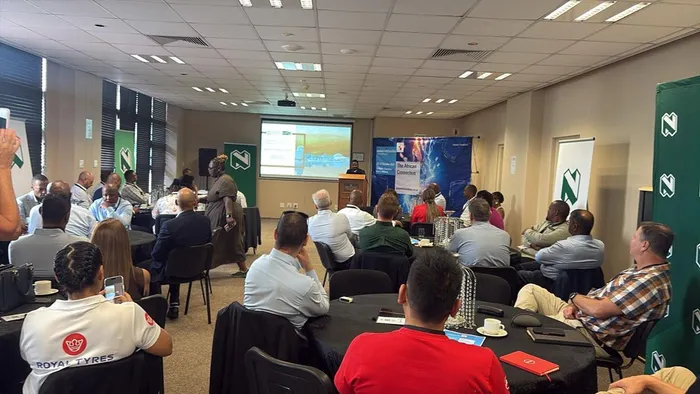
Automechanika Johannesburg CEO Breakfast took place at the Durban Chamber of Commerce and Industry on Friday with a focus on KwaZulu-Natal's Automotive Strengths.
Image: Supplied
KwaZulu-Natal’s automotive industry is showing renewed strength, with business leaders and policymakers highlighting growing exports, rising confidence, and emerging opportunities in electric vehicles (EVs) and the aftermarket sector.
This was the central message at the Automechanika Johannesburg CEO Breakfast, held at the Durban Chamber of Commerce and Industry last week, where stakeholders unpacked the province’s economic trajectory and industrial potential.
Meschack Zwane, company economist at Trade and Investment KwaZulu-Natal, said the province’s economy expanded by 1.4% in 2025, supported by a strong rebound in agriculture and a sharp increase in automotive exports.
“Business confidence reached a record 60 points in Q4 2025. KwaZulu-Natal is open for business, and the numbers back that up. Belgium has overtaken the United States as our largest export partner, and the UAE recorded export growth of nearly 180%,” he said.
Zwane added that these are not incremental gains; they signal a seismic shift in how the world sees KZN as an automotive hub.
“The conditions are right. The question is whether we are bold enough to seize them.”
Tshetlhe Litheko, chief policy officer at the Automobile Business Council, pointed to improvements in South Africa’s automotive production, which reached 618,077 vehicles in 2025, alongside a 15.7% increase in domestic sales.
However, he acknowledged a 22.8% decline in exports, describing it as an opportunity to reposition the industry strategically.
“South Africa has the industrial base, the policy framework, and the talent to be a serious player in the global transition to new energy vehicles,” Litheko said.
“The 150% investment allowance for EV production is a direct signal from the government that this is a priority. Disruption creates space for those who are prepared, and South Africa has every reason to be prepared.”
From a financial perspective, Takatso Sello, senior manager for manufacturing at Nedbank, emphasised the importance of sustainability in navigating cost pressures facing manufacturers.
“The manufacturers who will thrive are those who treat sustainability not as a compliance exercise, but as a competitive advantage. Nedbank is committed to being a financing partner for that transition because the business case is clear, and the window of opportunity is now,” Sello said.
Meanwhile, Anton Fiets, executive manager for industry development at the Automotive Industry Development Centre (AIDC), highlighted the growing importance of the aftermarket segment.
“The AIDC's Township Automotive Hubs initiative provides workshop bays, diagnostic tools, and technical training to township-based businesses, while its Manufacturing Centre of Excellence builds skills in mechatronics, EV systems, and Industry 4.0 technologies,” he said.
Fiets added that the aftermarket is not a footnote in South Africa's automotive story; it is a chapter in its own right.
“When we invest in township workshops and advanced technical training, we are building an economy that works for everyone.”
Michael Dehn, managing director of Messe Frankfurt, said that the engagement highlighted a clear recognition of where the opportunities lie and a determination to act on them.
“KwaZulu-Natal has the exports, the confidence, and the infrastructure to lead. Automechanika Johannesburg exists to give industry leaders the platform, the data, and the connections to turn that potential into results,” Dehn said.
The next CEO Breakfast is expected to take place on 7 May 2026 in Gqeberha.
BUSINESS REPORT