

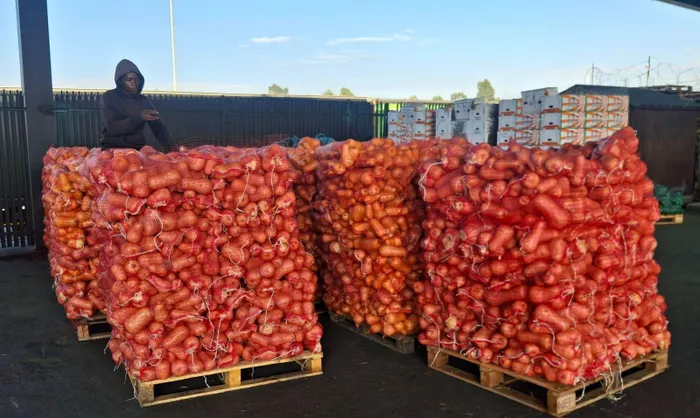
A report by cross-border payments platform Verto has indicated that volatile currency conditions are impacting fruit importers' profitability.
Image: Timothy Bernard / Independent Newspapers
Volatile currency markets are emerging as a major threat to the profitability of fruit importers and exporters, with a new report by Verto warning that foreign exchange (FX) fluctuations are increasingly undermining already thin margins in global agricultural trade.
According to the report, the traditional risks associated with fruit trading—such as weather, logistics and harvest cycles—are now being overshadowed by financial pressures linked to currency movements and outdated payment systems.
“Harvest cycles are short, logistics are complex and margins are thin. But increasingly, the greatest risks facing importers and exporters are not in orchards or shipping routes, they are in currency markets and financial infrastructure,” stated the report.
The report added that fresh produce shipments can take 30 to 60 days to move from orchard to retailer.
“During that period, currency markets may move dramatically, affecting landed costs, margins, and working capital. A shipment that leaves port profitable can arrive weeks later with its margin significantly eroded by exchange rate movements.”
The report said that despite this, many agricultural trading businesses still rely on legacy banking infrastructure and reactive FX management, exposing themselves to unnecessary financial risk.
“For decades, the economics of fruit importing and exporting were shaped by familiar forces: weather patterns, harvest cycles, shipping routes and market demand,” it said.
“But in the past five years, a new set of pressures has emerged. Global supply chains have become more fragile, freight costs more unpredictable and currency markets more volatile. Several structural shifts are driving this change.”
The report added that in this environment, logistics resilience alone is no longer enough; financial resilience is becoming a defining factor in long-term competitiveness.
“Many fruit exporters operate in emerging economies where currencies have experienced significant fluctuations in recent years. African currencies in particular have faced repeated depreciation cycles against the US dollar.”
The report said that interest rate increases across major economies have strengthened the dollar, amplifying volatility in global FX markets.
“Geopolitical tensions and trade realignments are reshaping trade corridors, introducing new financial and operational risks.”
The report added that across many fruit trading corridors, average operating margins range between 5% and 10%.
“Currency volatility across emerging markets often exceeds this range. In practical terms, this means currency risk alone can wipe out the majority of a trader’s profit margin.”
The report said that in agricultural trade, relationships between buyers and growers are critical.
“During tight harvest seasons, suppliers often prioritise buyers who offer the most reliable and predictable payment terms. Slow cross-border payment systems can therefore have indirect commercial consequences.”
The report added that in this way, payments infrastructure influences supply chain access, not just financial efficiency.
“Businesses that can pay instantly or predictably often secure stronger supplier relationships and better allocation during high-demand seasons. Modern fintech platforms can process cross-border payments up to 5x faster than traditional banking systems, significantly improving payment predictability.”
The report said that agricultural traders are exposed to currency risk across several stages.
“The highest risk period often occurs during shipment transit, when goods are already en route but payments have not yet been made,” stated the report.
“During this period, businesses are exposed to currency movements without the ability to adjust prices or renegotiate contracts. Structured hedging strategies can significantly reduce this exposure window.”
The report added that fruit importers are increasingly adopting integrated financial systems to manage both currency risk and cross-border payments more effectively.
“Supply chain resilience has traditionally focused on logistics. But in an era of global volatility, financial infrastructure is emerging as an equally critical pillar.”
The report concluded that businesses that optimise both the movement of goods and the movement of capital will define the future of global agricultural trade.
BUSINESS REPORT