

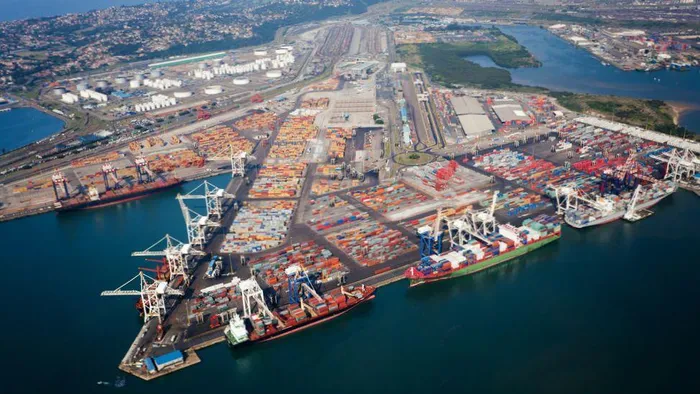
The South African Association of Freight Forwarders has cautiously welcomed Transnet's announcement last week that they recorded a strong operational recovery during the 2025/26 financial year, with vessel traffic rising by 9% year-on-year. .
Image: File
The South African Association of Freight Forwarders (SAAFF) has cautiously welcomed signs of operational improvement at Transnet after the State-owned logistics group announced stronger vessel traffic performance during the 2025/26 financial year.
Transnet said last week that vessel arrivals at South African ports rose by 9% year-on-year, signalling what it described as a strong operational recovery across its port system.
However, Dr Jacob van Rensburg, head of research and development at the SAAFF, said while the trend was encouraging, the industry should avoid drawing premature conclusions about the overall health of the country’s logistics network.
“Transnet’s media statement reports 8,630 vessel arrivals in FY2025/26, compared with 7,912 in FY2024/25, implying an increase of 718 arrivals, approximately 9.1%,” he said.
“However, by my own calculation using the vessel-arrival figures available to me based on the Transnet website, FY2025/26 appears closer to 9,380 arrivals versus 8,913 in FY2024/25, which implies an increase of 467 arrivals, or 5.2%.”
Despite the discrepancy, Van Rensburg noted that the overall direction remained positive.
“I would be careful about latching too strongly onto the “increased vessel arrival” narrative. It is useful evidence of recovery, but it is not the point in itself. Vessel calls are an important activity indicator, but they do not automatically prove that the port system is functioning optimally,” he said.
“The more important questions are whether volumes are increasing, whether cargo is moving more reliably, whether berth and landside productivity are improving, whether dwell times and anchorage delays are reducing, and whether the system is becoming structurally more competitive.”
Van Rensburg said that in that sense, the improvement indicates that Transnet’s ports are operating better than at the bottom of the cycle.
“There has clearly been some recovery in operational coordination, equipment availability, terminal performance, and cargo-handling momentum. And a certain level of credit needs to go to Transnet. However, there is an important caveat,” he said.
“These numbers should be interpreted in the context of a low base. South Africa’s port system has been through several years of underperformance, congestion, equipment constraints, vessel delays, and declining confidence. A positive annual movement is welcome, but it does not yet amount to full recovery.”
Van Rensburg argued that the more important indicators were whether cargo volumes were increasing consistently, cargo movement had become more reliable, and operational efficiencies within the ports were improving.
“Similar to the GOCH diversion narrative, increased vessel arrivals can be misread as proof of structural competitiveness when it may partly reflect routing, timing, backlog, cargo-cycle, or external-market effects,” he said.
“The Strait of Hormuz situation, for example, is different from the Red Sea crisis. The Red Sea disruption created a route-lengthening shock through large-scale rerouting around the Cape of Good Hope.”
South Africa’s ports have endured years of operational difficulties, including severe congestion, equipment breakdowns, vessel delays and declining confidence from shipping lines and exporters.
“Hormuz is more of a regional access, risk-premium, and capacity-immobilisation shock around Gulf-linked flows. It does not automatically translate into the same kind of sustained South African port upside,” added van Rensburg.
Van Rensburg acknowledged that Transnet deserved some credit for stabilising operations after a prolonged period of underperformance.
van Rensburg concluded that whether this proves that Transnet’s Reinvent for Growth strategy is working, he would say: partly, but not conclusively.
“The numbers support the view that recovery interventions are beginning to yield measurable improvements. They have not yet proved that the deeper structural reform agenda has succeeded,” he said.
“For that, we would need sustained multi-year evidence of higher throughput, improved productivity, lower logistics costs, better rail-port integration, credible private-sector participation, improved infrastructure execution, transparent performance reporting, and better service reliability.”
BUSINESS REPORT