

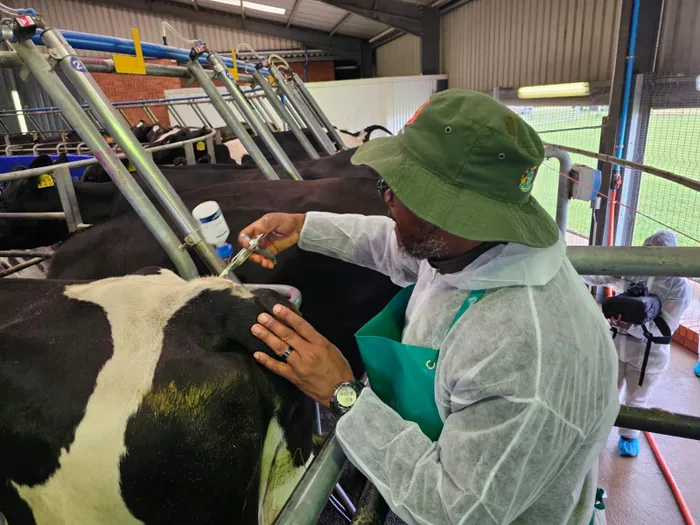
Cattle vaccination underway at the Colbourne Diary farm near Mooi River. FMD Response SA said the key issue is not the quality of the vaccines, but the speed, scale and synchronisation of the rollout.
Image: X
FMD Response SA has called for urgent clarity on South Africa’s foot-and-mouth disease (FMD) vaccination strategy, warning that the current rollout approach risks failing to contain the virus unless it is aligned with the biological realities of the disease.
The industry body on Wednesday raised concerns following remarks made by Agriculture Minister John Steenhuisen during Friday’s agriculture budget vote, where he indicated that government aims to achieve an 80% vaccination rate by the end of the year and that booster shots would be required six months after the first vaccination round.
Spokesperson Andrew Morphew said if government intends to vaccinate cattle over the course of the year and then administer boosters six months later, the campaign timing would undermine the effectiveness of the programme.
“If the goal is to vaccinate the country’s cattle once and then offer a booster after six months, then the first vaccination round cannot run until December,” Morphew said.
He noted that the first animals were vaccinated in February, meaning the initial vaccination campaign would need to be completed by August to avoid situations where animals vaccinated earlier require boosters before others have even received a first dose.
FMD Response SA said the key issue is not the quality of the vaccines, but the speed, scale and synchronisation of the rollout.
“A vaccine that offers immunity for six months does not give the government six months to vaccinate, as suggested. To stop transmission effectively, vaccination must be administered rapidly enough to create simultaneous immunity across the herd.”
“Without tightly managed, synchronised vaccination within windows of six to eight weeks, the virus is likely to persist in the environment and continue spreading between vaccinated and unvaccinated herds,” said FMD Response SA.
Morphew said that we need a wall of vaccine to stop the virus spreading.
“The best way to control FMD is to ensure cattle have simultaneous immunity. This can only be achieved through vaccination at speed and scale. Waiting until December to vaccinate the country’s cattle will not achieve that objective,” he said.
The warning comes as new FMD cases continue to emerge in parts of KwaZulu-Natal. FMD Response SA said dairy cattle on at least two farms in the province contracted the virus despite being vaccinated in March.
However, Morphew stressed that these incidents should not be interpreted as vaccine failure.
“They show the risk of rollout failure. Vaccinated animals remain vulnerable when they are surrounded by unvaccinated herds and when immunity is not achieved across an area at the same time.”
FMD Response SA pointed to countries such as Brazil and Argentina as examples of successful FMD control strategies, noting that both countries relied on tightly controlled cyclical vaccination programmes conducted within short timeframes and supported by private sector participation.
“South Africa needs to urgently adopt the same disciplined approach and should stop measuring progress only by the number of doses ordered, imported or held in storage.”
Morphew added that vaccine stockpiles alone would not stop the spread of the disease.
“Doses in cattle, administered fast enough to create synchronised immunity, do. The Minister’s speech confirms the need for greater clarity. Doses imported are not herd immunity",” he said.
“Doses administered slowly over a year are not herd immunity. South Africa needs a structured vaccination campaign with strict start dates and end dates designed around the biology of FMD, not around administrative milestones.”
BUSINESS REPORT