

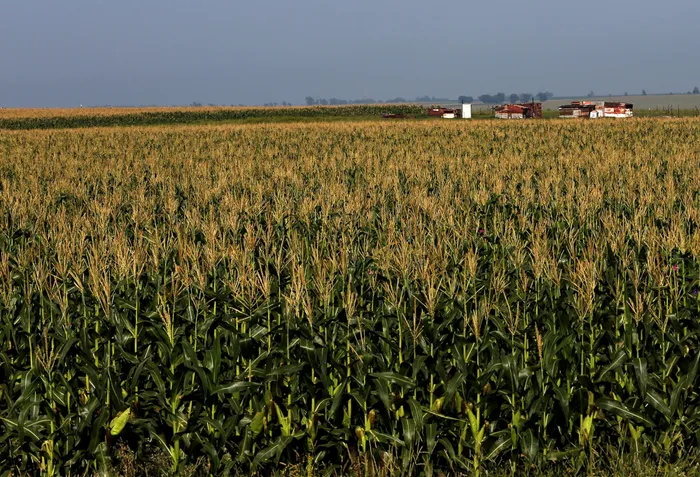
The latest report from the Crop Estimates Committee (CEC) indicates that the size of the expected commercial maize crop has been set at 17.064 million tons, which is 1.36% or 228,940 tons more than the previous forecast of 16.835 million tons. CEC said that this is the largest maize crop on record.
Image: File
South Africa is on track to produce its largest maize harvest on record, according to the latest report from the Crop Estimates Committee (CEC), with economists and agricultural experts saying the bumper crop could help ease pressure on food prices and livestock feed costs.
The CEC’s latest production forecast places the expected commercial maize crop at 17.064 million tons, representing an increase of 228,940 tons or 1.36% from the previous estimate of 16.835 million tons.
The committee said the expected crop is also 2.03% larger than the 2025 harvest, reflecting favourable growing conditions, expanded planting areas and improved yields across major producing regions.
“The estimated maize crop is 2.03% or 339,040 tons more than the 2025 crop. The three main maize producing areas, namely the Free State, Mpumalanga and North West provinces are expected to produce 82% of the 2026 crop,” noted the CEC report.
The latest estimates also showed improvements in both white and yellow maize production forecasts.
White maize production is now expected to reach 9.179 million tons, which is 94,040 tons or 1.04% higher than the previous forecast of 9.085 million tonnes.
The area planted to white maize is estimated at 1.665 million hectares, with an expected yield of 5.46 tons per hectare.
Yellow maize production is forecast at 7.885 million tons, up 134,900 tons or 1.74% from the previous estimate of 7.750 million tons. The area estimate for yellow maize is 1.052 million hectares, while expected yields are forecast at 7.50 tons per hectare.
The CEC noted that yield estimates for the Free State and North West provinces were largely based on scientific and objective assessments conducted by the Agricultural Research Council (ARC).
The report also pointed to strong growth in sunflower seed production, with the crop forecast rising to 877,680 tons — an increase of 56,050 tons or 6.82% from the previous estimate.
The area planted to sunflower seed is estimated at 570,100 hectares, with expected yields of 1.54 tons per hectare.
Wandile Sihlobo, chief economist at Agricultural Business Chamber of South Africa (Agbiz), described the outlook as reassuring amid ongoing global concerns around food security and agricultural supplies.
Sihlobo added that this monthly and yearly improvement in the overall harvest is underpinned by upward revisions to major grains and oilseeds, particularly maize, soybeans, and sunflower seed.
“If we zoom in on the major grains, the 2025-26 maize production estimate is 17.1 million tons, up 2% from last season, and the largest harvest on record. This is due to the back of expansion in area plantings and the expected large yields,” he said.
“Such a maize crop, combined with likely large carryover stocks from the current season, signals that South Africa will once again remain a net exporter of maize in the 2026-27 marketing year (this corresponds to the 2025-26 production season). South Africa’s annual maize consumption is 12.0 million tons.”
The bumper harvest has also raised hopes of improved affordability for consumers, particularly lower-income households that rely heavily on maize-based foods.
Mervyn Abrahams, director of the Pietermaritzburg Economic Justice and Dignity Group (PMBEJD), said maize remains a key staple ingredient used in products such as maize meal, maize rice, maize flour and samp.
“When there is a low harvest, it usually means that the products made from the primary source are going to be scarce and in most cases result in high prices,” Abrahams said.
The poultry sector could also benefit significantly from the stronger maize outlook.
Dranca Neo Phalatse, postgraduate coordinator at the faculty of natural and agricultural sciences at the University of Pretoria, said maize is one of the primary ingredients used in poultry feed.
"An increase in maize production usually improves the availability of feed grain in the domestic market, which may assist in easing pressure on feed costs," she said.
"Since feed constitutes a significant portion of poultry production costs, a larger maize harvest could provide some relief to poultry producers."
However, she cautioned that lower feed prices would still depend on several other variables, including international maize prices, exchange rates, transport and logistics costs, soybean prices and broader market conditions.
BUSINESS REPORT