

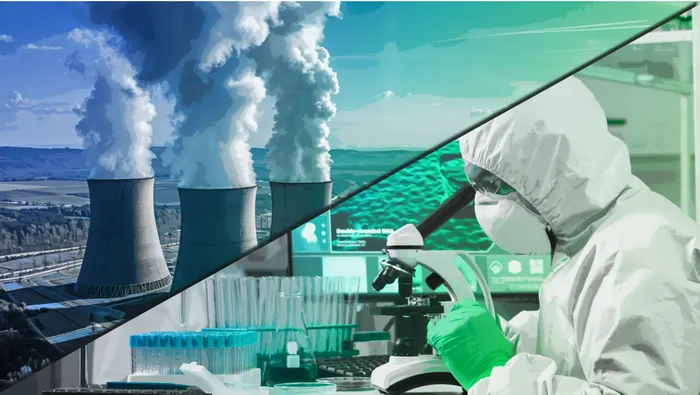
Discover how the rapid rise of AI is driving unprecedented energy demands in data centres, and learn about the transformative potential of sustainable liquid cooling solutions to meet these challenges head-on.
Image: DC Studio/Adobe Stock; Александр Марченко/Adobe Stock
Today, single AI query uses roughly ten times the electricity of a typical Internet search, and demand is climbing at lightning speed.
In fact, projections suggest data centres could account for approximately 3% of total global electricity consumption by 2030, nearly doubling their current share and, significantly, growing four times faster than the growth of total electricity consumption from all other sectors.
The result, a massive amount of heat generation which leads to a thermal challenges legacy data centres simply weren’t designed to handle. Traditional air cooling, the long-time workhorse of data centres, is being pushed to its practical limits by high-performance, high-density racks.
To unlock AI's full potential, data centres must move beyond the status quo and embrace advanced, sustainable liquid cooling.The move to high-density, liquid-cooled infrastructure
As mentioned, AI workloads are breaking the cooling mould and pushing rack power densities to new norms. Current rack densities can range from 40 kW to well over 100 kW, which is impractical to manage with air cooling.
Also, demands continue to climb rapidly with each new generation of GPU-accelerated servers.
For example, a fully populated NVIDIA-based GPU racks draws around 132 kW, and that number is set to rise.
The next generation, expected within a year, is projected to reach 240 kW per rack, and the industry is already preparing for future power densities of 1 MW per rack.
Unlike standard Central Processing Units (CPUs), the Graphics Processing Units (GPUs) and other AI accelerators that power these AI models generate intense, concentrated heat loads that require targeted, highly efficient cooling to maintain optimal performance.This is where liquid cooling becomes mission critical. Impressively, direct liquid cooling is up to 3,000 times more effective and more efficient at removing heat than air. Why? Because it captures heat directly at chip-level.
Not only can liquid cooling cut energy use by 30-60%, it can also eliminate water consumption altogether, providing efficiency gains that adiabatic air cooling simply can’t match.
In turn, savings in energy and water directly translate into carbon footprint savings. Yet even as adoption of liquid cooling rises, its full sustainability impact remains less understood compared to traditional air cooling.
Thus, to understand liquid cooling’s significance and broader adoption, we need to look deeper look into several data centre design and operational levers:
Energy Use: Next to IT systems, the cooling system is the second-biggest energy consumer for data centres. For this reason, potential energy savings can be significant, making this a primary sustainability consideration for liquid cooling deployments.
Energy use is driven by a range of design and operational decisions, from foundational site selection and climate considerations to detailed factors like heat rejection systems and IT inlet fluid temperature set points.
Water UseWater use in data centres can vary widely depending on factors such as heat rejection system design (evaporative or adiabatic cooling), local climate, and IT inlet fluid temperatures.
Because the liquid cooling loop is a closed system, racks themselves do not consume water directly. However, the data centre’s overall water footprint is still influenced by how heat is ultimately rejected outdoors.
Operating at higher temperatures, liquid cooling can reduce reliance on outdoor water for heat rejection. Like energy use, water consumption remains a direct and measurable environmental impact that operators can manage and optimise.
Greenhouse Gas (GHG) EmissionsWhile the carbon footprint is influenced by decisions made throughout the cooling system’s lifecycle, such as component selection and water use, it is primarily driven by energy consumption, especially if the grid relies heavily on fossil fuels.Another lever to keep in mind is coolant toxicity. While direct-to-chip liquid cooling is deployed as a closed-loop system, safe operations and responsible disposal are critical.
Future-proofing AI infrastructure
Moving to liquid cooling requires careful planning and a forward-looking strategy.
Here's a practical blueprint to follow:
There is no doubt liquid cooling is the foundation for sustainable, high‑density AI data centres. It offers far superior removal of heat whilst also reducing water and energy waste, setting the benchmark for resilient, future‑ready infrastructure.
Steven Santini, Secure Power Vice President, Schneider Electric Sub-Saharan Africa.

Steven Santini, Secure Power Vice President, Schneider Electric Sub-Saharan Africa.
Image: Supplied.
Follow Business Report on Facebook, X and on LinkedIn for the latest Business and tech news.