

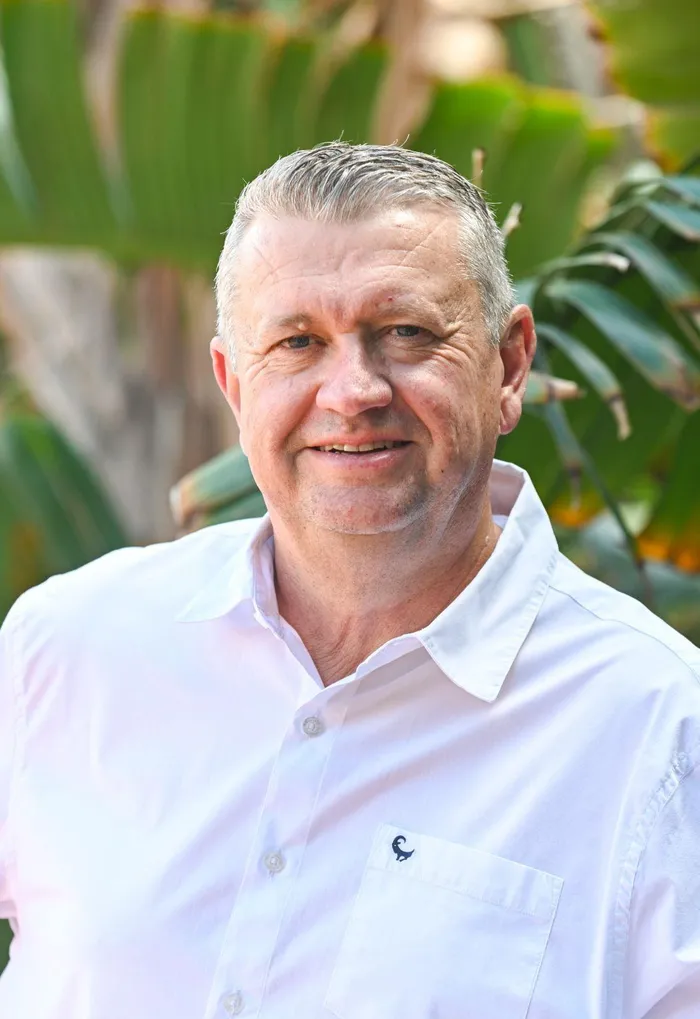
Thomas Garner holds a Mechanical Engineering degree from the University of Pretoria and an MBA from the University of Stellenbosch Business School.
Image: Supplied
The current oil shock is a reminder that energy dependence is never merely an economic issue.
It is a sovereignty issue. As conflict in the Gulf has intensified, disruption around the Strait of Hormuz has taken a meaningful share of global oil and LNG supply offline, driving volatility in energy markets.
Brent crude has traded above $100 a barrel in recent weeks, with analysts warning that prices could remain elevated if instability continues.
Facing potential increases of around R5.20 per litre for petrol and R8.80 per litre for diesel, the lesson for South Africa is straightforward.
Petrol and diesel prices are not determined in Pretoria.
They are shaped by shipping routes, wars, exchange rates and decisions taken far beyond our borders.
A country that imports fuel at scale imports volatility with it.
Maintaining strategic crude oil reserves without sufficient refining capacity does little to change that exposure.
This is why the debate about South Africa’s energy future should move beyond decarbonisation language alone.
The more immediate issue is freedom from imported fuels whose price and availability lie outsideour control.
South Africa already understands this problem in electricity.
Load shedding demonstrated the economiccost of dependence on a failing central system.
The same principle applies to liquid fuels.
If transport, industrial heat and distributed energy systems remain tied to imported hydrocarbons, then inflation,logistics costs and household expenditure remain exposed to shocks that domestic policy cannot contain.
The strategic response is electrification.
The world is moving toward what can be called the electro-state: an economy in which electricity becomes the dominant operating energy across transport, industry, buildings and digital systems.
This shift is no longer theoretical. It is becoming visible in technology, manufacturing and infrastructure.
China provides the clearest large-scale example.
The country leads the world in solar manufacturing,battery production and electric vehicle deployment.
Each new technological advance compresses the gap between electricity and fuel.
BYD’s latest battery and flash-charging announcement illustrates the pace of change.
The company recently unveiled a second-generation Blade Battery capable of charging from 20% to 97% in under twelve minutes while maintaining high performance even in extremely cold conditions.
At the same time,BYD plans to expand its flash-charging network to 20 000 stations by 2026.
Range is now above 1000km per charge.
The importance of developments like this goes beyond one manufacturer.
Electric vehicles have longfaced three practical objections in South Africa: range, charging time and infrastructure.
Advances in battery technology and charging systems are steadily weakening those constraints.
They also shift the strategic centre of gravity from imported fuel to domestic electricity.
A vehicle charged from local solar, wind and storage operates within a different risk environment from one dependent on imported petrol or diesel.
Electricity tariffs and network capacity are domestic policy variables that can bereformed.
A war in the Gulf cannot.
South Africa should therefore begin treating electrification as an economic security project.
Several practical steps follow from that logic.
First, electricity reform must continue with urgency.
Grid expansion is central.
Transport electrification cannot scale if transmission and distribution networks remain constrained.
Faster build-out of the grid,clearer municipal wheeling frameworks, an operational wholesale electricity market and pricing structuresthat support investment all form part of this effort.
Second, industrial policy should shift toward the electrification value chain.
Batteries, charging systems, power electronics, grid equipment and electric mobility components will define the next generation of industrial production.
South Africa does not need to manufacture every component, but it does need a credible strategy to localise segments of the value chain where mineral resources, technical skills andindustrial capacity offer advantages.
Third, fuel substitution should proceed sector by sector.
Passenger vehicles will electrify more rapidly than freight transport. Urban buses and commercial fleets represent practical early opportunities.
Industrial heat will require a mix of electrification, storage and alternative fuels.
The objective is not uniformity but steady reduction in oil and gas dependence.
Fourth, tariff design should support the transition.
Households and firms that invest in solar, batteries,demand management and electric mobility should face pricing structures that reward flexibility and efficient use of the system.
Energy security must therefore be understood more broadly than fuel procurement alone.
In an era of volatile oil routes and shifting geopolitics, security increasingly depends on the ability to generate, store and use electricity domestically across the economy.
There will be no immediate exit from liquid fuels.
South Africa will continue to rely on them for years.
Yet dependence can be reduced.
Each electric bus deployed, each charging corridor established and each additional megawatt connected to the grid shifts the balance.
The deeper point is simple.
The electrotech future is no longer about virtue.
It is about resilience. Countries capable of producing more of their operating energy domestically will remain less exposed togeopolitical disruption.
Those that continue importing strategic fuels at scale will remain price takers in crises they did not create.
South Africa has the solar and wind resources, technical skills and industrial base to move faster in this direction.
What is required now is a policy framework that treats electrification as a route to economic freedom rather than as a secondary element of climate policy.
Thomas Garner holds a Mechanical Engineering degree from the University of Pretoria and an MBA from the University of Stellenbosch Business School. Thomas is self-employed focusing on energy, energy related critical minerals, water and communities. He is a Fellow of the South African Academy of Engineering and a Management Committee member of the South African Independent Power Producers Association.
*** The views expressed here do not necessarily represent those of Independent Media or IOL.
Follow Business Report on Facebook, X and on LinkedIn for the latest Business and tech news.