

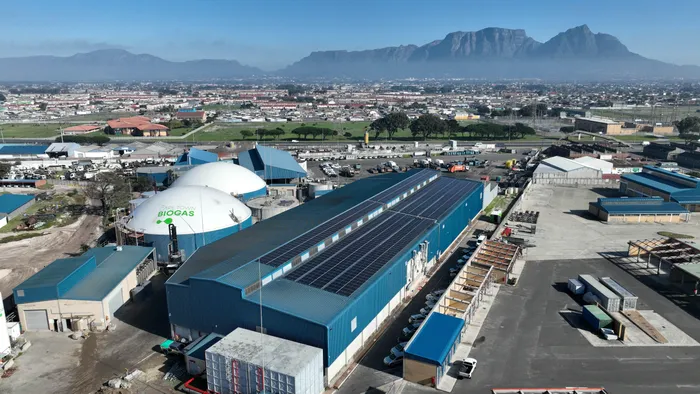
Installation by RenEnergy at Cape Town Biogas, featuring a 324.3 kWp solar PV system.In a rapidly expanding renewable energy market, distinguishing between a promising EPC partner and a risky choice will be vital in determining whether investments result in financial success or costly mistakes.
Image: Supplied.
As South Africa’s renewable energy market finds its footing amid electricity supply instability and rising tariffs, businesses are increasingly investing in private energy infrastructure.
This shift holds profound implications for sectors ranging from mining to logistics, as companies seek to manage energy costs, reduce reliance on the national grid, and secure long-term power supply.
With commercial solar installations, hybrid systems, and off-grid solutions becoming key components of business strategies, the emphasis is now shifting from merely adopting renewable technology to carefully selecting the partners who will build and maintain that infrastructure.
The choice of engineering, procurement, and construction (EPC) partner is emerging as perhaps the most critical decision in the renewable energy landscape.
Given that energy projects often have multi-decade lifespans, companies must recognise the long-term consequences of choosing an inexperienced or unqualified EPC provider.
Poor engineering, unqualified contractors, and insufficient operational support can not only jeopardise safety but also diminish the anticipated financial benefits of these investments.
South Africa's regulatory changes have reshaped the commercial and industrial renewable energy market, leading companies to forge long-term partnerships with private energy providers.
Claude Peters, Managing Director at RenEnergy, noted that this has resulted in fundamental transformations in decision-making processes.
“In the past, businesses effectively had one electricity supplier. Now, the decision shouldn’t be driven by cost alone; there are several other important factors to consider,” Peters said.
The longevity of renewable projects means that selecting a robust EPC partner transcends simple cost analysis.
A stark illustration Peters provides is that two identically sized solar systems can yield vastly different energy outputs due to the quality of engineering involved.
A well-designed project might outperform a poorly designed counterpart by as much as ten per cent each year.
Over two decades, this variance translates into a significant energy yield difference.
“Renewable infrastructure is not just about installing panels. It’s about engineering an energy system for reliability over decades,” he said.
As the market expands rapidly, it has drawn new operators—some with substantial engineering experience and others with little to none in large-scale project management.
Peters said that inexperienced providers can misrepresent their capabilities, which poses real challenges for businesses looking to install substantial energy infrastructure.
“Installing a few rooftop panels is a far cry from designing and building a complex commercial energy system,” he added.
The ramifications of poor choices can be dire, ranging from safety hazards to financial losses.
Businesses may find their systems underperforming due to substandard engineering or inadequate maintenance.
Business executives evaluating renewable energy projects must engage in a rigorous due diligence process when choosing an EPC partner.
Here are five essential criteria Peters advised that should guide their selection:
Sim Khuluse, Technical and Policy Manager of the South African Photovoltaic Industry Association (SAPVIA), reinforced that “quality in solar projects cannot be confined to installation alone. It must be embedded across the full lifecycle.”
With SAPVIA planning to launch a Working Group focused on Operations and Maintenance, industry stakeholders are actively working to raise standards.
Follow Business Report on Facebook, X and on LinkedIn for the latest Business and tech news.