

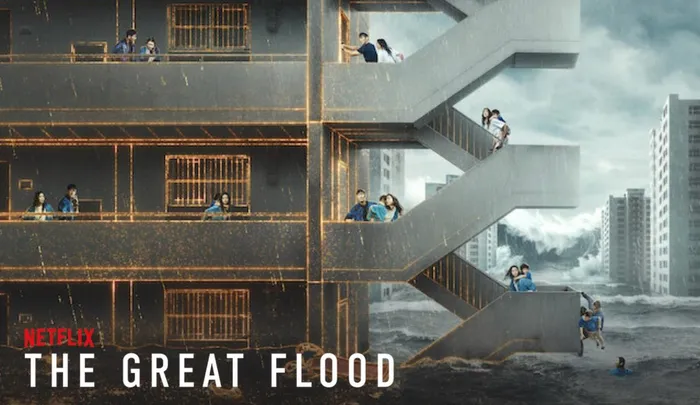
“The Great Flood” on Netflix is a Korean sci-fi film that initially promises a thrilling disaster narrative but ultimately reveals itself as a simulation-driven story about AI, leaving viewers with a mix of originality and disappointment. Picture: Netflix
Image: Netflix
I’m all for a good genre-bending movie or even a good twist in the tail, but in the Korean film The Great Flood currently streaming on Netflix, it’s a disaster that promises plenty and delivers little.
*Spoilers ahead
Don’t get me wrong, I enjoy a good sci-fi movie and most disaster films are obviously considered sci-fi.
However, with The Great Flood, after an intriguing first 45 minutes or so, we find out that this show isn’t actually about a massive worldwide flood with the constant threat of tidal waves lurking ominously.
At first, we learn that the mother (An Na) desperately trying to save her son (Ja In) from the rising water while making her way up the floors of her apartment building is actually some kind of programmer who designs a ‘human emotion engine’ for AI, which will help repopulate the Earth after an extinction event.
This is still fine, as she is promised a rescue from the impending flood that is basically going to destroy Earth.
But the fatal flaw in the plot comes when she is rescued with well over an hour left in the movie. The viewer then finds the day of the rescue starting all over again, and the events begin to repeat as An Na makes different choices, which lead to different outcomes.
Every time, though, after the initial rescue, she loses Ja In every time.
It becomes very clear that the rescue attempt is just a simulation, and that only by finding her son and actually saving him is the key to the rescue. It revolves around An Na listening to her whining son about his drawing that he has made for her.
The important thing here is that she creates a deeper, empathetic connection with her son, and the only way the emotion engine can be created successfully is if she does this.
Of course, An Na does this in the end, and the programming of the emotion engine is complete. Finally, we learn that the flood may not have happened at all, as the conclusion cuts to An Na being seriously wounded in a spaceship.
She tells her companion that she wants to be used as the basis for the emotion engine, which in turn explains why it was presumably her mission we witnessed for most of the film.
When the credits roll, you realise this was completely a story about AI, and the premise of a natural disaster was nothing but a simulation.
For me, this was disingenuous despite its originality. Ultimately, it was two stories that were woven together, but I found that they just never did effectively.