

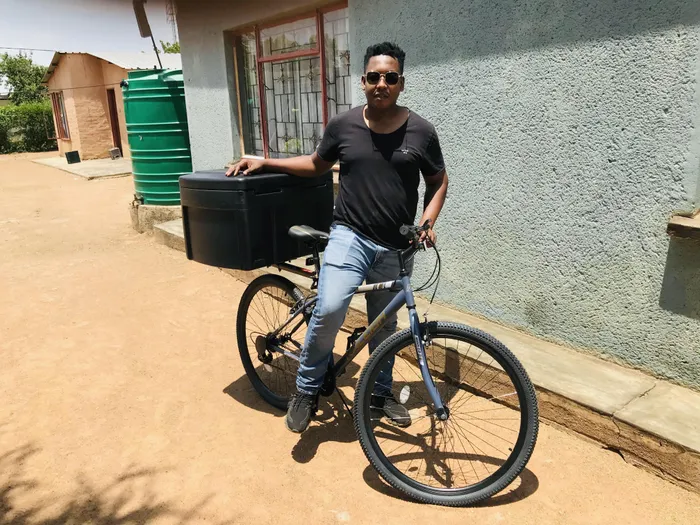
As a former Bolt driver operating in Gauteng townships, Kamogelo Lucas quickly realised that South Africa’s mobility systems were not designed with township realities in mind.
Image: Supplied.
Kamogelo Lucas is not building a delivery company from a boardroom. He is building it from lived experience.
As a former Bolt driver operating in Gauteng townships, Lucas quickly realised that South Africa’s mobility systems were not designed with township realities in mind.
His journey from driver to founder of Lupa Township Delivery reflects a deeper understanding of safety, trust and hyper local economics that traditional delivery platforms have struggled to address.
“A defining moment came when I realised I was only truly comfortable operating in my own township. I could not freely drive in places like Tembisa, Soweto, or Ivory Park, not because I did not want to, but because I did not have the same community network there,” Lucas told Business Report.
He described an informal but powerful protection system rooted in belonging.
“In my township, even if I do not personally know every taxi driver, I know someone who knows them. There is a layer of informal protection that comes from belonging. But outside of that, the risk increases significantly,” Lucas said.
Conversations with other drivers confirmed a pattern. Each felt safest operating within their own community.
When Uber Eats and Mr D withdrew from certain township areas due to security concerns, and retailers avoided expanding last mile delivery into these communities, Lucas saw both a gap and an opportunity.
“I had already started helping elderly residents collect essentials like maize meal and vegetables using a bicycle,. That small act showed me something powerful. Township delivery needed a community based solution,” he said.
That solution became Lupa Township Delivery.
Transitioning from earning daily income as a driver to building a long term business required a significant mindset shift.
“The biggest mental shift was moving from earning daily income to building something long term,” Lucas says.
The Bolt Accelerator Program, delivered in partnership with Pranary Business School, played a pivotal role in helping him structure that transition.
“It showed me that an idea that starts in one township can scale to a province and eventually nationally. My main challenge was understanding how to scale. Through the accelerator, I gained clarity on business stages, growth strategy and structured expansion,” Lucas said.
The programme equipped him with practical skills in pitching, financial modelling and investment readiness.
“I learned how to draft a pitch deck, present confidently, structure financial projections and approach investors. That structured learning turned Lupa from a lived experience idea into a credible, scalable business model.”
What began as a simple bicycle errand service for elderly residents is now an award winning concept. Lucas was selected from 120 applicants into the top three of the accelerator programme and won the Most Innovative Idea Award.
“I initially thought my idea was too simple,” he says. “Being selected from 120 applicants, then reaching the top three and winning Most Innovative Idea was beyond anything I imagined. It validated that simple, community rooted ideas can solve national problems.”
At the heart of Lupa’s model is a zero emission bicycle delivery network operated by community members.
“People often see bicycles as informal or small scale. I see them as efficient, sustainable infrastructure,” Lucas said.
He argued that within township delivery distances, bicycles can perform the same function as motorbikes at a fraction of the cost.
“A motorbike may be faster, but it comes with fuel costs, maintenance expenses and pollution. A bicycle is zero emission, low maintenance, affordable and reliable. Everything a motorbike can carry within township delivery distances, a bicycle can carry too.”
The model mirrors ride hailing platforms in one key respect. Riders use their own bicycles.
“For Lupa to be profitable and scalable, riders use their own bicycles, similar to how Bolt drivers use their own vehicles,” he explained.
“If we owned a fleet, costs would increase. People take care of what they own. By allowing riders to use their own bicycles, we lower barriers to entry and create shared responsibility.”
The first four bicycles operating in Soshanguve provided valuable lessons. Road safety and customer expectations were immediate considerations.
“Motorists can be impatient with cyclists. Education and awareness are critical,” Lucas added.
“Customers are used to motorbike speeds, so we had to educate them that bicycle delivery may take longer but it remains reliable. We offer live WhatsApp tracking once the order is collected, which builds transparency and trust.”
Trust, he emphasises, is the company’s strongest asset.
“Our riders are members of the community. They serve their neighbours, elders and families. Trust comes from being local.”
Beyond logistics, Lupa is designed as a socio economic intervention.
“Our riders are individuals who struggled to find employment, yet they possess deep knowledge of their communities. Now that knowledge generates income,” Lucas said.
“It keeps them active, away from crime and substance abuse, and allows them to support their families. When a customer knows that Thabo, son of Bra Oupa, is delivering their groceries, it builds personal trust. We are not just creating income. We are restoring dignity.”
Lucas believes township based logistics can redefine economic participation in South Africa. Many logistics workers originate from townships, yet large scale services rarely operate within those same communities.
“I envision partnerships with Takealot, Amazon, Woolworths and Shoprite, building local depots inside townships,” he said.
“I call this hyper localization. Serving communities from within, using community driven delivery networks.”
He argues that growing township economies is essential to reducing unemployment, crime and forced migration. “When big corporations partner with township businesses, everyone benefits.”
Winning the Bambelela Business Award strengthened Lupa’s credibility and provided capital to support expansion.
“The prize money will support rider onboarding, including delivery boxes, safety gear, service kits and training. This ensures every new rider entering the system is fully equipped as we expand township by township.”
Looking ahead, Lucas identifies technology infrastructure as the biggest scaling challenge. Automated systems for order management, rider onboarding and real time tracking will be critical as partnerships expand.
Yet he is clear that growth must not dilute the company’s identity.
“Growth must never replace our identity. We remain committed to hiring locally and serving communities from within. Lupa Township Delivery is from the township, for the township.”
In five years, he envisions operations beyond Gauteng, supported by township based depots and partnerships with major retailers.
“Private and public partnerships will work together to uplift township economies sustainably,” he says.
His advice to other drivers and informal workers is simple but powerful.
“Do not underestimate your idea. I once believed mine was too simple. Today, it is scalable. Your daily experience is valuable insight. Pursue it. Develop it. Refine it.”
“If I could turn lived experience into a business, so can you.”
BUSINESS REPORT