

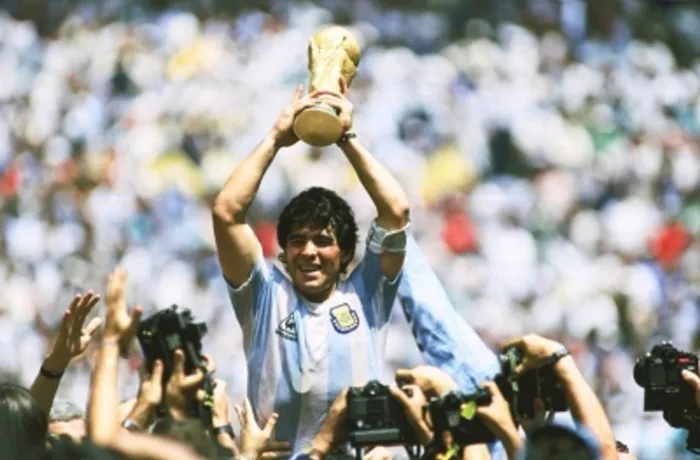
Diego Maradona led Argentina to the 1986 World Cup title in Mexico.
Image: IANS
As we mark four decades since the 1986 Fifa World Cup, we celebrate the absolute zenith of an individual genius carrying a collective to glory under the baking Mexican sun.
After Brazil's Pelé dominated the world stage from 1958 until 1970, it was now the turn of Diego Armando Maradona. Argentina’s mercurial No 10 did not merely play in a football tournament; he treated the sport’s greatest stage as his personal canvas, painting a masterpiece that was as deeply flawed as it was undeniably divine.
None more so than in the controversy-filled quarter-final against England, when he authored the two most famous goals in the history of the sport.
The first was when he illegally punched the ball with his fist over England goalkeeper and captain, Peter Shilton, into the net. Unnoticed by the referee and his assistants, Maradona and Argentina celebrated the "goal", which Maradona later referred to as "The Hand of God".
The second, just minutes later, was pure, unadulterated divinity. Receiving the ball in his own half, Maradona danced past five English defenders – Peter Beardsley, Steve Hodge, Peter Reid, Terry Butcher, and Terry Fenwick – before rounding Shilton and slotting it home. It came to be known as "The Goal of the Century".
In just four minutes, Maradona showed us the devil and the angel. He scored five goals in total – one short of Golden Boot winner, England’s Gary Lineker – and provided five assists, meaning he was directly involved in 10 of Argentina's 14 goals en route to driving Argentina to the championship title.
Africa: Algeria, Morocco
Asia: Iraq, South Korea
Europe: France, Hungary, Italy, Poland, Scotland, Spain, West Germany, England, Soviet Union, Denmark, Belgium, Bulgaria, Northern Ireland, Portugal
North America: Mexico (hosts), Canada
South America: Argentina, Brazil, Paraguay, Uruguay
Eleven cities hosted the tournament, with a total of twelve stadiums used (two of them in Mexico City). This included all five stadiums that had hosted the 1970 tournament. The Azteca Stadium in Mexico City, the largest venue used for the tournament, hosted nine matches (including the final) — more than any other stadium.
The format of the competition changed from 1982. The final pair of matches in each group started at the same time, and the second round was played on a knockout basis rather than in groups.
The 24 qualified teams were divided into six groups of four (A to F). The top two teams, along with the four best third-place finishers from the six groups, advanced to the knockout Round of 16.
Africa justified having a second team at the FIFA World Cup when Morocco became the first side from the continent to advance to the second round. They did so by topping Group F after holding both Poland and England to goalless draws and beating Portugal 3–1.
Additionally, Canada, Denmark, and Iraq made their first-ever World Cup appearances.
Round of 16
Puebla: Argentina 1 – 0 Uruguay
Mexico City (Azteca): England 3 – 0 Paraguay
Querétaro: Denmark 1 – 5 Spain
León: Soviet Union 3 – 4 Belgium (after extra time)
Guadalajara: Brazil 4 – 0 Poland
Mexico City (Olímpico): Italy 0 – 2 France
San Nicolás de los Garza: Morocco 0 – 1 West Germany
Mexico City (Azteca): Mexico 2 – 0 Bulgaria
Quarter-finals
Mexico City (Azteca): Argentina 2 – 1 England
Puebla: Spain 1 – 1 Belgium (Belgium won 5–4 on penalties)
Guadalajara: Brazil 1 – 1 France (France won 4–3 on penalties)
San Nicolás de los Garza: Mexico 0 – 0 West Germany (West Germany won 4–0 on penalties)
Semi-finals
Mexico City (Azteca): Argentina 2 – 0 Belgium
Guadalajara: France 0 – 2 West Germany
Third-Place Play-off
France beat Belgium 4–2 (after extra time) to claim third place.
West Germany manager Franz Beckenbauer had assigned Lothar Matthäus to man-mark Diego Maradona, a tactic that successfully kept the Argentine captain relatively quiet for most of the match. However, just moments after West Germany had clawed their way back from a two-goal deficit to draw level at 2–2, Maradona found a split second of freedom.
Surrounded by green shirts in the centre circle, he managed to poke a perfect, first-touch through-ball that instantly split the German defence.
Jorge Burruchaga latched onto the pass, sprinted clear down the right channel, and slid the ball past the advancing Schumacher to secure Argentina's 3–2 victory and their second World Cup title.
Mexico was never supposed to host that summer. Colombia had withdrawn due to financial reasons, and less than a year before the tournament kicked off, Mexico City was devastated by a catastrophic 8.0 magnitude earthquake that claimed thousands of lives.
Yet, from the rubble of tragedy, Mexico staged a tournament vibrating with colour, passion, and life. The Azteca Stadium became a cathedral of the sport, and the Mexican wave – the ola – rippled across global television sets, a symbol of a nation refusing to be broken.