

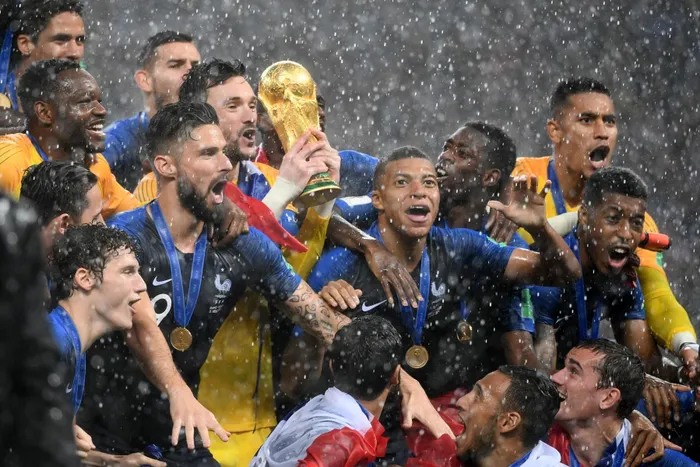
France's players lift the Fifa World Cup trophy after the Russia 2018 World Cup final football match between France and Croatia at the Luzhniki Stadium in Moscow on July 15, 2018.
Image: AFP
The build-up to the 2018 Fifa World Cup in Russia was overshadowed by intense global scrutiny. From rampant racism in domestic football and human rights abuses by authorities to strict state-sponsored anti-homosexual propaganda laws, controversy followed the tournament at every turn.
The use of migrant labour to build the stadiums was also a contentious issue, with Fifa president Gianni Infantino admitting there had been human rights abuses of North Korean workers involved in the construction of Saint Petersburg's Zenit Arena.
Human costs and security fears further heightened tensions ahead of the tournament. By June 2017, at least 17 workers had died on World Cup construction sites, while a direct threat from the Islamic State (IS) forced Russian counter-terrorism units into a massive security clampdown to safeguard the event.
Ultimately, the World Cup went off without any major incidents with a highly entertaining tournament defined by tactical discipline, dramatic penalty shootouts, and with the host nation — who were the lowest ranked team at the competition - enjoying a dream run through to the quarter finals, having eliminated 2010 champions Spain in Round 16.
The crowning moment came when a dominant French team claimed their second World Cup title, two decades after their first triumph in 1998.
Africa: Egypt, Morocco, Nigeria, Senegal, Tunisia
Asia: Australia, Japan, Saudi Arabia, South Korea, Iran,
Europe: Belgium, Croatia Denmark, England, France, Germany, Iceland (debut), Poland, Portugal, Russia, Serbia, Slovakia, Spain, Sweden, Switzerland
North America: Costa Rica, Mexico, Panama
South America: Argentina, Brazil, Uruguay, Colombia, Peru
The were 11 host cities, utilising 12 stadiums. Of the 12 stadiums used for the tournament, three (Luzhniki, Yekaterinburg and Sochi) had been extensively renovated and the other nine were brand new. A whopping $11.8 billion (about R192.8 billion) was spent on hosting the tournament.
Competing countries were divided into eight groups of four teams (groups A to H). Teams in each group played one another in a round-robin, with the top two teams advancing to the knockout stage.
The "Champion's Curse", however, continued with defending 2014 champions Germany suffering a shocking group-stage exit. Defeats to Mexico and South Korea left them at the bottom of Group F, continuing a trend of recent European champions failing to advance past the first round in subsequent tournaments.
In the third-place play-off clash, Belgium beat England 2-0 in St Petersburg.
The final was the highest-scoring World Cup decider since 1966. France took the lead through a Mario Mandžukić own goal — the first own goal ever scored in a World Cup final. Croatia's Ivan Perišić quickly equalised with a stunning strike, but an Antoine Griezmann penalty (awarded via VAR for a handball) restored France's lead just before halftime.
In the second half, quickfire strikes from Paul Pogba and 19-year-old Kylian Mbappé put the game out of reach. Mbappé's goal made him the first teenager to score in a World Cup final as France crowned 4-2 victors in the pouring rain.
The 2018 tournament was the first World Cup to implement the Video Assistant Referee (VAR) system. Its introduction had a massive impact, leading to a record-breaking 29 penalties awarded throughout the tournament.