

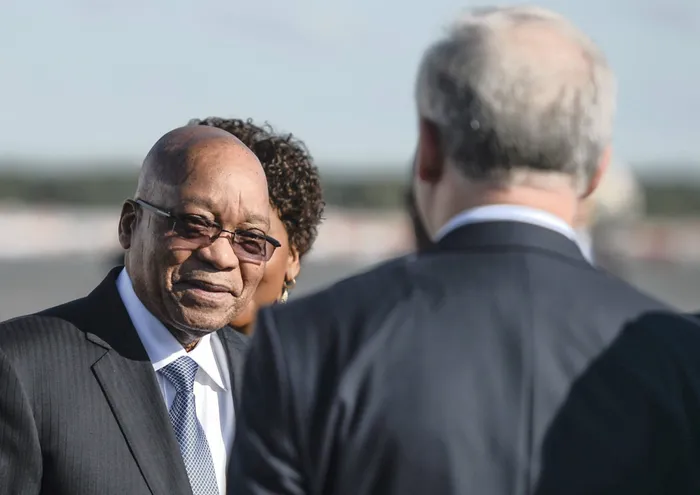
President Jacob Zuma arrives in St Petersburg on Wednesday on the eve of the Group of 20 summit. Photo: Reuters President Jacob Zuma arrives in St Petersburg on Wednesday on the eve of the Group of 20 summit. Photo: Reuters
Moscow - The Group of 20 (G20) cut its teeth in the global financial crisis of 2009, achieving an unprecedented level of co-operation between developed and emerging nations that has not been matched since.
Four years on, shifts of power and money – led by capital flight from emerging markets – and gaping divisions over Syria will test the resolve of the G20 leaders when they meet in Russia’s second city of St Petersburg this week.
It is the very breadth of the forum, which groups developing and developed economies accounting for two-thirds of the world population and 90 percent of its output, that makes it hard to forge a united front.
“There is a tremendous vacuum of policy co-ordination. I don’t think I’ve ever seen it this bad,” one economist, who spoke on condition of anonymity, said as he looked ahead to the two-day talks starting today.
President Barack Obama of the US, who has already pulled out of a meeting with host President Vladimir Putin after a falling out between Washington and Moscow, might be forgiven for wanting to skip the gathering altogether.
Putin wants Syria put on the G20 agenda and is unlikely to pull any punches less than three months after being cast as a pariah over Syria at the last big meeting of world leaders – the Group of Eight.
“It’s not a substitute for the UN Security Council, it can’t take decisions on the use of force. But it’s a good platform to discuss the problem. Why not take advantage of this?” Putin said at the weekend.
Moscow has repeatedly used its UN Security Council veto to block action against Syria.
A few numbers reveal a strategic disconnect: US defence spending accounts for 39 percent of the global total, nearly twice its 22 percent share of the world economy.
And it is the dollar’s outsized role in the global financial system – it counts for 62 percent of central bank reserves – that has been in part responsible for a roller-coaster ride on markets throughout Russia’s G20 presidency.
The year started with controversy over whether the aggressive fiscal and monetary stimulus launched by Japanese Prime Minister Shinzo Abe was an act of “currency war” designed to bring about a competitive devaluation.
So-called Abenomics got a free pass in the end when G20 finance ministers met in February. The US Federal Reserve had, after all, been buying up $85 billion (R875bn) worth of bonds every month to try to restore the flow of affordable credit to the US economy.
When chairman Ben Bernanke cautioned in May that the Fed would slow the printing presses, the cheap dollars that had flooded emerging markets turned tail.
Countries running external and fiscal deficits, above all India, have been most exposed.
“We expect an intense debate about the possible side effects of the US withdrawal from the policy of quantitative easing,” Russia’s G20 summit co-ordinator, Ksenia Yudayeva, told a news briefing.
There has been no sign of the other members of the Brics emerging markets bloc – Brazil, Russia, China and South Africa – rallying to India’s side after New Delhi called for joint currency intervention last Friday.
“The emerging markets pressures and volatility are a reminder that the recovery could easily be capsized,” said Neil MacKinnon, a macroeconomic strategist at Russian investment bank VTB Capital.
Yet Brics has struggled to reach agreement on founding a joint development bank, with a deal months or even a year away, while the idea of creating a shared currency intervention pool has faded.
No summit would be complete without so-called “deliverables”, and leaders are expected to sign off on proposals – unveiled in July – to fight tax avoidance by multinationals.
An initiative to refine regulation of the $630 trillion global market for financial derivatives to prevent a possible market blow-up will also be presented to summit leaders.
The G20’s Financial Stability Board will also give the so-called “shadow banking” sector until 2015 to comply with new global rules.
While the US and China have taken aggressive action to spur demand, the EU has been slower to let go of austerity and Germany resists signing a blank cheque to back a euro zone banking union.
Missing from the G20 debate is leadership on the pressing issue of how to wean the world off its reliance on one currency.
“The dollar, and by extension quantitative easing, are key for markets,” said Neil Shearing of Capital Economics in London.
For emerging markets, he said: “The only thing that’s worse than a weak dollar is a strong dollar.”
Meanwhile, President Jacob Zuma had arrived in Russia for the summit, the presidency said yesterday.
The South African delegation would promote African interests and development.
“Zuma will also attend a meeting of Brics leaders, which will give the leaders an opportunity to reflect on the progress made with regards to… the Durban Declaration,” spokesman Mac Maharaj said.
Zuma was accompanied by Finance Minister Pravin Gordhan and International Relations Minister Maite Nkoane-Mashabane. – Reuters
Additional reporting by Sapa