

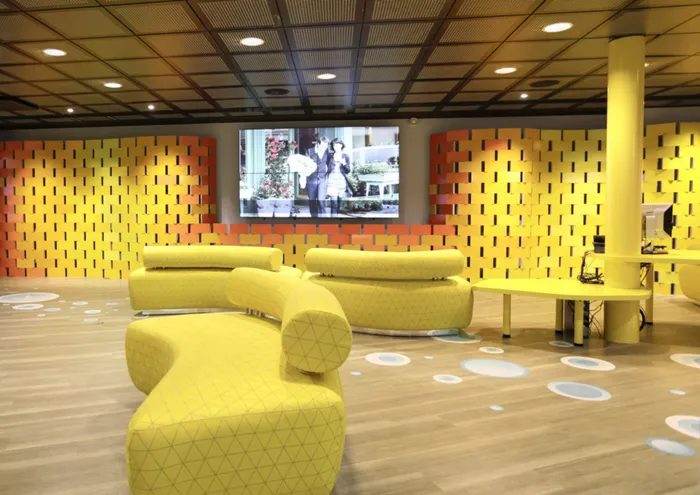
A BNP Paribas bank branch in central Paris features a futuristic lobby. The French banking giant and several other leading lenders are setting trends by remodelling their flagship outlets to attract a new generation of tech-savvy customers and compete with online-only rivals. Photo: Reuters A BNP Paribas bank branch in central Paris features a futuristic lobby. The French banking giant and several other leading lenders are setting trends by remodelling their flagship outlets to attract a new generation of tech-savvy customers and compete with online-only rivals. Photo: Reuters
Velizy, France - Installation art, interactive walls and a robot doorman; the flagship branches of the world’s top banks have come a long way from the iron grilles and potted plants of old.
To compete against online-only rivals and to attract a new generation of customers, banks are installing sleek interiors and hi-tech gadgetry. ATMs that read fingerprints, touch-screen desks to flick through your finances and videoconference units are all on display at payments technology firm Wincor Nixdorf’s showroom in Paris.
“Banks are investing a lot in their retail branches,” said Steve Bousabata, the head of Wincor’s French banking services arm. “They want customers to come back.”
The reason is clear: after years of relying on branches to drive retail revenue, European banks expect such networks to supply only 62 percent of sales by 2020 from today’s average of 81 percent, according to Equinox Consulting.
Banks are under pressure to cut costs and are balancing the need to pare back branch networks by sprucing up select outlets. But branches are still the first point of contact for many customers and are still the primary location for product sales such as mortgages, new accounts and insurance, underlining the importance of upgrading them for a more tech-savvy generation.
The difficulty is knowing exactly what belongs in the branch of the future and what is better left behind.
“Are all the things we see in branches today going to be seen in branches tomorrow? I very much doubt that,” said Mike Baxter, the head of management consultancy Bain’s Americas Financial Services.
“There’s an awful lot of experimentation of stuff that turns out to be unsuccessful and uneconomic.”
Flashy “bank of the future” branches mixing gadgetry with design similar to Apple’s minimalist stores have been opened by BNP Paribas in Paris, Barclays in London and Deutsche Bank in Berlin. They include lounge areas, giant interactive screens and other trimmings such as handbags for sale and pieces of art.
Gauging their success is tricky. Only BNP Paribas was willing to give data on its refurbished flagship branch in Paris – which three years ago was fitted with a wall covered in plants, iPads for customer use and a touch-screen desk – saying that footfall was up 40 percent and new clients up 25 percent.
Italy’s Unicredit also said that footfall and new business were up at its newly revamped flagship branch in the Bulgarian capital of Sofia, which offered “welcoming scents” and a touch-screen wall. Visits were up by an average of 60 percent while loans and deposits had doubled, a spokeswoman said.
On the other hand, BNP Paribas has done away with some ideas that failed to click with consumers: it has scrapped the iPads and touch-screen desk in favour of an interactive wall.
Beyond Europe, the experiments are even bolder.
In South Korea, Hana Bank allows mobile users to transfer money to one another by physically “bumping” smartphones. Shinhan Bank has also introduced unmanned “smart” branch kiosks that communicate with handsets. In the US, customers of the Washington branch of Carolina Premier Bank will soon be greeted by a robot.
Although some of these advances may prove too gimmicky or not functional enough to catch on, long-distance banking via videoconference is seen as a way to reduce branch staff without hurting service.
The ultimate question of whether to scrap the branch entirely was not being considered, consultants said.
The preference is for a “hub-and-spoke” model that pools resources in urban areas and reduces smaller, rural branches.
“Even in developed markets, the death of branches is somewhat exaggerated,” Ernst & Young wrote in a 2012 report.
“We will see further evolution of the branch experience from something that looks like a local government office… [to] a hybrid between coffee shop and technology store.” – Reuters