

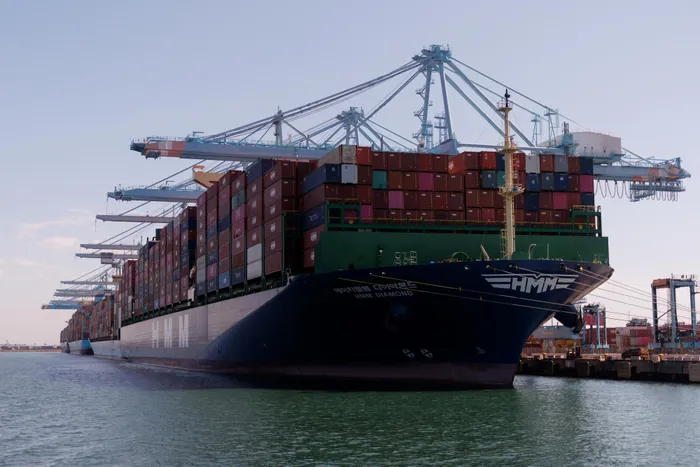
The HMM Diamond container ship at the Port of Los Angeles in Los Angeles, California, US.
Image: Bloomberg
World economic activity will remain “subdued” next year amid trade uncertainty and geopolitical tensions that are restraining investment outside of artificial intelligence and weighing on government finances, a UN agency predicted in a new report.
Global growth will weaken this year to 2.6% and maintain that pace in 2026, according to the report released this week by the Geneva-based UN Conference on Trade and Development. After a 2.9% expansion last year, those projections if realized would be 0.4 percentage point lower than the pre-pandemic average.
“The global economy and trade have shown resilience during 2024 and 2025,” Rebeca Grynspan, secretary-general of the United Nations agency, said in an interview. “But the reasons may not be sustainable if we don’t lower uncertainty and we don’t go back to some predictability for investment really to pick up.”
The nearly 200-page report highlights risks to economies and financial markets beyond the US’s evolving and unpredictable tariff policy under President Donald Trump. Developing economies, it said, remain vulnerable to currency swings and punishing tariffs on their exports to the US.
The report also points to a worrying gap between economies in the so-called Global South that account for more than 40% of global GDP, half of foreign direct investment flows and about 45% of goods trade - all while remaining “peripheral” to global equity and bond markets needed to fund long-term development.
While about 72% of global trade is still governed by the World Trade Organization most-favored nation rules, global finance on which 90% of international commerce depends is much more concentrated and tied to “long-standing market practices and conventions,” regulatory arbitrage and functions delegated to private authorities.
“In the short run, this interdependence can help avoid fracture and provide an effective signal for policy recalibration, as happened, for instance, in April 2025,” the report said, referring to the market selloff after Trump announced his harshest so-called reciprocal tariffs on April 2, and the rally after he moderated those duties on China in particular.
The report continued that “over the long run, the disparity between the rules-based matrix of global trade and the centralized global finance system manifests a deeper imbalance in the global economy.”
At the heart of the system is the dominance of the US currency, and even though the dollar has dropped as a share of international reserves, a suitable challenger has yet to emerge, UNCTAD said.
“Despite its notable decline, the dollar continues to account for a far greater share of central banks’ reserve assets than any other currency,” the UN agency’s report said. “While the move away from the dollar in official foreign-exchange reserves is clear, no indication exists of another currency as a potential replacement.”
BLOOMBERG