

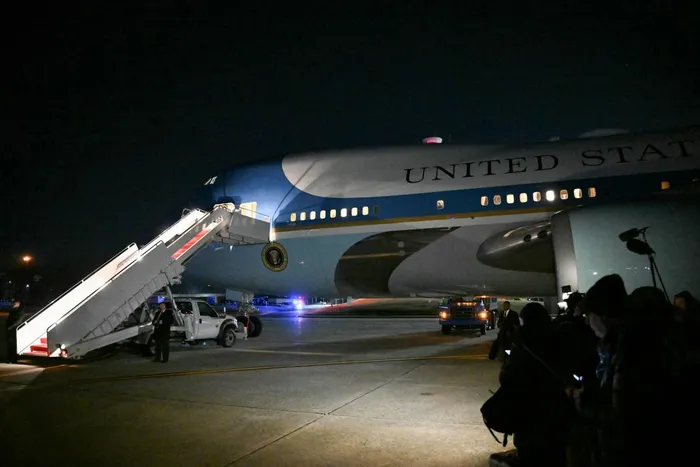
Air Force One is seen on the tarmac at Joint Base Andrews in Maryland on January 20, 2026 after it was forced to return to the air base due to a "minor electrical issue" shortly after departing for Switzerland, the White House said.
Image: AFP
Global leaders gathered at the World Economic Forum (WEF) Annual Meeting in Davos have taken a strong stance against the United States' apparent disregard of the rules-based international system and spoke against the weaponisation of tariffs in global trade.
This comes as US President Donald Trump has threatened to impose tariffs on eight European countries, including Germany, France and the UK, from next month, unless they support his ambition to take control of Greenland.
Trump has also faced international criticism after his administration took control of the Venezuelan oil following the capture of the country's president Nicolás Maduro and his wife, Cila Flores, who have been hauled before a court in New York.
Speaking to a packed hall in Davos on Tuesday afternoon, Canadian Prime Minister Mark Carney delivered a stark assessment of the world’s fading rules-based system, arguing that pretending it still functions as advertised is no longer sustainable.
Carney said the old order has ruptured, and clinging to its rituals now carries real risks.
He said that economic integration itself has become a source of coercion, with tariffs, financial infrastructure and supply chains used to exert pressure. To continue invoking the rules-based order without confronting this reality, he warned, is to live within a lie.
"We are in the midst of a rupture, not a transition. More recently, great powers have begun using economic integration as weapons. Tariffs as leverage. Financial infrastructure as coercion. Supply chains as vulnerabilities to be exploited," Carney said.
"You cannot live within the lie of mutual benefit through integration when integration becomes the source of your subordination. The multilateral institutions on which the middle powers have relied, the WTO, the UN, the COP, the architecture, the very architecture, of collective problem-solving are under threat.
"And as a result, many countries are drawing the same conclusions, that they must develop greater strategic autonomy in energy, food, critical minerals, in finance, and supply chains. And this impulse is understandable. A country that can't feed itself, fuel itself, or defend itself has few options.
"When the rules no longer protect you, you must protect yourself. But let's be clear-eyed about where this leads. A world of fortresses will be poorer, more fragile, and less sustainable."
Trump is scheduled to deliver a special address at Davos on Wednesday afternoon if he eventually arrives after his Air Force One turned back to Joint Base Andrews due to a minor electrical issue shortly after takeoff in Washington D.C. However, the White House reported that Trump will board a different aircraft and head to Switzerland.
Meanwhile, French President Emmanuel Macron, in his special address at WEF also on Tuesday, also echoed Carney's sentiments, saying there was a "shift towards autocracy" across the world as a result of unending wars in Ukraine, the Middle East and in Africa.
"It's clear that we are reaching a time of instability, of imbalances, both from the security and defense point of view and the economic point of view. Look at the situation where we are...a shift towards autocracy against democracy. It's as well a shift towards a world without rules, where international law is trampled underfoot, and where the only law that seems to matter is that of the strongest. And imperial ambitions are resurfacing," Macron said.
"This is as well a shift towards a world without effective collective governance and where multilateralism is weakened by powers that obstruct it or turn away from it and rules are undermined.
"Without collective governance, cooperation gives way to relentless competition. Competition from the United States of America through trade agreements that undermine our export interests, demand maximum concessions, and openly aim to weaken and subordinate Europe combined with an endless accumulation of new tariffs that are fundamentally unacceptable, even more so when they are used as leverage against territorial sovereignty.
"Export control has become more dangerous new tools, destabilizing global trades and the international system. And the answer in order to fix this issue is more cooperation and building new approaches. And it's clearly building more economic sovereignty and strategic economy, especially for the Europeans, which is for me the core answer," Macron said.
The shift towards a greater European independence was the central theme of the European Commission President Ursula von der Leyen, who argued that geopolitical shocks and a fractured global order must be treated not as temporary crises, but as a permanent reality demanding structural change.
Von der Leyen said Europe was living through a “seismic change” comparable to the collapse of the Bretton Woods system in the early 1970s, saying that was a moment that reshaped the global economic order and forced Europe to rethink its dependencies.
"The world may be very different today, without any question, but I believe the lesson is very much the same," she said.
"That geopolitical shocks can and must serve as an opportunity for Europe, and in my view, the seismic change we are going through today is an opportunity, in fact a necessity to build a new form of European independence. And this need is neither new, nor a reaction to recent events. It has been a structural imperative for far longer."
China’s Vice Premier He Lifeng said the world is undergoing transformations “not seen in a century,” marked by growing unilateralism, trade tensions and regional conflicts that are reshaping the global economic and trade order.
Li noted that tariff and trade wars since last year have delivered “significant shocks” to the world economy, disrupting supply chains and weakening confidence.
"China advocates a universally beneficial and inclusive economic globalization. We are committed to building bridges, not walls. We will firmly support trade and investment liberalization and facilitation and continue to share development opportunities with the world," Li said.
"We will work with all parties to create a bright future of prosperity and development where every country and every community shares the dividends of development. Second, we should firmly safeguard multilateralism and make the international economic and trade order more just and equitable. The multilateral trading system now faces the most serious challenges in years."
BUSINESS REPORT