

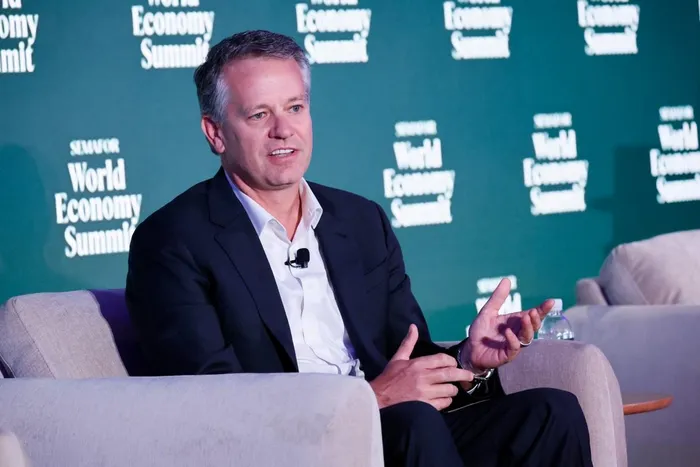
Walmart Inc.’s John Furner.
Image: AFP
New CEOs often arrive with a mandate to turn a company around. Walmart Inc.’s John Furner is taking the helm with another daunting challenge: coming in at a high point.
The world’s largest retailer is seeing strong growth from newer, wealthier customers and is benefitting from success in e-commerce. Its shares are up 20% in the past year, with a market value approaching $1 trillion. Outgoing Chief Executive Doug McMillon is widely revered and viewed as the company’s most influential leader since founder Sam Walton.
For Furner, a 51-year-old Walmart lifer who will become the company’s sixth CEO next week, that backdrop leaves little room for missteps. Known as tech savvy and willing to challenge convention, he now must figure out how to press the Bentonville, Arkansas-based company’s advantage and prepare for the new era of artificial intelligence without losing the discipline that has defined the retailer.
“We are standing on the cusp of the most disruptive period in retail since the advent of e-commerce,” said Chad Lusk, a managing director at Alvarez & Marsal’s consumer and retail group. “As John takes the reins there, especially as an insider, there’s no resting on those laurels.”
Meanwhile, competition looms as Amazon.com Inc., Aldi Inc. and others sharpen their focus on low prices, and Target Corp. seeks to reverse its yearlong slump with an emphasis on stylish merchandise and improved store experiences. Target also has a new CEO, Michael Fiddelke, who’s set to start next week.
As the head of Walmart US, the company’s biggest division, Furner is closely tied to McMillon - the two even attended the same college. Yet people who have worked with the longtime heir apparent describe him has someone who’s willing to challenge convention at a company that’s known for its deeply ingrained corporate culture.
That instinct shows up most clearly in how he operates day to day. During store visits, he offers direct, specific feedback on what’s working and what isn’t, according to people familiar with his approach, who asked not to be named discussing internal matters.
While running the Sam’s Club warehouse chain, Furner backed the opening of a small-format location, an indication of his appetite to experiment and curiosity around emerging ways of shopping. During the pandemic, when Walmart rolled out its loyalty program, Furner pushed to test a cash-back benefit for customers, even as some inside the company questioned whether the perk conflicted with the retailer’s everyday-low-prices ethos.
He’s taken a more public-facing role over the years as he interviewed employees, industry executives and celebrities about their work experiences. A guitarist, he once led a corporate band with other executives called “Smashing Prices” - a nod to rock band Smashing Pumpkins - playing holiday tunes at an internal meeting.
“He is very curious about what's around the corner,” said Dan Bartlett, Walmart’s executive vice president of corporate affairs, who has worked with Furner for more than a decade. “That feeds his style, as far as pushing the teams to not just manage day-to-day but try to see where things are headed.”
Deep Roots
Furner grew up on farms in Arkansas and started working at Walmart as a part-time employee in the garden department of a supercenter. His father also worked for the retailer, and Furner has spoken about how employees helped raise money for his mother’s cancer treatment in the 1980s. He and his wife met at the company.
Furner held roles from cart pusher to store manager before leading groups including China’s merchandising business and Sam’s Club. He became the head of the US business in 2019.
As he moved up through the ranks, his calm demeanor and clear communication style reminded some Walmart employees of McMillon. The two worked closely together, especially as they navigated the pandemic and its aftermath. The retailer’s online operations ballooned while US inflation soared during that time.
In an interview with Bloomberg News last year, Furner said he and McMillon have sought to stay true to Walmart’s heritage amid various business shifts, and “everything else, we have to change as the world changes and as the consumer changes.”
Furner is known as a detail-oriented leader who once directed candles and other birthday items to be placed closer to the cake area of a store. He’s comfortable against the grain and perceives that ability as an edge, the people who have worked with him say. He is willing to take big bets, as exemplified his call to shut dozens of underperforming Sam’s Club stores, which rarely had closed locations at that scale. In meetings, he often does back-of-the-napkin calculations to test ideas in real time.
“Part of his operating style is that he’s approachable,” said Scott Benedict, a retail consultant who worked with Furner at Sam’s Club. At the same time, he “has no problem challenging people in different areas of the business.”
Fluency in tech has long been important for Furner, who was among the earliest ones at the company to talk about drones. More recently, he’s been chatting with AI while he drives to work and has spent time with companies in Silicon Valley to personally understand emerging technologies. He has also turned to AI to help with singing and other musical tasks.
Walmart and its competitors are now racing to get ahead of the AI wave, investing in tech partnerships and encouraging employees to embrace new ways of working.
“Over the past five years or so, Walmart has been one of the success stories in retail,” said Neil Saunders, managing director at research firm GlobalData Retail. “The challenge is, this is all great, but how do we keep this going? For John, that’s the real ask.”
Furner, who has been visiting international markets in recent weeks, has already signaled that changes are coming. He named his team of senior executives in January, notably naming David Guggina, who has been leading e-commerce efforts, as his successor for Walmart US. By selecting the 40-year-old, Walmart broke with its tradition of placing store or merchandising operators in the position, signaling its ambitions to further grow its digital footprint.
“I’ve been asked a lot of questions from investors recently, does this mean a pivot in strategy or is this going to be a bow wave of spending?” Chief Financial Officer John David Rainey said at an investor conference in December, referring to Furner’s ascension. “What you need to know is the strategy that we’ve been executing on over the last several years, John has his fingerprints all over.”
BLOOMBERG