

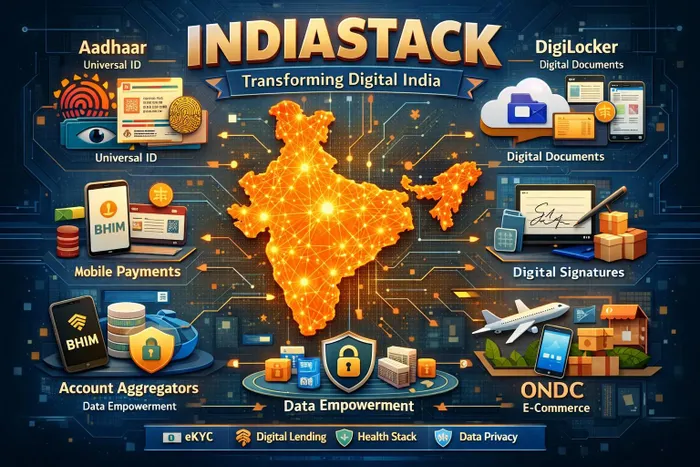
India Stack offers a solution to Africa’s development challenges.
Image: AI generated.
India Stack, a digital public infrastructure (DPI), has become a buzzword among African policymakers and businesses seeking to modernise public administration, bridge the digital divide, expand financial inclusion, and reduce the cost of doing business.
It is a suite of Application Programming Interfaces (APIs) and digital public goods that functions as a foundational digital infrastructure, enabling governments and businesses to build secure, interoperable, and inclusive financial and social services.
At scale, it allows the state, businesses, and households to access multifunctional digital services seamlessly and securely. India Stack’s core components include Aadhaar (digital identity), UPI (payments), and DigiLocker, all designed to support presence-less, paperless, and cashless service delivery for large populations.
Together, these systems enable personal transactions, government transfers, healthcare access, insurance, and education services.
Although developed by the Indian government, India Stack's open-source architecture allows anyone to operate and develop commercial applications on it. It is widely regarded as one of the most significant developmental innovations of this century, offering low-cost, scalable, and interoperable digital infrastructure for impactful service delivery.
Through public–private partnerships, India Stack has improved productivity and transformed welfare delivery in India—an achievement that has drawn the attention of African leaders facing similar developmental challenges and seeking efficient, cost-effective public service platforms.
Aadhaar, the world’s largest biometric identification system, has attracted particular interest across Africa. This simple 12-digit identification number, which serves as proof of identity and address for Indian residents, underpins much of India’s digital economy. It has significantly reduced leakages, fraud, and malpractice in cash transfers and welfare programmes.
Several African countries—including South Africa, Namibia, Ghana, Rwanda, Sierra Leone, Mauritius, and Morocco—are adopting this technology to curb corruption and inefficiencies in public service delivery. In South Africa, for example, it can solve the problem of ghost teachers and social grant beneficiaries who cost the state and taxpayers millions, if not billions, of rand each year.
While India Stack can help African countries address key developmental challenges, its adoption also presents substantial commercial opportunities for Indian firms involved in developing and supporting the technology.
Benefits for Africa
According to World Bank estimates for 2023–2025, more than half of the 800 to 850 million people worldwide who lack formal identification live in Sub-Saharan Africa. This “identity gap” disproportionately affects marginalised groups - especially women, children, rural communities,and low-income populations - excluding them from essential services such as finance, education, and healthcare.
India Stack’s Aadhaar digital identity system can empower African countries to improve their public administration systems through greater transparency, reduced fraud, and improved service delivery. Such systems would also enable governments to better identify and reach vulnerable populations, strengthen governance, accelerate digitisation, and support sustainable development across the continent.
More than half of Africa’s population remains unbanked, limiting economic participation and preventing small and micro enterprises from accessing finance, expanding, and creating jobs. India Stack’s UPI component could accelerate financial inclusion by offering a universal, low-cost digital payment platform that leverages Africa’s high mobile phone penetration and stimulates economic growth.
The public–private partnership model underpinning India Stack could also help financially constrained African governments mobilise funding for digital innovation and modernise public services.
India and Africa share strong trade and diplomatic ties, reinforced by India’s support for the African Union’s admission to the G20. These relations are promoting Africa’s adoption of India Stack, supported by Indian technical expertise and logistical assistance.
Already, at least eight major technology initiatives across Africa have incorporated elements of India’s digital innovations in various forms. Challenges and considerations Despite its promise, the wholesale adoption of India Stack in Africa carries risks.
Economic and developmental disparities between African countries and India mean that some states may lack the financial resources, skilled personnel, or technical capacity required to deploy such a complex system at scale. Others may have the resources but lack public trust, which could undermine implementation efforts.
Nonetheless, India Stack holds significant potential to transform Africa’s public administration and economic landscape. Its success on the continent depends on ensuring mobile money interoperability (similar to Tanzania’s TIPS or Kenya’s M-Pesa), establishing robust data protection frameworks, and designing systems that function effectively on low-bandwidth networks and basic feature phones.
Fawzia Moodley is a freelance reporter.
BUSINESS REPORT