

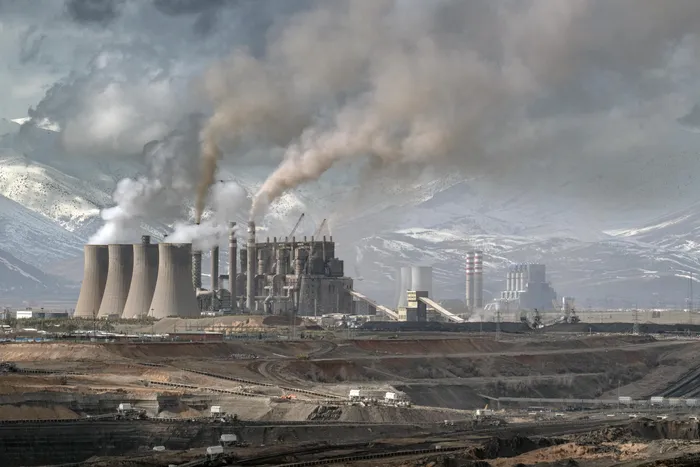
The Elbistan power plant has operated since 1984 and is one of Türkiye’s largest thermal facilities, with eight units generating 2 795 megawatts. The author says South Africa's absence from an influential climate conference raises urgent questions about its commitment to a sustainable energy future.
Image: AFP
South Africa has missed a strategic opportunity to join a “coalition of the willing” of 57 countries meeting in Santa Marta in Colombia this week in what promises to be a landmark climate conference aimed at accelerating a move away from fossil fuels.
Among the attendees of the first international conference on Transitioning Away from Fossil Fuels (TAFF) are major oil, coal and gas producers such as Canada, Australia, Brazil and Norway. African countries attending include Angola, Tanzania, Mauritius, Senegal, Sierra Leone and Cameroon. This international meeting seeks to advance concrete actions to reduce dependence on oil, gas and coal, in coherence with scientific evidence and global climate objectives. It represents the first significant effort outside of the UN climate negotiations process to explicitly seek to co-ordinate the transition away from fossil fuels at the international level by defining next steps on implementing commitments on fossil fuels. Santa Marta moves the conversation from “whether” to “how” to deliver a just energy transition. It creates the political space to do what climate COPs have struggled to deliver: real-world progress on phasing out fossil fuels.
Engagement in emerging international processes that are shaping the fossil fuel transition is critical to informing and strengthening our domestic planning. Unfortunately, South Africa’s failure to participate in the Santa Marta conference is a missed strategic opportunity – but it doesn’t have to end there. There will be further opportunities and meetings coming out of Santa Marta, and we would urge our government to get involved as soon as possible.
At a time when international climate finance, concessional funding, and technical support is increasingly linked to demonstrable engagement in credible transition processes, absence from this forum is short-sighted. South Africa’s dependence on coal and the urgency of addressing the triple challenge of poverty, unemployment and inequality as the country undertakes the net zero transition remain central considerations. As a country, we need a clear and concrete national roadmap to deliver on our climate commitments. Without this clear pathway for a just transition away from fossil fuels – including clear aligned targets and financial commitments for carbon removals –we risk falling short of our international commitments.
WWF strongly encourages South Africa to join the “coalition of the willing” represented at the TAFF meeting. This would enable us as a country to:
• contribute to discussions on a roadmap to transition away from fossil fuels in line with our national commitments
• gain exposure to international thinking, tools and implementation approaches on the fossil fuel transition to inform national processes
• demonstrate our leadership and experience in a just energy transition, and
• help shape the international architecture for fossil fuel transition.
By standing back from this process, South Africa risks ceding its long-standing leadership role among developing economies on climate and energy transition issues, as well as losing influence over emerging norms, governance arrangements, and future funding pathways associated with the fossil fuel transition. Independent modelling by many groups, among them South Africa’s Presidential Climate Commission, show that decarbonising the economy is South Africa’s best potential development pathway, supporting increased employment in the energy sector, reduced environmental impacts, and improved access to global markets.

James Reeler is the senior climate specialist at WWF South Africa.
Image: Supplied
In addition, WWF’s Illustrative People’s Energy Plan highlights the opportunities for South Africa’s development through a decarbonisation pathway at this critical moment, which can help guide the development of the upcoming national Integrated Energy Plan (IEP). The largest contributor to the climate crisis is the world’s reliance on fossil fuels. Production and use of fossil fuels contribute around 75% of global greenhouse gas emissions and 90% of carbon dioxide emissions. Meeting the essential target of limiting climate change to under 2°C requires a rapid reduction in emissions, through a complete phase-out of all fossil fuels before 2050, with developed countries taking the lead and phasing out fossil fuels by 2040.
Countries must define a timeline for the equitable phasing out of fossil fuels with specified milestones. Achieving the energy transition will require national climate plans that establish policies that realistically enable this goal, as well as clear global mechanisms to support the transition for developing countries. There is no emissions space for new fossil fuels, so no new oil and gas extraction sites should be opened, and all subsidies for fossil fuels redirected to support renewable energy and just transition policies.
* James Reeler is WWF South Africa’s senior climate specialist.