

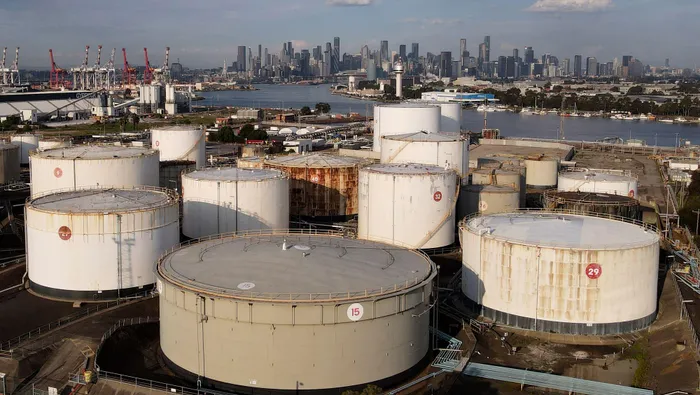
As tensions flare between the US and Iran, global markets react sharply. Discover how escalating hostilities and surging oil prices are reshaping the economic landscape, creating ripples that reach far beyond the Gulf.
Image: William West / AFP
The financial world is witnessing unsettling tremors as tensions between the United States and Iran spike, casting an ominous shadow over global markets.
President Donald Trump's assertion that Iran has agreed to nearly all of the US's 15 conditions for peaceful resolution is belied by real-time developments that tell a different story.
Over the weekend, the Iran-backed Houthis escalated hostilities, while Iranian assaults on Gulf neighbours intensified, marking a precarious chapter in an already fraught geopolitical landscape.
In a significant military show of support, the US announced the deployment of additional troops to the Gulf region, exacerbating worries about a protracted conflict.
Bianca Botes, director at Citadel Global, commented on the precarious state of financial markets saying, "Asia started the week on a negative note. The sell-off from Friday persisted, with Japan's Nikkei index plummeting by 4.7%, while South Korea’s KOSPI faced a decline of 4.2%.
This turmoil hints at broader concerns surrounding geopolitical tensions and their implications for global economic stability."
While futures for the S&P 500 displayed some resilience in early trading, hovering in the green, overall market sentiment remained cautious, with other major index futures dangerously close to negative territory. Analysts anticipate further volatility as the day progresses.
The surge in oil prices reflects the heightened stakes.
After President Trump issued a stern warning about potential control over Kharg Island, an essential export hub for Iran, Brent crude soared by 1.94%, pushing prices to $114 per barrel.
Concurrently, gold prices steadied at $4,500 per ounce, and the US Dollar Index strengthened, trading just above the 100 mark—a clear signal of investor uncertainty swirling around riskier assets.
Botes also highlighted that this week is critical for economic data with US employment figures set to be released.
The ripples of international dynamics are being felt strongly in South Africa, where the rand is trading at R17.13 to the dollar, R19.72 to the euro, and R22.72 to the pound. These fluctuations underscore the vulnerabilities of emerging market currencies in the face of escalating geopolitical hostilities.
As Brent crude prices climb to around $115 a barrel, a staggering increase of nearly 60% in March, the CEO of deVere Group, Nigel Green, warns that this is not merely a temporary spike.
He said, "Brent at $115 is being treated as a spike. The data tells a different story."
With significant disruptions to supply routes through the Strait of Hormuz, up to 20% of global supply is now compromised, reshaping the landscape of energy pricing and availability.
Green elaborated, pointing out the potential for a loss of 10 to 14 million barrels per day if disruptions persist, amidst a demand rate slightly above 100 million barrels. The implications of such a gap could send shockwaves through an already strained global economy.
With attacks on crude infrastructure extending into industrial supply chains, prices in the aluminium market are also on the rise, illustrating the extensive impact of the conflict on various sectors.
European gas prices are climbing once again, further embedding energy shocks into broader inflationary pressures affecting consumers and industries alike.
Despite this, investor psychology appears stuck in an era of relative stability.
"Markets are still conditioned by the past decade, where geopolitical risk created volatility but rarely sustained price moves," Green said.
The ongoing tempo of disruption is beginning to resemble the prolonged stagflation of the 1970s, a far cry from the short-lived shocks of recent memory.
The dual messaging from the Trump administration, possibility of a deal juxtaposed with threats of seizing Iranian oil assets, enhances market volatility, making it clear that political intent is now a central variable in energy markets.
In this tumultuous environment, the macroeconomic outlook remains uncertain. The potential for re-emerging stagflation dynamics poses new challenges, echoing caution among investors as they navigate unparalleled volatility in both the oil markets and global economic landscape.
Follow Business Report on Facebook, X and on LinkedIn for the latest Business and tech news.