

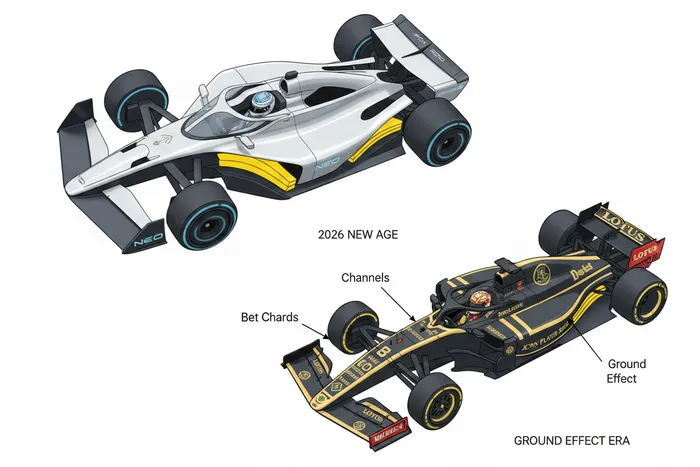
Ground effect cars were considerably faster in corners than the new regulation F1 cars. But with active aero, they are superior on straights. Ground effect cars were considerably faster in corners than the new regulation F1 cars. But with active aero, they are superior on straights.
Image: Google Gemini
Ground effect may have been the pinnacle of Formula 1, now that cornering is set to become substantially slower than the era we are leaving behind.
The 2022 to 2025 generation reintroduced Venturi tunnels and underfloor downforce, creating cars that could slice through high-speed corners with astonishing stability.
Straight-line speed may have crept upward in the years since, but it was those relentless, flat-out sweeps that truly set F1 apart from the rest of motorsport. Now, the sport pivots again.
From 2026, active aerodynamics and a new power unit philosophy will reshape the balance between cornering grip and straight-line velocity. The headline number is stark: downforce levels are being reduced by roughly 30% compared to the ground-effect cars, while drag in straight-line configuration drops by around 50%.
The result is a machine optimised for acceleration and top speed, but one that is less dominant in fast turns.
When Formula 1 introduced its new technical platform in 2022, the mission was clear: clean up "dirty air" and bring cars closer together. The solution was a return to ground-effect floors. Sculpted tunnels accelerated airflow beneath the chassis, lowering pressure and effectively pulling the car into the track surface.
At low-drag circuits such as the Italian Grand Prix at Monza and the Belgian Grand Prix at Spa-Francorchamps, peak speeds exceeded 360 km/h in qualifying trim with DRS and a slipstream. In race conditions, most cars ran between 320 and 340 km/h depending on setup.
But straight-line pace was not the defining trait. In high-speed corners such as Copse at the British Grand Prix or Pouhon at Spa, cars could carry between 250 and 290 km/h. Drivers routinely experienced lateral loads of 4.5G to 6.0G during rapid directional changes. The underfloor generated a significant portion of total downforce, meaning grip increased exponentially with speed. The faster the car travelled, the harder it was pressed into the asphalt.
The trade-off came in slow-speed hairpins. At venues like the Monaco Grand Prix, minimum corner speeds dipped to 60 or 70 km/h. The cars were heavier—around 798 to 800 kg—and less agile than their 2021 predecessors. Mechanical grip dominated, and rotation was slower. Even so, in high-speed sections, the 2022 to 2025 cars represented one of the most aerodynamically efficient packages in F1 history.
The 2026 regulations change the equation entirely. Active aerodynamics replace the traditional fixed-wing concept, and cars will operate in two primary configurations: a high-downforce mode for corners and a low-drag mode for straights. Unlike DRS, which simply reduces rear-wing drag, the new system alters both front and rear-wing profiles to optimise either grip or speed.
But even in maximum downforce configuration, the total aerodynamic load is around 30% lower than in the ground-effect era. That reduction directly impacts high-speed cornering. Early simulations suggest high-speed corner velocities could drop by 40 to 60 km/h compared to 2024 and 2025 benchmarks. Where a car once attacked a 280 km/h sweep flat-out, it may now approach at closer to 220 or 230 km/h depending on the circuit.
In contrast, straight-line performance benefits from dramatically reduced drag. In low-drag mode, resistance is cut by roughly half. Combined with a revised hybrid system that shifts to a near 50-50 split between combustion and electric power, acceleration zones become critical overtaking opportunities.
Top speeds in excess of 350 km/h are expected to remain common. Under ideal conditions, figures approaching 380 km/h are theoretically possible at power-sensitive circuits.
Less downforce means reduced lateral grip; reduced drag means higher terminal velocity. The 2022 to 2025 cars were defined by aerodynamic stability in high-speed arcs. The 2026 machines will be defined by energy deployment, aero-switching, and straight-line aggression. Ground effect gave Formula 1 back its high-speed identity; the next generation will trade some of that cornering supremacy for efficiency and strategic variability.
Faster on the straights, slower in the bends—whether that represents progress or regression depends on what you believe makes Formula 1 truly special.