

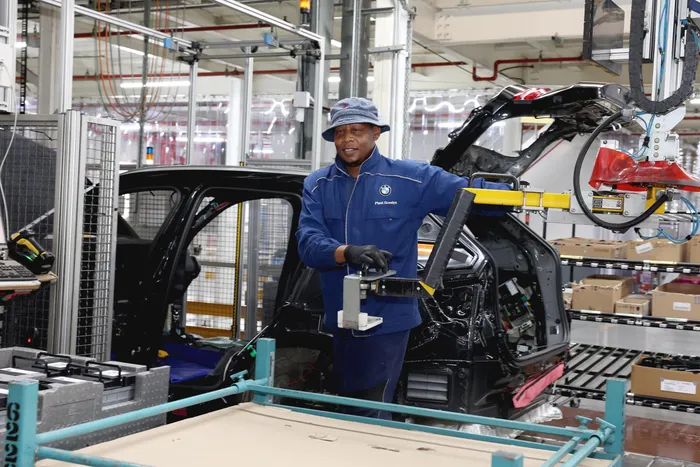
Naamsa has called on Government to refine existing policies rather than radical overhauls to secure the industry's future.
Image: GCIS
When Parliament’s Portfolio Committee on Trade, Industry and Competition met with South Africa’s automotive industry this week, the tone was unusually constructive.
According to Peter van Binsbergen, CEO of BMW Group South Africa, speaking in his capacity as a NAAMSA chairperson, the sector was invited to help shape solutions rather than defend itself.
“They invited us to help, not to give us a hard time that was very clear from the questions,” he said on the sidelines of BMW’s Start of the Year Media Engagement in Midrand.
The session brought together vehicle manufacturers, component suppliers, labour, retail bodies and development agencies.
The committee, which oversees the Department of Trade, Industry and Competition (DTIC), wanted an assessment of the health of the local auto industry and what needs to be done to secure its future.
Missing 2035 targets
Van Binsbergen stated that South Africa is falling well short of the targets outlined in the Automotive Masterplan 2035. Those include producing 1% of global vehicle output, achieving 60% local content and doubling industry jobs.
“We’re far from those targets,” he said. “Our share of global production has crept up to about 0.63%, jobs have stagnated, and local content is stuck at around 40%.”
The core challenge, he argued, is competitiveness.
“We’re never going to get to 1% without more OEMs coming to South Africa and producing here,” Van Binsbergen said. “There’s no way the existing manufacturers can simply double production.”
Make SA investable again
From NAAMSA’s perspective, the focus must be on fixing the business case for local manufacturing. Infrastructure constraints, unreliable logistics, port inefficiencies, water shortages and the cost of electricity all undermine investment decisions.
“The cost of electricity is prohibitively expensive for production,” he said.
Export market instability is another challenge, particularly the impact of US tariffs on South African-built vehicles.
“Our fully built vehicle exports to the US have ground to a halt with a 25% duty,” van Binsbergen said. “No one is going to export cars under those conditions.”
The knock-on effect for suppliers could be severe, he admitted.
“If suppliers lose export volume and reach a point where it’s no longer viable to stay in South Africa, they shut down,” he warned. “Then we lose local content, jobs and localisation.”
Tyres: targeting the wrong problem
One proposal raised during broader policy debates - that imported vehicles should arrive fitted with locally produced tyres - was dismissed as impractical.
“I don’t agree with that,” Van Binsbergen said. “Cars literally drive onto ships and drive off again. How do you do that without tyres?”
He said the real opportunity for local tyre manufacturers lies in the aftermarket, not new vehicle imports.
“There’s a massive car park out there, replacing tyres as they wear out,” he said. “That’s where the real business case is.”
Instead, he called for tougher action against substandard tyre imports.
“The problem is cheap, poor-quality tyres undercutting local manufacturers,” he said. “If you tighten the controls there, you end up with a much healthier aftermarket.”
Refine APDP
NAAMSA’s message to Parliament was that the Automotive Production and Development Programme (APDP) needs refinement rather than a radical overhaul.
“We need to close the SKD loophole because it creates a skewed playing field,” van Binsbergen said.
He also questioned the continued application of the ad valorem tax across the market.
“It was originally a luxury car tax, but it’s now charged on the cheapest vehicles,” he said. “If you adjust that, you can make locally produced vehicles more attractive and help grow the domestic market.”
There was broad alignment on these issues across manufacturers, labour and retail bodies, though frustration remains around the pace of implementation.
Nissan/ Chery deal welcomed with caveats
The proposed sale of Nissan South Africa’s plant to Chinese manufacturer Chery was seen as an opportunity, provided it meets the same requirements as existing manufacturers.
“As long as it’s a true production facility - stamping, welding and painting - and suppliers come onshore, it’s a great opportunity for South Africa,” Van Binsbergen said.
However, he warned against special exemptions.
“If it skews the rules, it would be very bad for the industry,” he said. “You end up with a two-class production system, and that wouldn’t be healthy.”
The portfolio committee indicated it would take industry proposals forward, while the DTIC has convened working groups to unpack the details.
“I’m not holding my breath,” he added. “But I remain optimistic, because this is a serious situation for the industry.”