

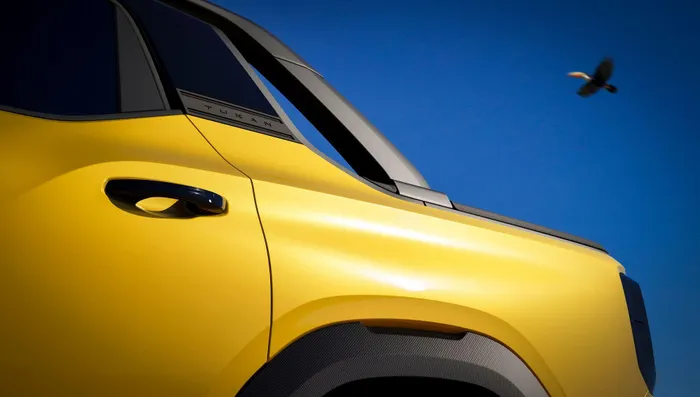
The first and only teaser image of Volkswagen's upcoming compact bakkie, the Tukan.
Image: Supplied
2026 has been described as a “make or break” year for Volkswagen’s future as a manufacturer of vehicles.
As IOL reported last week, Volkswagen Group Africa Chairperson Martin Biene wrote to President Cyril Ramaphosa in December, requesting urgent policy reforms to make South Africa a more attractive destination. Hinging on this is Volkswagen SA’s next proposed project, which requires a significant investment decision from the company’s headquarters in Germany.
And here’s where things get potentially exciting for South African consumers, as the vehicle that Volkswagen’s local division wants to build here is a “light” bakkie, Bloomberg reports, which is believed to be similar to a new model called the Tukan, which is expected to launch in South America in 2027.
Biene believes such a product would be the right fit for South Africa. The company hopes to produce the first units at its Kariega plant in the Eastern Cape around 2029 or 2030, if all goes according to plan, she told Bloomberg.
Volkswagen has yet to officially reveal the Tukan, which its Brazilian division is currently developing, but the first teaser images have been released, revealing a double cab body that displays similar design cues to the Tera compact SUV, which will be built in South Africa from 2027.
This correlates with international media reports stating that the upcoming compact bakkie will be related to the Tera. Although the two are expected to share Volkswagen’s MQB A0 architecture, it remains to be seen just how many components they will share.
The Tukan is expected to replace the Volkswagen Saveiro, a half-tonne bakkie that many South Africans have wished for over the years, but which never got green-lighted for South African production, largely due to its unique Brazilian platform and the expense of converting to right-hand drive.
However, with the new light truck sharing DNA with an SUV that will be produced locally, it appears that the sums are finally adding up for a local half-tonner, provided that the government comes to the party with the necessary policy reforms and incentives.
Brazilian media reports indicate that the new Tukan will be offered in both single-cab and double-cab guises, with VW’s 1.5-litre TSI Evo2 engine, with 110kW and 250Nm, forming the backbone of the range, although some sources have also mentioned the Tera’s 1.0-litre TSI three-cylinder unit as an entry-level option.
It is not known whether 4Motion all-wheel drive would be offered, but given that front-wheel drive is the most common drive format in this segment in Brazil, and that no other MQB A0 models offer the option, it would be a long shot.
The Tukan name was inspired by Brazilian fauna, such as the toucan bird that is renowned for its vibrant colours. This ties in with the headline launch colour, Canary Yellow, which has historical significance for VW in Brazil.
“The goal was to find a unique, short, and strong name, capable of engaging with different cultures, sounding good in various languages, and reflecting the product's mission from its inception,” said Fernando Silva, sales and marketing VP at Volkswagen do Brasil.
The Tukan will likely be revealed later this year, although its potential South African introduction still hangs in the balance.
A vehicle such as the Tukan could be crucial to the future viability of the Kariega plant, given that the internal-combustion-engined Polo - which is a major export for VWSA - faces discontinuation in the early 2030s. The company has so far only confirmed that Polo will live until the end of this decade, although some international reports suggest the current model’s life cycle could be extended, together with significant upgrades.
IOL Motoring