

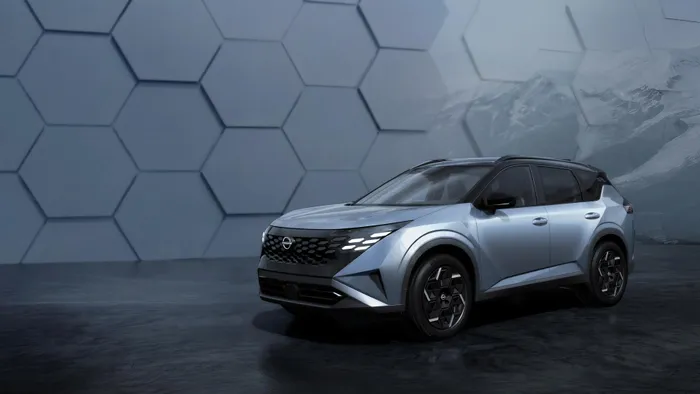
Nissan has outlined its ambitious vision for the future, focusing on AI integration and electrification.
Image: Supplied
Nissan Motor Company has outlined its long-term direction under the banner “Mobility Intelligence for Everyday Life", setting out a strategy centred on customer experience, artificial intelligence, and electrification.
Announced at the recent Nissan Vision event in Yokohama, Japan, the plan positions the company beyond its current recovery phase, with the existing Re:Nissan strategy now in its final year of execution.
The programme has focused on improving cost competitiveness, increasing capacity utilisation and rebuilding product momentum across key markets.
The plan also includes substantial restructuring, including the closure and sale of unprofitable manufacturing plants around the globe, among them the Rosslyn plant in Pretoria, which was sold to Chinese manufacturer Chery.
President and CEO Ivan Espinosa said the new vision provides a clearer path forward as the company transitions into its next phase.
“This is the right moment to articulate Nissan’s long-term vision as we look beyond the Re:Nissan plan and set a clear path for the future. Our vision defines where Nissan is heading, with customer experience as our guiding priority.”
Artificial intelligence will play a central role in Nissan’s next generation of vehicles through the introduction of AI-defined vehicles (AIDV).
The approach combines two key systems: AI Drive technology, which focuses on vehicle control, safety and driver assistance, and AI Partner technology, aimed at improving in-car interaction and connectivity.
Nissan plans to deploy AI Drive technology across 90% of its global line-up over time, signalling a broad rollout rather than a feature limited to flagship models. The next-generation ProPILOT system, which forms part of this strategy, is targeted to achieve end-to-end autonomous capability by 2027.
The first application will be seen in the next-generation Nissan Elgrand, scheduled for introduction in 2026, which will adopt the updated ProPILOT system as part of its technology package.
“By advancing mobility intelligence, we will deliver products and technologies that are safer, more intuitive and more accessible, with outstanding value and a more rewarding overall experience,” Espinosa said at the company’s headquarters.
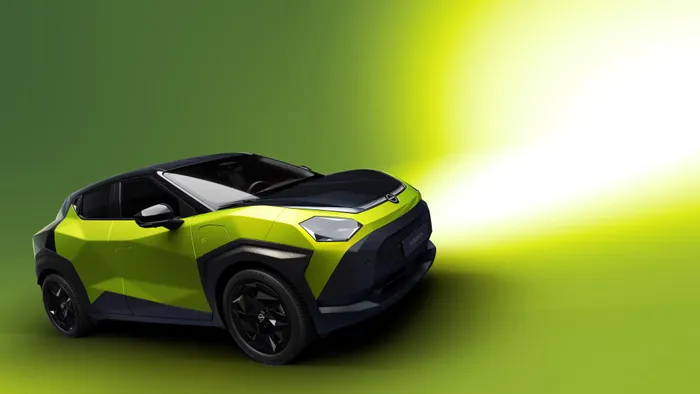
The Nissan Juke EV planned for Europe.
Image: Supplied
Electrification remains a central pillar of Nissan’s product strategy, supporting the rollout of AI-enabled technologies while addressing varying market requirements.
The company will continue expanding its e-POWER hybrid system, which uses an electric motor to drive the wheels while a petrol engine acts as a generator.
It is positioned as a transitional technology, offering electric driving characteristics without the need for external charging infrastructure.
Alongside e-POWER, Nissan will broaden its electrified portfolio to include hybrid electric vehicles (HEVs), plug-in hybrids, and range-extender systems.
A new hybrid system is also in development for body-on-frame vehicles such as bakkies, targeting markets where towing capability, durability, and long-distance driving are essential.
Nissan says this multi-pathway approach allows it to tailor its offering across different regions, where infrastructure, regulation and customer demand vary significantly.
As part of its new strategy, Nissan will reduce its global model range from 56 to 45 vehicles.
The move is aimed at improving efficiency by focusing on higher-volume models while increasing the number of powertrain options available within each nameplate.
The revised product strategy groups vehicles into four categories: Heartbeat (models embodying Nissan’s identity, emotional value and innovation), Core (models that sustain global business through scale and stability), Growth (models targeting expansion in emerging demand areas) and Partner (models that extend market coverage through disciplined collaboration).
Core models will form the backbone of Nissan’s sales volumes. These include vehicles such as the Nissan X-Trail and Rogue, both of which will feature e-POWER hybrid systems as part of their offering.
Other models highlighted at the event as part of the future line-up include the fully electric Nissan Juke for Europe, as well as the Nissan Skyline and the returning Nissan Xterra, representing more specialised products within the range.
In the premium segment, Infiniti will continue to play a key role with a refreshed model line-up.
The next-generation Infiniti QX65 is scheduled as the first of several new introductions, followed by additional hybrid SUVs and a performance-focused sedan.
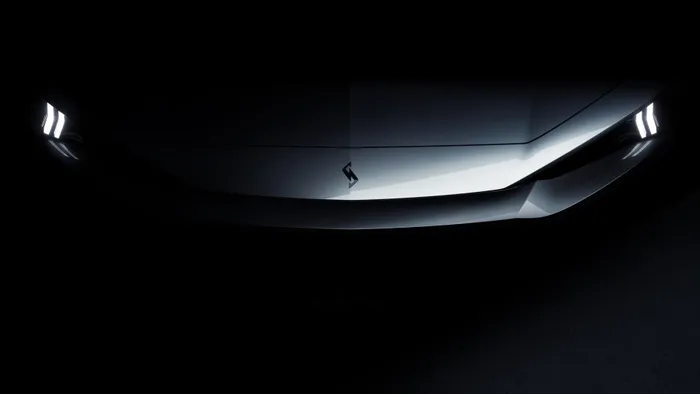
The Nissan Skyline will make a welcome return.
Image: Supplied
Nissan is also restructuring how it develops and produces vehicles through a product family approach.
Instead of engineering each model independently, the company will adopt shared platforms, powertrains, and software architectures across multiple vehicles. This is intended to reduce complexity, improve cost control, and accelerate development timelines.
Under this system, three core vehicle families are expected to account for more than 80% of global production. Nissan also expects the approach to increase volume per model and enable faster rollout of new technologies across its range.
The alignment between product planning and industrial execution is aimed at improving consistency in quality while supporting more competitive, large-scale production.
Japan, the United States, and China anchor Nissan’s global strategy, each with defined roles in both sales and development.
Japan remains the company’s home market and will serve as a base for introducing new technologies, including next-generation ProPILOT systems and mobility services.
The company also plans to expand its compact Kei car line-up from 2028 onwards.
The United States is positioned as a key market for volume and profitability, with a focus on larger vehicles and a strong local manufacturing presence.
Future products will include updated hybrid SUVs and a new generation of body-on-frame vehicles, led by the return of the Xterra, which will feature both V6 and new V6-hybrid powertrain options, along with continued use of V6 engines in D-segment SUVs where customer demand requires.
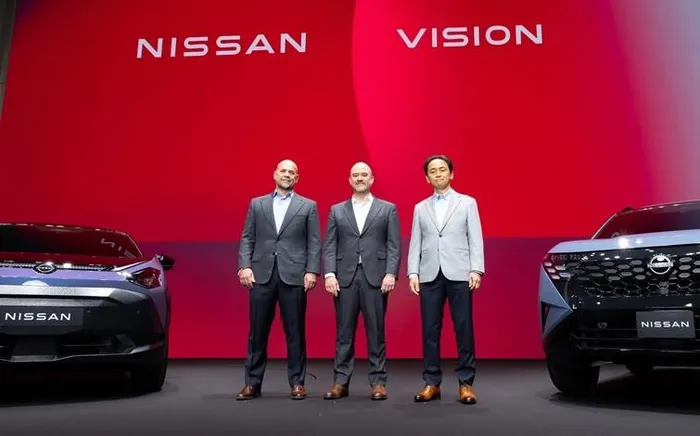
President and chief executive officer Ivan Espinosa stood flanked by two of his senior executives as he presented the company’s long-term strategy, underscoring a unified leadership front at a pivotal moment for Nissan.
Image: Supplied
China will play a dual role, contributing to development speed and cost efficiency while also serving as an export hub.
Nissan plans to expand its new energy vehicle (NEV) range in the market, with selected models such as the N7 earmarked for export to regions including Latin America, ASEAN markets, and the Middle East.
Mexico is positioned as a core industrial and profitability anchor, driving scale expansion and earnings across the Americas and beyond through a strong manufacturing base and Nissan’s highest global market share.
The Middle East remains a priority growth and profit market, supported by exports from key production hubs and a product mix skewed toward large SUVs and premium segments, where Nissan’s strengths closely align with customer demand.
Other regions, including Europe, India, and Africa, will support broader market expansion, contributing to overall global volume and brand presence.
“As we continue on our path to recovery, it is essential that Nissan demonstrates its relentless focus on serving customers, seizing the opportunities presented by AI technologies, expanding electrification and driving innovation across our vehicles to deliver sustainable market growth,” Espinosa said of the company’s next phase.