

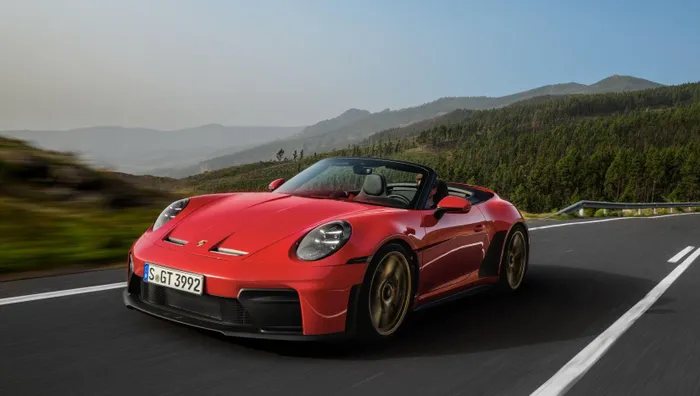
Porsche turns up the drama with the new GT3 S/C — lighter, louder, and open to the sky.
Image: Supplied
It’s easy to understand why Porsche has never created a convertible version of its 911 GT3 — open tops are less rigid, and for a purist who typically buys this hallowed sports model, any deficit to the handling equation could surely be a deal breaker.
But then it’s also easy to understand why Porsche has just created the first-ever topless version of the GT3 — because the select few who buy it will get to enjoy that high-revving 4.0-litre normally aspirated flat-six motor in all its bellowing glory.
The new 911 GT3 S/C is set to cost from R6,138,000 in South Africa. Although it comes at a R1.4 million premium over the tin-top GT3, it does inherit a raft of high-tech and lightweight features from the 911 S/T. Who says convertibles have to weigh more?
To that end, the bonnet, wings and doors are made from carbon fibre, as are the suspension anti-roll bars, while the shear plate is also carried over from the S/T.
Same goes for the wheels and brakes.
The centre-lock wheels, measuring 20 inches up front and 21 inches at the back, are made from lightweight magnesium, shaving 9kg off the rotating mass. The PCCB braking system saves a further 20kg versus Porsche’s regular cast-iron brakes.
The powertrain is lifted straight from the regular GT3, with the normally aspirated boxer unit producing 375kW and 450Nm. But whereas the GT3 is available with PDK auto transmission, the GT3 S/C is fitted exclusively with a close-ratio manual gearbox.
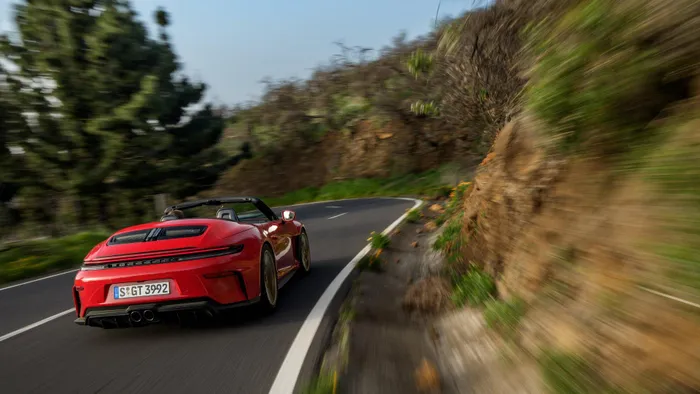
Magnesium, carbon fibre and a manual gearbox — the GT3 S/C recipe.
Image: Supplied
According to Porsche the GT3 S/C can accelerate from 0-100km/h in 3.9 seconds and reach a top speed of 313km/h.
The cabin also abounds with lightweight features inherited from the S/T.
These include lightweight carpets and pared-back door panels, complete with carbon-fibre pull handles, all aimed at trimming unnecessary mass.
Unlike regular 911 convertibles, the GT3 S/C is a two-seater, with occupants sinking into Porsche’s Sports Seats Plus, upholstered in black leather. Carbon-fibre bucket seats are available as an option for those seeking to save even more kilograms.
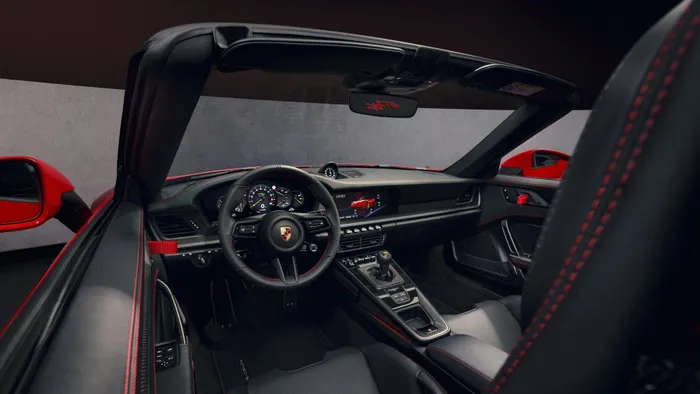
Lightweight cabin stripped back to pure GT3 intent.
Image: Supplied
The ‘Track Screen’ display mode pares back the digital interface on either side of the rev counter, leaving only essential readouts such as tyre, oil, coolant and fuel data. Shift lights flanking the rev counter indicate the optimal gear change points, while the display can also be configured to rotate the dial, positioning the 9,000rpm redline at the 12 o’clock position for improved visibility under hard driving.
A digital instrument cluster provides a clean, driver-centric interface, and in a nod to Porsche tradition, the GT3 S/C retains a rotary ignition switch to the left of the steering wheel instead of a conventional start button.
The soft top is automatically operated, featuring a lightweight magnesium operating mechanism of course, and the roof can be opened or closed in approximately 12 seconds, at speeds of up to 50km/h.
"We have already learned with the 911 Speedster and the 718 Spyder RS just how well our high-revving naturally aspirated engine, a particularly dynamic chassis setup and thorough lightweight construction combine to create a true driver's car without a roof," said Andreas Preuninger, Head of GT Cars.
"For the first time, the 911 GT3 S/C uses the double wishbone front axle on an open-top 911. Combined with the particularly high-grip sports tyres and low weight, the car offers driving pleasure on winding roads that was previously virtually unheard of in an open-top car."