

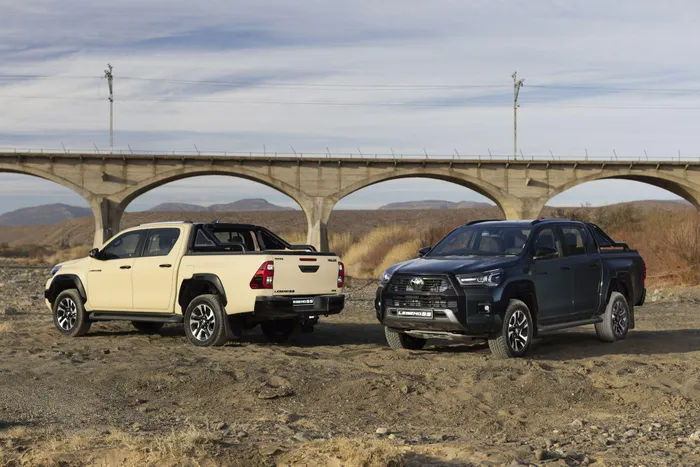
Toyota sold 10,677 units in May.
Image: Supplied
Despite the many economic headwinds facing South Africa, as rising fuel prices filter through to the economy, the country’s new vehicle market continues to outperform expectations.
According to Naamsa, new vehicle sales rose to 51,071 units in May, an increase of 12.8% versus the same month last year. It was also the best May performance since 2013. Dealer sales made up the bulk of local volume, accounting for 90.1% of domestic sales, followed by rental sales (5.3%), corporate fleets (2.5%) and government sales (2.1%).
Passenger car sales led the way at 36,871 units, representing year-on-year growth of 16.3%, while light commercial vehicle and bakkie sales, at 11,251 units, grew by 2.5% versus the same month in 2025. Medium and heavy commercial vehicle sales grew by 13.6% and 12.9%, respectively.
Exports remained under pressure, however, declining by 4.8% year-on-year to 30,859 units.
Toyota topped the manufacturer charts in May, followed by Suzuki and Volkswagen. The Chinese brands found themselves firmly in the top 10, with GWM in 6th, Chery in 7th and Jetour in 8th.
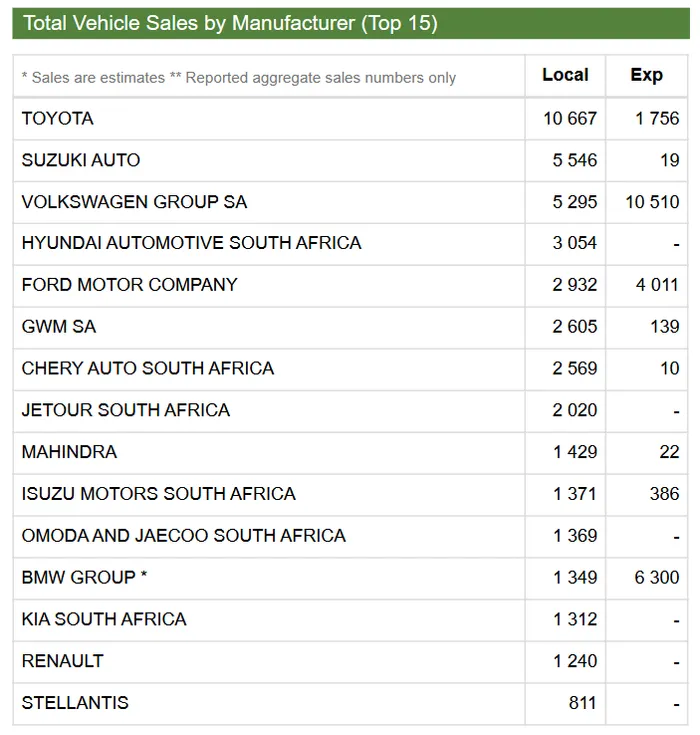
15 top manufacturers in May.
Image: Naamsa
Naamsa said that while favourable domestic economic conditions continued to support market activity, the latest results emerged against a backdrop of increasing global volatility and mounting cost pressures, as rising inflation risks, higher fuel prices and tighter financial conditions began to reshape the operating environment.
“The economic backdrop that underpinned the vehicle market's recovery through the first quarter of 2026 is gradually giving way to a more challenging set of conditions. Earlier gains were supported by a combination of contained inflation, stable borrowing costs and strengthening consumer and business confidence, which collectively improved affordability and encouraged deferred purchasing decisions to return to the market,” Naamsa said.
“The environment has since shifted. Rising fuel prices, mounting inflation risks and a changing interest rate outlook have altered the trajectory of the broader economy, introducing new pressures on household budgets and business operating costs. Following a sharp increase in global oil prices, domestic fuel costs rose significantly during April and May, contributing to an acceleration in headline consumer inflation to 4.0% year-on-year in April.
In response to these evolving risks, the South African Reserve Bank increased the repo rate by 25 basis points to 7.0% in May 2026, raising the prime lending rate to 10.50%. For a sector in which the majority of purchases are credit-financed, these developments are likely to influence both vehicle affordability and purchasing behaviour,” the industry body added.
IOL Motoring