

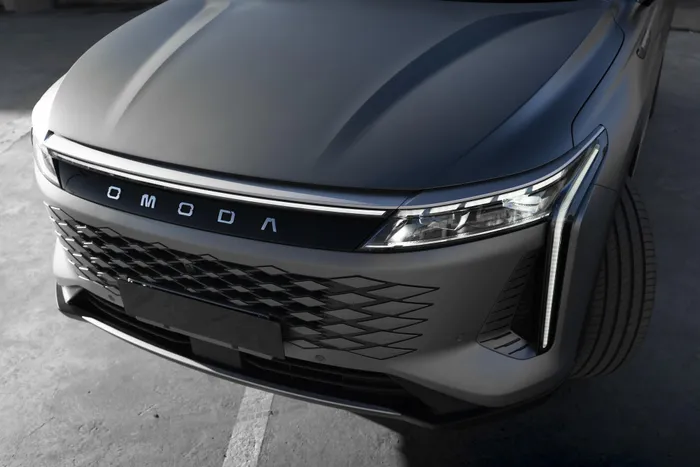
The Omoda C9 is luxurious, engaging to drive, and sexy to boot.
Image: Supplied
You'd be forgiven for feeling conflicted when you first lay eyes on the Omoda C9.
It's undeniably a sexy car, but you can't help but notice design elements seemingly borrowed from others – the nose is hardly unique, and has an air of familiarity to it you can't quite place, but it gets more recognisable the further back you go. The wing mirrors are giving Lexus, flush, retractable door handles a la Tesla Model S, and adopted by Range Rover, the flowing C-pillar is starkly reminiscent of Lexus' RX, while the tail lights and roof spoiler with dual shark fin antennae evoke Porsche Cayenne. Even the stylish rims are reminiscent of the stately multi-spoke wheels on some Mercedes-Benz S Class models.
But packaged all together, it's more than easy on the eye. The coupe-style sloping roofline and its generous proportions look svelte and sexy.
And it's a dream to drive.
The Omoda C9 comes in three flavours – 4x2 and 4x4 petrol-powered models and a PHEV version – and all models ship with a massive sliding panoramic glass roof and an adaptive suspension system. The massive glass roof helps with a sense of lightness inside the cabin to offset the black roof lining. You don't feel at all claustrophobic as you might in, say, the Audi Q8 S Line (which also has a large glass roof, with black roof lining covering its sloping coupe roof).
The drive is smooth, with Omoda's Continuous Damping Control system very closely resembling air suspension. Unlike its smaller C5 sibling, the C9 feels planted and sure-footed, and incredibly forgiving over rough surfaces.
The traditionally motivated C9 is powered by a 2.0l turbocharged petrol engine that's good for 192kW and 400Nm while the plug-in hybrid churns out a monstrous 440kW and over 900Nm.
And the delivery of that power, whether to the front wheels in the Inspire model or via the AWD system in the Explore derivative, is velvety smooth. There is no noticeable turbo lag and you reach the peak power band with urgency, rather than a sudden jolt. Even at highway speeds and beyond, you feel completely in control. Let's say, hypothetically, of course, you were travelling at 160km/h, it feels like you're doing 100.
All this power is delivered through a high-performance 8-speed automatic gearbox that is very sure of itself, unless you're at low speeds. Crawling through traffic you may find it hunting for gears a little, and in Normal and Eco modes, the throttle response can be a little delayed.
In Sport mode, you'll get more out of the rev range, but the gear shifts are just as slick and swift in the other two modes. It's also rather quiet, even under harsh acceleration.
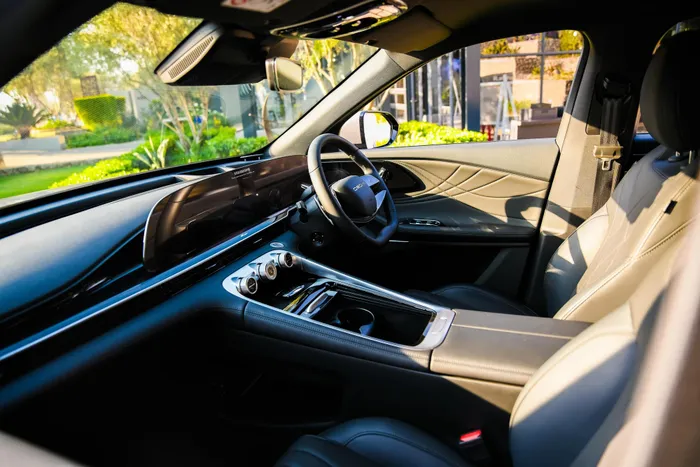
The interior design borrows heavily from Mercedes-Benz, executing the executive look flawlessly.
Image: Supplied
Inside, bar the steering wheel design and door handles (which are more reminiscent of the latest Volvo EX models), you'd be forgiven for thinking you're in a Mercedes-Benz. It's got a continuous curved display from the driver dials over to the swooping, sloping infotainment system, the gear selector stalk and the split arm-rest and sliding centre console cover all look very much like they were conceived in Stuttgart, just like the quilted leather seats - which are heated and cooled at the front and even heated in the back - and the quilted leather door cards.
Every touchpoint is luxurious and soft to the touch, even the switchgear and steering column stalks feel expensive.
While it all feels very lush and expensive, in this class, it isn't. Consider the luxury competitors - Audi Q5, BMW X3, or Mercedes-Benz GLC start at over R1.1m. The C9's coupe roof line pits it more closely against Range Rover's Velar, which starts at R1.5m, before you start adding optional extras. A Velar I recently reviewed cost R2.6m.
The Omoda C9 starts at under R800,000, with the 4x4 model fetching just shy of R890,000, while the plug-in hybrid is still under a bar.
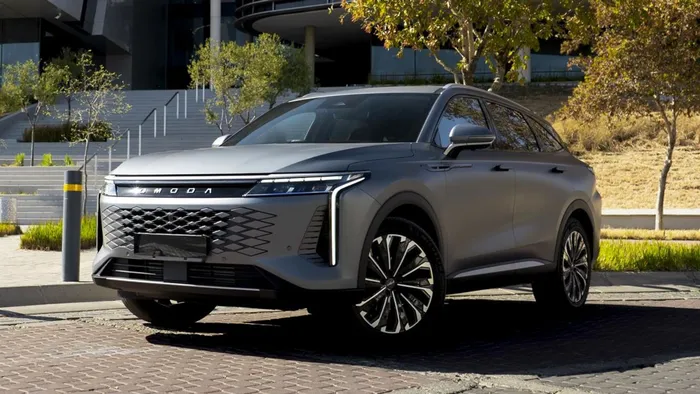
The Omoda C9 starts at R785,900.
Image: Supplied
With build quality, features and value far exceeding what's on offer from the German luxury marques, at the price of a Korean or Japanese model which, while hardy and reliable in most cases, are really all just very generic vanilla, I would say yes.
The Omoda C9 is engaging to drive, feels sturdy and planted, and exudes luxury inside.
In the Quantum Grey matte finish I had on test, it's also incredibly attractive, earning the nickname "The Chinese Dragon" from my learned colleagues.
IOL Motoring